Mechanical performance evaluation of science museum seating systems using FEM - Nature
This story deserves to be shared
Send it to someone who'd care, or post it on your networks.
This article is an excerpt. To read the full content, visit the original source. Nature
Related articles
Nuclear adaptation to intracellular mechanical forces regulates the phagocytic capacity of Drosophila macrophages in vivo - Nature
We’re sharing this article early to provide faster access to peer-reviewed, accepted research. It is citable and carries a permanent DOI. This version is subject to further edits and will be replaced automatically by the final Version of Record. All legal disclaimers apply. AbstractHow macrophages fine-tune their appetite to fulfil their clearance role is incompletely understood. Phagocytosis exacerbates cytoplasmic crowding, but whether macrophages can sense this increase and use it to regulate their phagocytic capacity has never been investigated. Here, we test the hypothesis that phagosomes exert a strain on the nucleus, which in turn responds to the intracellular mechanical inputs influencing macrophage appetite. Combining genetic manipulation and live in vivo imaging, we show that engulfed apoptotic bodies indent and deform the nucleus of Drosophila embryonic macrophages, and that phagocytosis increases Lamin B levels. Importantly, we show that silencing Lamin B or components of the LINC complex negatively regulates apoptotic body engulfment in vivo.
Cosmic 'hamburger' offers rare edge-on view of where giant planets may take shape - Phys.org
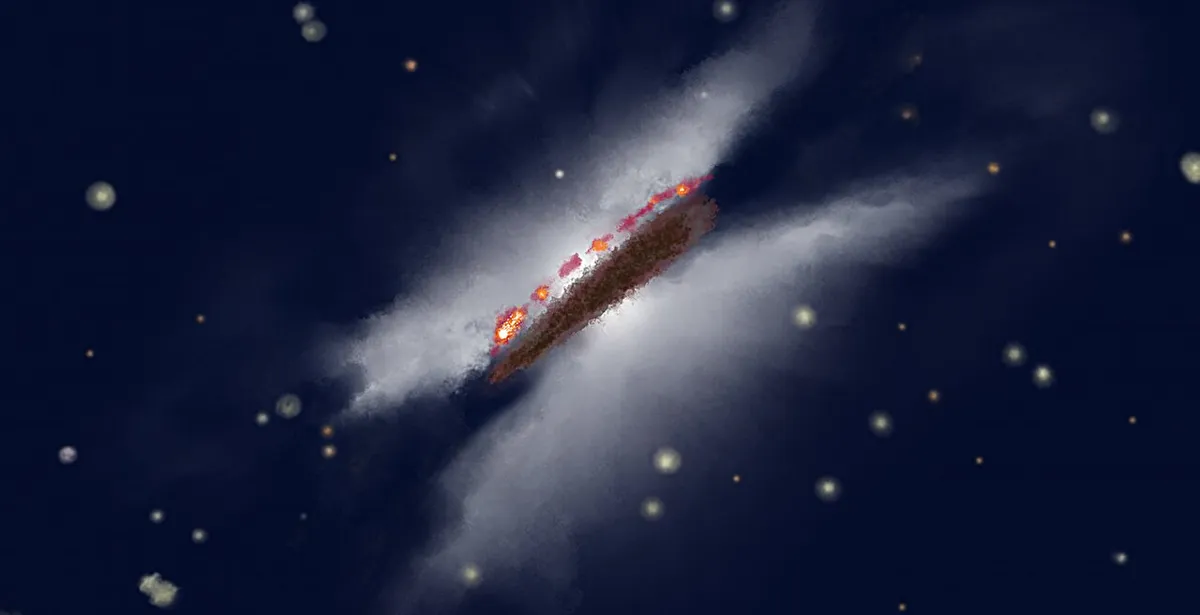
Gomez's Hamburger System. This artist's impression of the Gomez's Hamburger system shows the stacked layers of gas and dust as they rotate around a young star. ALMA observations reveal a direct view of its vertical structure at millimeter wavelengths, allowing astronomers to map the location of the millimeter-sized dust grains and several different gas-phase molecules, which have arranged themselves into distinct levels. Credit: NSF/AUI/NSF NRAO/P. Vosteen. Astronomers using the Atacama Large Millimeter/submillimeter Array (ALMA) were surprised to discover the earliest phases of giant planet formation between the dense layers of gas and dust in the "Gomez's Hamburger" system, referred to as GoHam.
The ESA's Euclid Space Telescope Has Discovered A New Comet - Universe Today
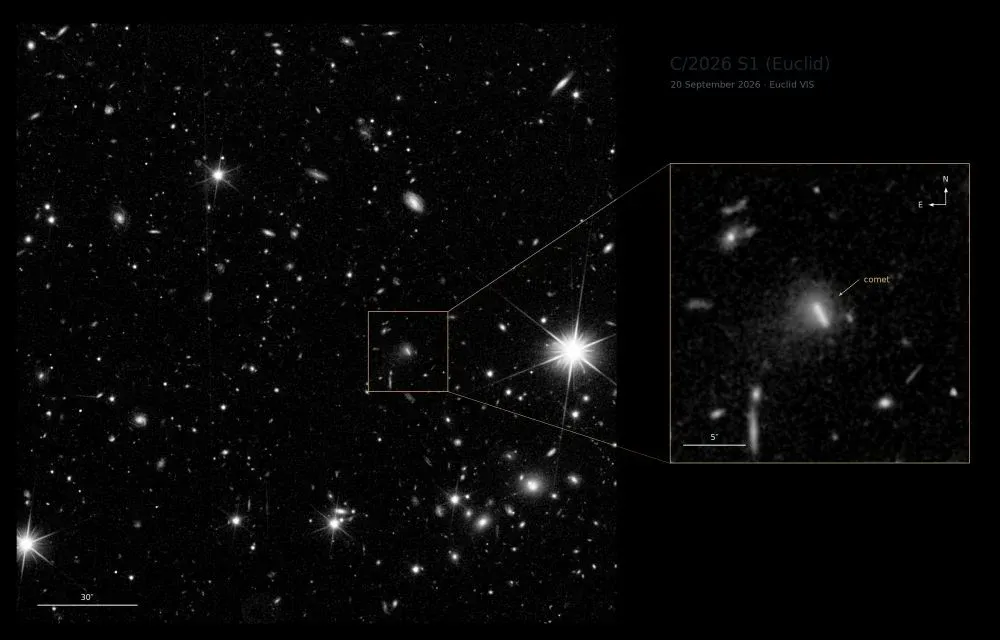
The ESA's Euclid Space Telescope has discovered its first comet, a result that's not part of its primary mission. The telescope was launched at the beginning of July, 2023, and its mission is to observe about 1.5 billion galaxies out to redshift z=2, which corresponds to seeing around 10 billion years into the past. The goal is to measure the redshift of a massive amount of galaxies, to shed light on the expansion history of the Universe and the force that drives it, dark energy. The space telescope has observed other comets, but this is the first time it's discovered one. The comet was found in multiple images captured between September 16th and 24th, 2026. For a telescope built to take deep images of distant galaxies, discovering a rapidly moving comet in the Milky Way is a surprising bonus.
0 comments
No comments yet. Be the first to share your thoughts!