Amino acid stabilizes material's quantum state above room temperature - Phys.org
This story deserves to be shared
Send it to someone who'd care, or post it on your networks.

An illustration represents the interaction between blue-outlined arginine molecules and tantalum disulfide's star-shaped crystal pattern. Credit: Duan Lab/UCLA
New research started with a special material that behaves unusually when it's extremely cold—135 degrees below zero Fahrenheit (minus 93 degrees Celsius), close to the most frigid temperature ever recorded in Antarctica—and showed that the unusual behavior could be extended to well above room temperature—up to about 135 F (57 degrees Celsius), close to the highest heat ever measured in Death Valley, California.
This article is an excerpt. To read the full content, visit the original source. Phys.org
Related articles
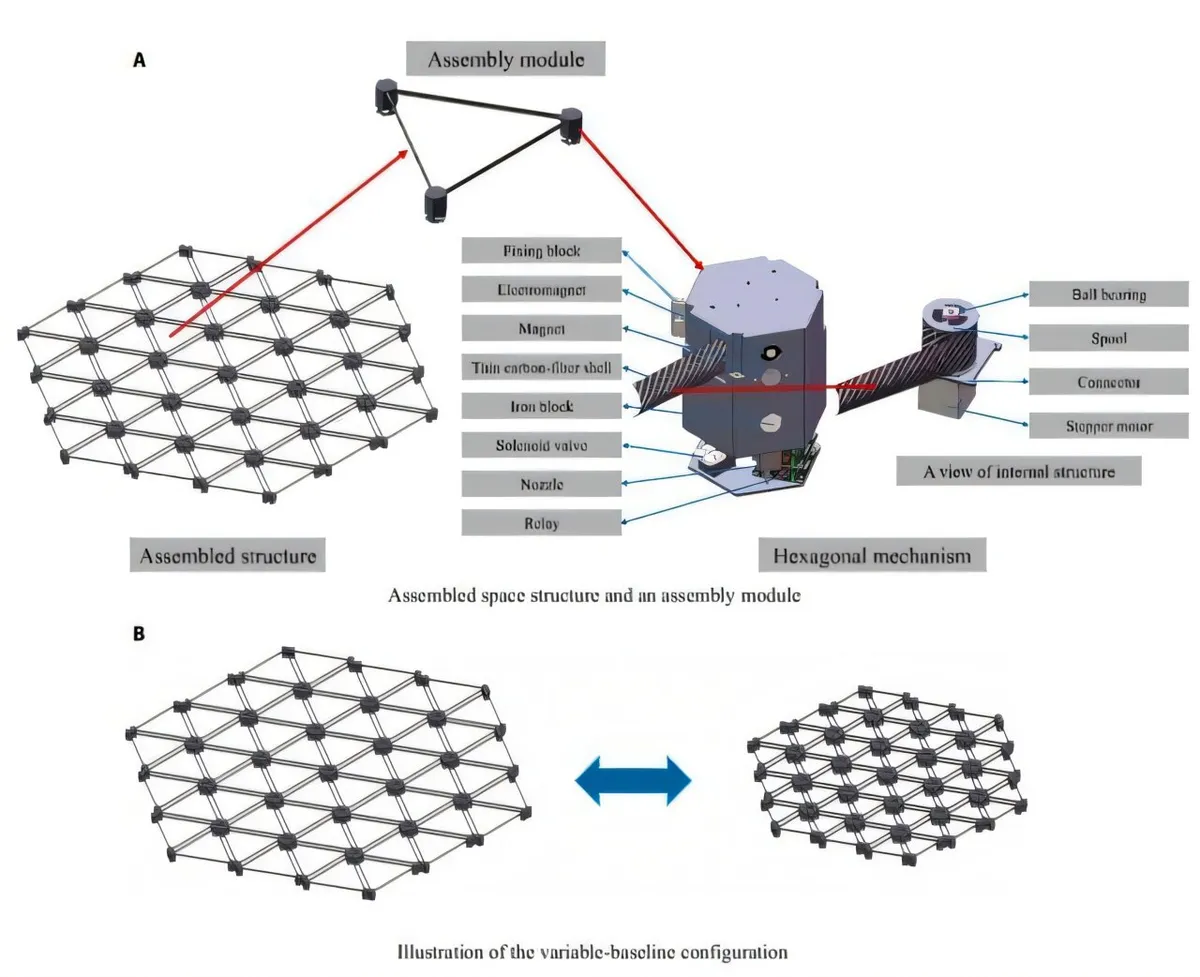
Autonomous triangular modules could build tomorrow's mega-observatories - Phys.org
Private companies are getting better at launching more mass into space with larger rockets. But there is still a major constraint on the size of objects we can get into orbit—fairing size. This places physical constraints on the overall shape of what we can launch and severely limits the sizes of, say, a communications array or a power satellite. But a new paper from researchers at Nanjing University of Aeronautics and Astronautics and the Beijing Institute of Technology offers a solution—a self-shaping, deployable module that can fine-tune both its positioning and its own dimensions. The findings are published in the journal Space: Science & Technology. To understand how that offers an advantage, it's best to look at how engineers currently solve this problem. Typically, they use a rollable deployable boom—a stiff, thin strip of carbon fiber that can coil up like a tape measure, then unwind to snap straight once deployed in microgravity. The problem is that these systems almost never deploy perfectly in real environments, and when talking about snapping together multiple modules, even a few millimeters of error can cause the entire mission to fail.
0 comments
No comments yet. Be the first to share your thoughts!