Autonomous triangular modules could build tomorrow's mega-observatories - Phys.org
This story deserves to be shared
Send it to someone who'd care, or post it on your networks.
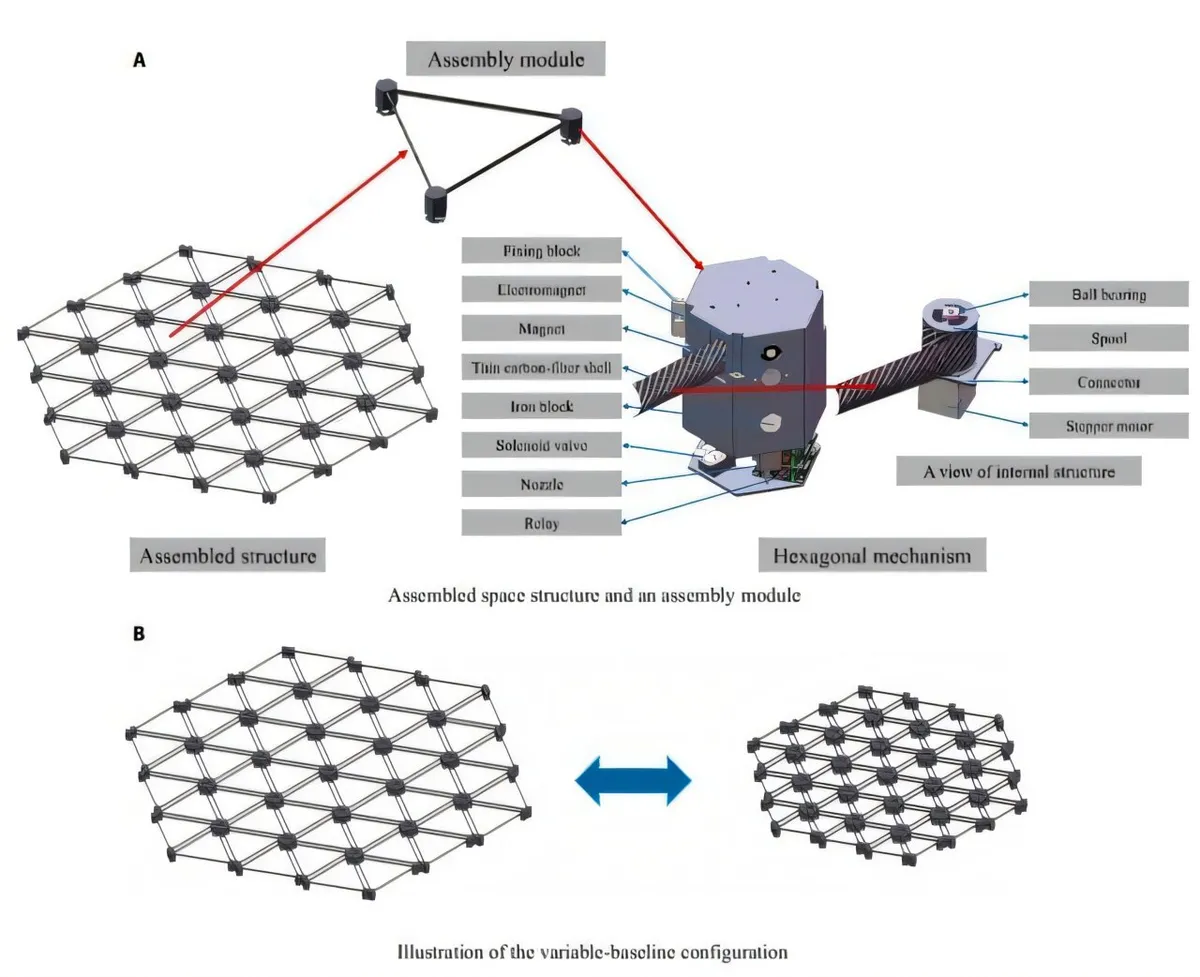
Private companies are getting better at launching more mass into space with larger rockets. But there is still a major constraint on the size of objects we can get into orbit—fairing size. This places physical constraints on the overall shape of what we can launch and severely limits the sizes of, say, a communications array or a power satellite. But a new paper from researchers at Nanjing University of Aeronautics and Astronautics and the Beijing Institute of Technology offers a solution—a self-shaping, deployable module that can fine-tune both its positioning and its own dimensions. The findings are published in the journal Space: Science & Technology.
To understand how that offers an advantage, it's best to look at how engineers currently solve this problem. Typically, they use a rollable deployable boom—a stiff, thin strip of carbon fiber that can coil up like a tape measure, then unwind to snap straight once deployed in microgravity. The problem is that these systems almost never deploy perfectly in real environments, and when talking about snapping together multiple modules, even a few millimeters of error can cause the entire mission to fail.
This article is an excerpt. To read the full content, visit the original source. Phys.org
Related articles
NASA, NOAA Observatories Set to Study Space Weather - NASA Science (.gov)

Cambridge scientists create a $10 chip that could put a medical lab on your wrist - Science Daily
A new optical sensor costing just $10 could bring laboratory-level precision to wearable health monitors, potentially allowing people to track blood glucose without needles. The technology could also transform food testing, industrial quality control, and environmental monitoring. Researchers at the University of Cambridge and GlitterinTech (a start-up founded by the same research group) have developed a new type of optical spectrometer that combines exceptional accuracy with a remarkably small size and low cost. Measuring just centimeters across, the device could be incorporated into portable electronics and wearable health technology. Its potential applications range from monitoring important health markers in real time to identifying materials and detecting changes in chemical composition.
Ultrafast light pulses track molecular motion with three-femtosecond resolution - Phys.org
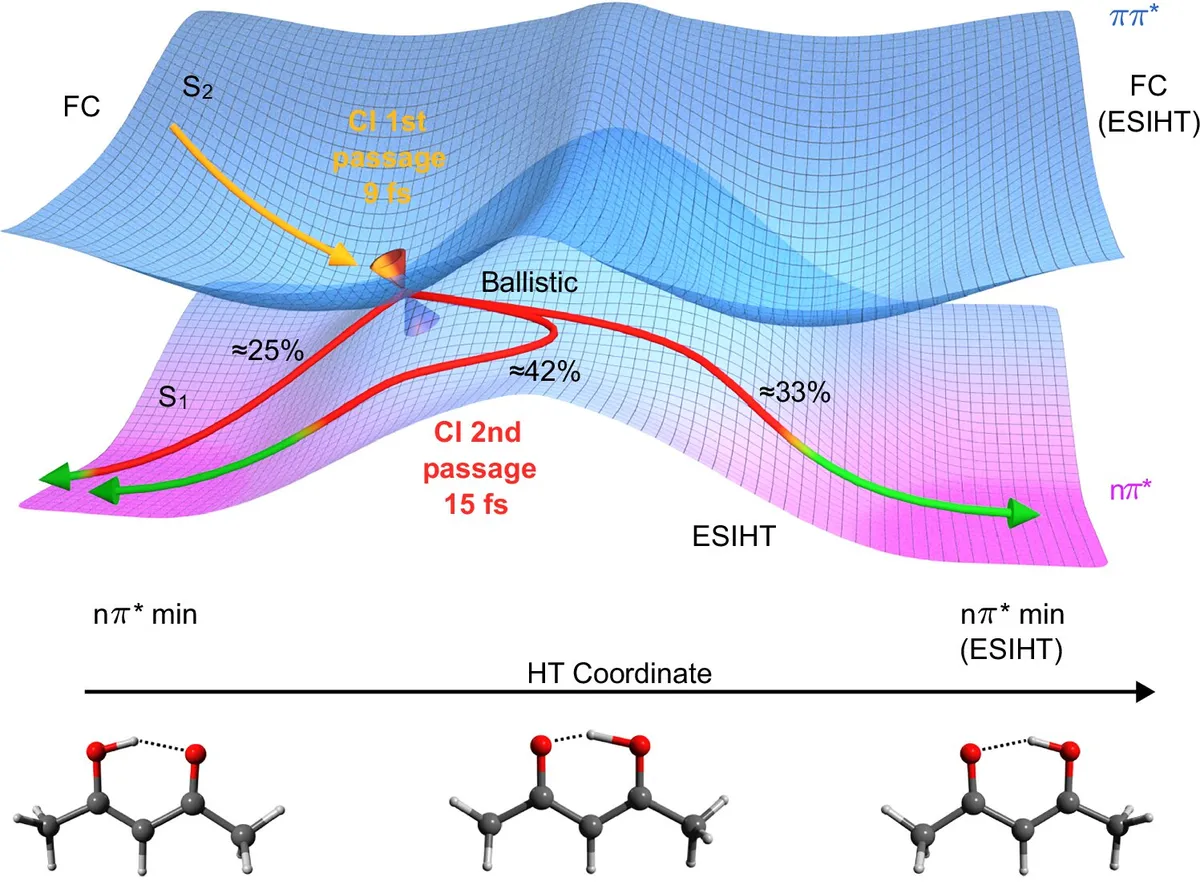
Acetylacetone short-timescales deactivation mechanism. Credit: Nature Communications (2026). DOI: 10.1038/s41467-026-76602-4 Researchers have observed a molecule in the first instants after it has absorbed light and tracked the coordinated motion of electrons and nuclei with a temporal resolution of three femtoseconds. This is the result achieved by an international research group led by the Politecnico di Milano, which has developed a new apparatus for studying ultrafast photochemical processes.

Scientists Just Cracked a Quantum Mystery That's Puzzled Physicists For Decades - ScienceAlert
The Kondo effect is one of the most important in quantum physics, describing the strange interference that magnetic atoms can have in metals. Usually, as metals cool, they become better at conducting electricity, because the reduction in energy means electrons can flow more smoothly. Add in a magnetic atom or two, though, and below a certain temperature (the Kondo temperature), electrical resistance starts to rise again. That's the Kondo effect, and we already know a lot about it. But in a physics first, researchers from the California Institute of Technology (Caltech) and Yale University in the US have managed to precisely quantify the effect in a real material via fundamental physics calculations. The work, published in Science, represents a significant step forward. Previously, scientists had to use real-world experiments and simplified models to pin down the Kondo effect, without getting predictions as precise as the new method. Scientists have known about the Kondo effect since the 1930s – that magnetic impurities can cause increased electrical resistance at lower temperatures.
Supramolecular assembly opens a new route to building quantum materials - Phys.org
A joint research team fabricated a two-dimensional structure that exhibits properties of both the honeycomb and Kagome lattices using organic molecules. They discovered that edge states specific to topological materials (states that exist only at the edges and are distinct from those in the interior) appear in this structure. The team included researchers from NIMS, Toyota Kosen (National Institute of Technology, Toyota College), Saga University, Nara Women's University, Kiel University (Germany) and other institutions.

Europe's Space Rider vehicle comes crashing down during drop test - Space
This was not exactly what engineers had in mind when they performed Space Rider's drop test.
0 comments
No comments yet. Be the first to share your thoughts!