Ultrafast light pulses track molecular motion with three-femtosecond resolution - Phys.org
This story deserves to be shared
Send it to someone who'd care, or post it on your networks.
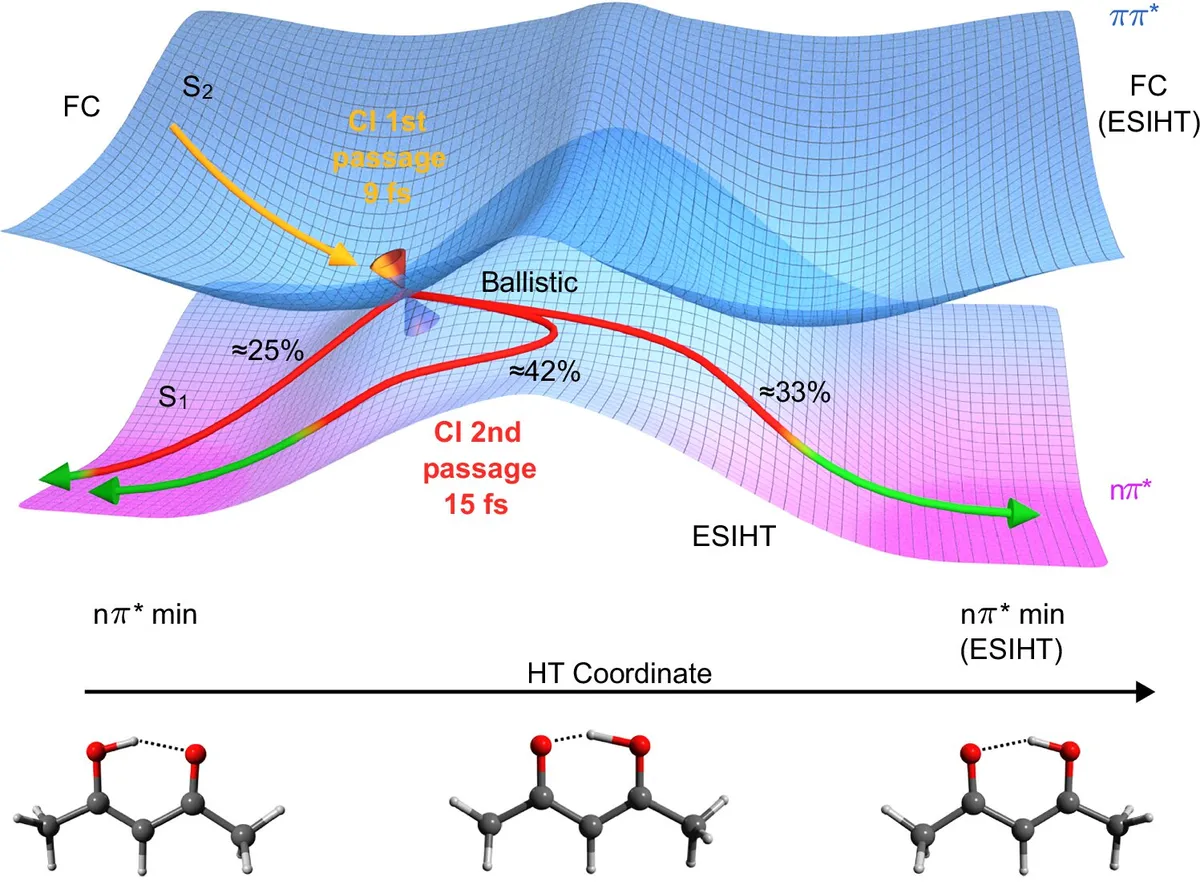
Acetylacetone short-timescales deactivation mechanism. Credit: Nature Communications (2026). DOI: 10.1038/s41467-026-76602-4
Researchers have observed a molecule in the first instants after it has absorbed light and tracked the coordinated motion of electrons and nuclei with a temporal resolution of three femtoseconds. This is the result achieved by an international research group led by the Politecnico di Milano, which has developed a new apparatus for studying ultrafast photochemical processes.
This article is an excerpt. To read the full content, visit the original source. Phys.org
Related articles
X-ray free-electron laser sets new record for shortest high-energy pulses - Phys.org
Researchers at the Linac Coherent Light Source (LCLS) at the U.S. Department of Energy's SLAC National Accelerator Laboratory have measured the shortest high-energy X-ray pulses ever recorded at an X-ray free-electron laser (XFEL). The pulses had photon energies of about 9 kiloelectronvolts (keV) and clocked in at durations of 100 to 400 attoseconds—mere billionths of a billionth of a second. The results are published in Nature Photonics.
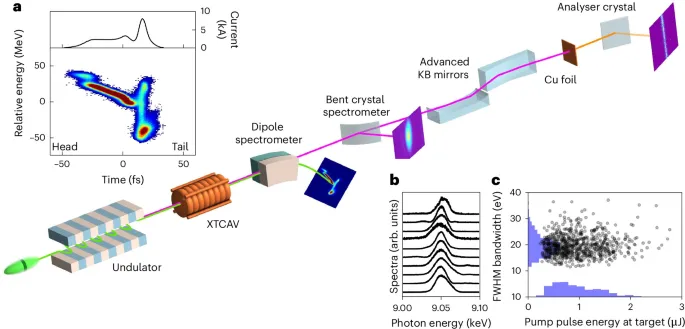
Experimental demonstration of attosecond hard X-ray pulses - Nature
Data availabilitySource data are provided with this paper. Additional data supporting the findings of this study are available from the corresponding authors upon request. ReferencesKrausz, F. & Ivanov, M. Attosecond physics. Rev. Mod. Phys. 81, 163–234 https://doi.org/10.1103/RevModPhys.81.163 (2009). Article Corkum, P. B. Plasma perspective on strong field multiphoton ionization. Phys. Rev. Lett. 71, 1994–1997 https://doi.org/10.1103/PhysRevLett.71.1994 (1993). Article

Record-shattering X-ray pulses focus into spot 100,000 times smaller than a hair - Interesting Engineering
Electrons move so quickly inside atoms and molecules that studying their behavior requires flashes of light lasting just a fraction of a billionth of a billionth of a second. Now, scientists have found a way to concentrate these ultrashort X-ray flashes into a tiny spot, making them more powerful at the point where they hit a sample.
0 comments
No comments yet. Be the first to share your thoughts!