X-ray free-electron laser sets new record for shortest high-energy pulses - Phys.org
This story deserves to be shared
Send it to someone who'd care, or post it on your networks.
Researchers at the Linac Coherent Light Source (LCLS) at the U.S. Department of Energy's SLAC National Accelerator Laboratory have measured the shortest high-energy X-ray pulses ever recorded at an X-ray free-electron laser (XFEL). The pulses had photon energies of about 9 kiloelectronvolts (keV) and clocked in at durations of 100 to 400 attoseconds—mere billionths of a billionth of a second. The results are published in Nature Photonics.
This article is an excerpt. To read the full content, visit the original source. Phys.org
Related articles
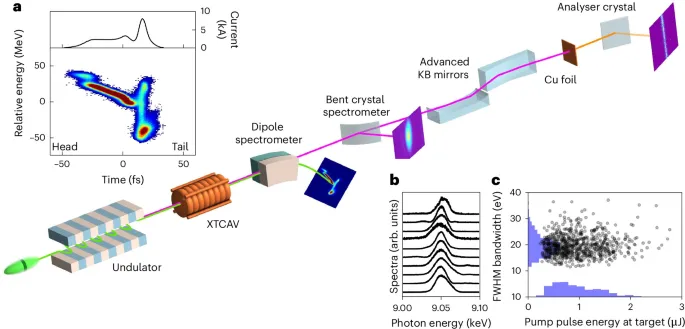
Experimental demonstration of attosecond hard X-ray pulses - Nature
Data availabilitySource data are provided with this paper. Additional data supporting the findings of this study are available from the corresponding authors upon request. ReferencesKrausz, F. & Ivanov, M. Attosecond physics. Rev. Mod. Phys. 81, 163–234 https://doi.org/10.1103/RevModPhys.81.163 (2009). Article Corkum, P. B. Plasma perspective on strong field multiphoton ionization. Phys. Rev. Lett. 71, 1994–1997 https://doi.org/10.1103/PhysRevLett.71.1994 (1993). Article

Record-shattering X-ray pulses focus into spot 100,000 times smaller than a hair - Interesting Engineering
Electrons move so quickly inside atoms and molecules that studying their behavior requires flashes of light lasting just a fraction of a billionth of a billionth of a second. Now, scientists have found a way to concentrate these ultrashort X-ray flashes into a tiny spot, making them more powerful at the point where they hit a sample.
Controlled nucleation of hopfions with field pulses - Nature
We’re sharing this article early to provide faster access to peer-reviewed, accepted research. It is citable and carries a permanent DOI. This version is subject to further edits and will be replaced automatically by the final Version of Record. All legal disclaimers apply. AbstractWe demonstrate a mechanism for the deterministic nucleation of magnetic hopfions in cylindrical nanopillars via transient magnetic field pulses. By exploiting a chiral magnetic cylinder with engineered surface uniaxial anisotropy, we show that field pulses trigger a non-equilibrium magnetization dynamics. Depending on the pulse amplitude, the system relaxes into distinct topologically protected energy minima, stabilizing either isolated hopfions or coexisting states with other three-dimensional solitons. This approach offers a framework for manipulating 3D topological textures without requiring localized spin-polarized currents, broadening the understanding of three-dimensional nanomagnetism.

New Evidence Links Electron Spin Fluctuations to High-Temperature Superconducting States - AZoM
Superconductivity has many important practical applications, including creating powerful magnets used in high-resolution medical scans, transporting electricity efficiently, and building ultra-sensitive measuring devices. Until now, understanding exactly what lay behind this unique phenomenon at high temperatures has eluded scientists over many decades. But pioneering research, led by physicists at the University of Bristol and published this week in the journal Nature Physics, has identified the vital mechanism which explains how electrons in these copper-oxide high-temperature superconductors combine to transmit power with no loss of energy - the 'superconductive' state of infinite electrical conduction.

The roadmap for runaway electron-induced plasma facing component damage in tokamaks - Physics World
Join the audience for a live webinar at 3 p.m. GMT/10 a.m. EST on 10 November 2026, sponsored by the IOP Publishing journal, Plasma Physics and Controlled Fusion Explore the recently published The Roadmap for runaway electron-induced plasma facing component damage in tokamaks
0 comments
No comments yet. Be the first to share your thoughts!