How femtosecond lasers push the limits of nanostructures for thermal engineering - Science Tokyo
This story deserves to be shared
Send it to someone who'd care, or post it on your networks.
This article is an excerpt. To read the full content, visit the original source. Science Tokyo
Related articles
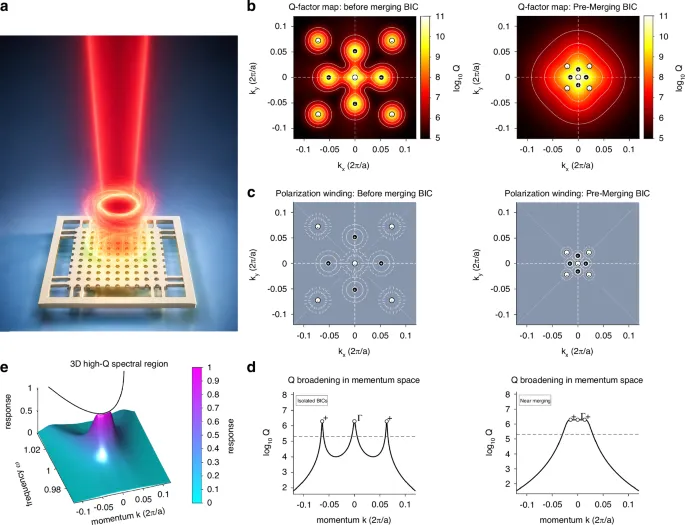
Single-mode lasers before the merger - Nature
A central problem in semiconductor lasers is deceptively simple: how can one increase optical performance without allowing unwanted modes to oscillate? In broad-area semiconductor lasers, increasing the emission area increases the available power, but it also favors many-mode oscillation and degraded beam quality. Photonic-crystal surface-emitting lasers have addressed this problem by engineering optical coupling inside a two-dimensional photonic lattice. In the large-area limit, recent works have shown that single-mode operation can be preserved by controlling Hermitian and non-Hermitian couplings so that higher-order modes experience larger radiation losses than the fundamental mode1. The lesson is broader than the particular device: a good laser is not defined only by the quality factor (Q) of one mode, but by the threshold margin separating that mode from all its competitors. Recently published in Light: Science & Applications, the work of Peng and colleagues, “Robust single-mode laser via merging bound state in the continuum”, brings this principle into the realm of compact bound-state-in-the-continuum lasers2.
0 comments
No comments yet. Be the first to share your thoughts!