Scientists recreate life’s first step: Linking amino acids to RNA - Science Daily
This story deserves to be shared
Send it to someone who'd care, or post it on your networks.
This article is an excerpt. To read the full content, visit the original source. Science Daily
Related articles

Amino acid stabilizes material's quantum state above room temperature - Phys.org
An illustration represents the interaction between blue-outlined arginine molecules and tantalum disulfide's star-shaped crystal pattern. Credit: Duan Lab/UCLA New research started with a special material that behaves unusually when it's extremely cold—135 degrees below zero Fahrenheit (minus 93 degrees Celsius), close to the most frigid temperature ever recorded in Antarctica—and showed that the unusual behavior could be extended to well above room temperature—up to about 135 F (57 degrees Celsius), close to the highest heat ever measured in Death Valley, California.

Scientists recreate a bizarre quantum effect that stops a particle cold - Science Daily
A particle does not have to pass through a magnetic field to be influenced by it. That surprising feature of quantum physics has now been recreated by researchers at the University of Oxford, who used a hybrid quantum computer to demonstrate how an invisible magnetic influence can bring a simulated particle's movement to a complete stop. The experiment reproduced a phenomenon known as the Aharonov-Bohm effect, in which a charged particle traveling around a region containing magnetic flux experiences a measurable change in its quantum state, even though its path never takes it through the magnetic field itself.

Forecasters recreate the weather that made D-Day possible - Popular Science
The weather forecast did not inspire confidence for Allied forces ahead of June 6, 1944. The thick clouds blanketing much of France and the English Channel made aerial reconnaissance even more dangerous than anticipated, while stormy conditions complicated the naval advance towards Normandy Beach. But despite the challenges, calling off D-Day remained unthinkable. “Troops set off into a sky that was still breaking up after days of storms into a narrow window of better weather,” University of Reading meteorologist Ed Hawkins explained in a statement. “A day earlier, or a few hours either way, and the weather could have stopped the invasion in its tracks, and changed the outcome of the war.”
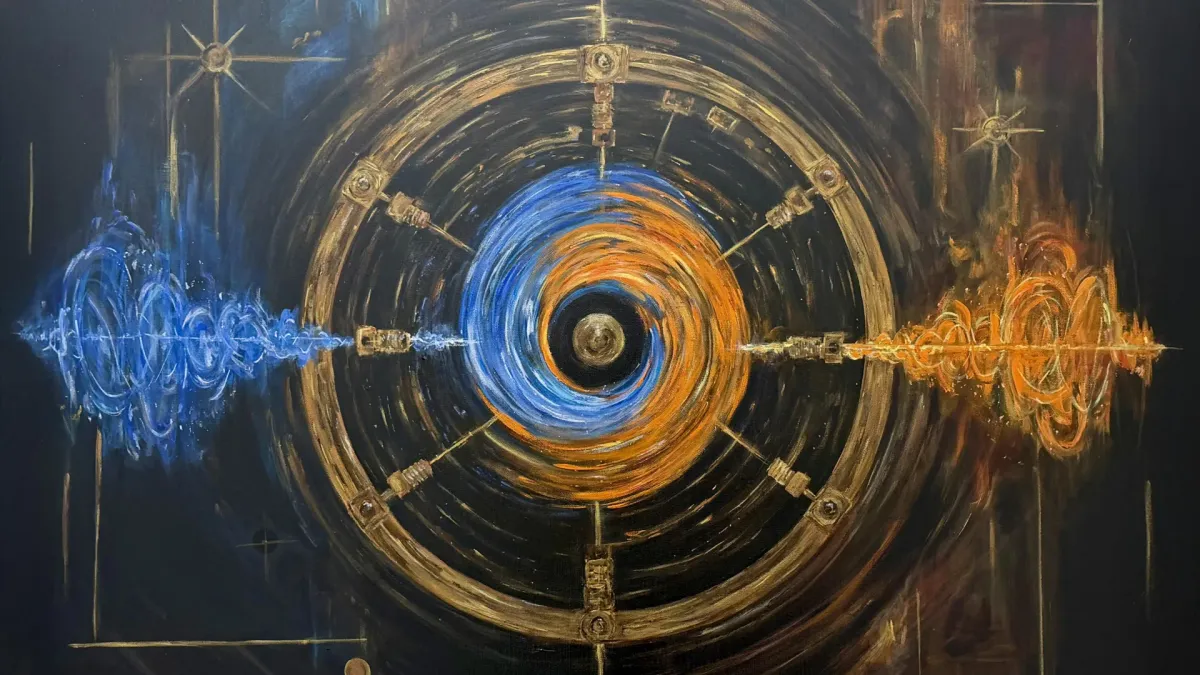
Physicists recreate black hole energy extraction in the lab - Science Daily
More than 50 years ago, physicist Sir Roger Penrose proposed a remarkable idea: under the right conditions, it might be possible to extract energy from a rapidly spinning black hole. In his concept, a particle entering the black hole's ergosphere, a region where spacetime is dragged along by the object's rotation, could split into two. One fragment would fall into the black hole while the other escaped carrying away more energy than the original particle. Later, physicist Yakov Zel'dovich expanded on this concept, predicting that waves interacting with an object rotating fast enough could also gain energy and become amplified. Now, researchers at the Advanced Science Research Center at the CUNY Graduate Center (CUNY ASRC) have demonstrated an experimental approach inspired by those long standing theories. Writing in the journal Nature, the team showed that wave amplification can be achieved using a device that simulates extreme rotation without physically spinning.
0 comments
No comments yet. Be the first to share your thoughts!