Short RNA chaperones promote aggregation-resistant TDP-43 conformers to mitigate neurodegeneration - Science | AAAS
This story deserves to be shared
Send it to someone who'd care, or post it on your networks.
This article is an excerpt. To read the full content, visit the original source. Science | AAAS
Related articles
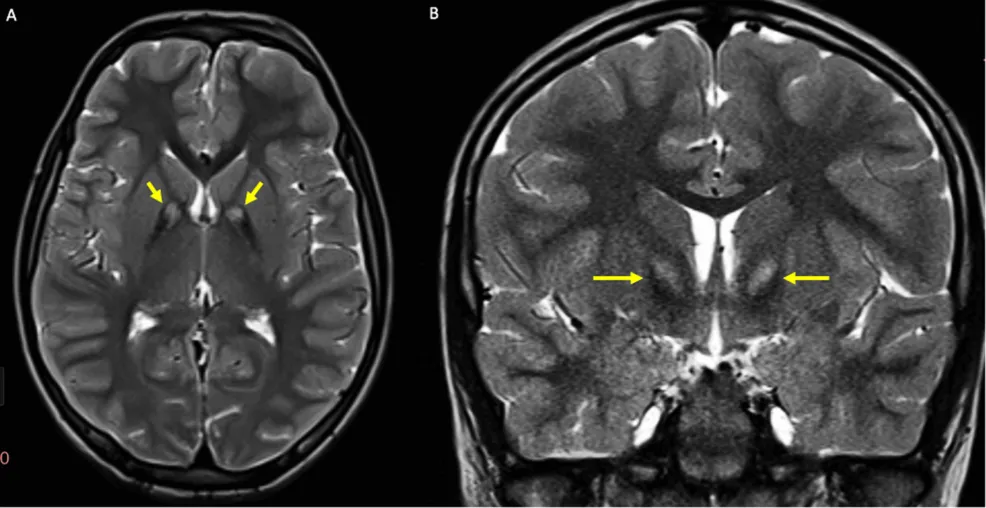
Eye-of-the-Tiger Sign: A Case Report of a Key MRI Clue to Pantothenate Kinase-Associated Neurodegeneration in an Eight-Year-Old Girl - Cureus
Pantothenate kinase-associated neurodegeneration (PKAN) is an autosomal recessive disorder and the most common form of neurodegeneration with brain iron accumulation (NBIA), whose imaging hallmark is the "eye-of-the-tiger" sign of the globus pallidus on brain MRI. We report the case of an eight-year-old girl, born to first-cousin parents, with a history of delayed walking and language acquisition, who presented with a four-month history of worsening gait instability and frequent falls. Neurological examination revealed dysarthria, lower-limb dystonia, postural tremor, brisk deep tendon reflexes, and bilateral extensor plantar responses. Brain MRI at 1.5 T showed bilateral, symmetric T2 hypointensity of the globus pallidus surrounding a central hyperintense focus, consistent with the eye-of-the-tiger sign, with marked pallidal signal loss on susceptibility-weighted imaging (SWI). The substantia nigra, dentate nuclei, cerebellum, and remaining brain parenchyma were normal, as were serum copper, ceruloplasmin, and lactate levels. This combination of a progressive extrapyramidal and pyramidal syndrome with the eye-of-the-tiger sign pointed to PKAN, pending genetic confirmation. This ca
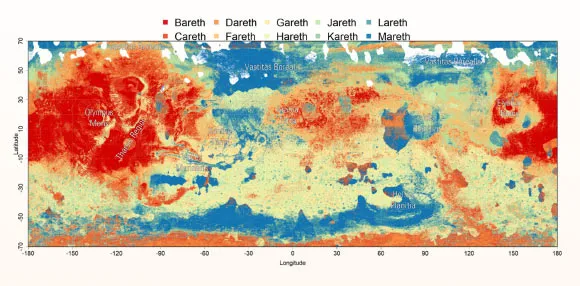
Planetary Scientists Create Classification System and Map of Martian Soils - Sci.News
Planetary researchers at the University of Sydney have proposed a new way to classify the soils of Mars, along with a new word for them: areth (the name comes from Ares, the Greek name for Mars). Classification of realms across the Martian surface. Image credit: McBratney et al., doi: 10.1016/j.catena.2026.110649.
Spatially resolved host and microbiota RNA profiling in the mouse gut using microDBiT - Nature
AcknowledgementsThe authors thank the Yale Department of Pathology and Yale Pathology Tissue Services for technical and tissue-related support. FundingThe research is supported by Maximizing Investigators Research Award (MIRA) for Early-Stage Investigators 1R35GM150838 (to Y. L.). The research is also supported, in part, by Grant #IRG-21-132-60-IRG from the American Cancer Society. We also acknowledge the support of Leslie H. Warner Postdoctoral Fellowship to D. W. Author informationAuthor notesThese authors contributed equally: Bo Tao, Deguang Song, Mingze Dong, Gaocai Li. Authors and AffiliationsDepartment of Pathology, Yale School of Medicine, New Haven, CT, USABo Tao, Mingze Dong, Gaocai Li, Shenjie Wang, Dejiang Wang, Xiangjun Di, Fu Gao, Liyun Lin, Xiaohui Yu, Junyi Xu, Mo Liu, Mariana Kelley, Anthony Y. Feng, Yu Jin, Yuval Kluger & Yang LiuDepartment of Neurology, Yale School of Medicine, New Haven, CT, USABo Tao, Gaocai Li, Shenjie Wang, Dejiang Wang, Xiangjun Di, Fu Gao, Liyun Lin, Xiaohui Yu, Mariana Kelley & Yang LiuDepartment of Immunobiology, Yale School of Medicine, New Haven, CT, USADeguang Song & Noah W.
Algae fossils from Cambrian explosion hint at sophisticated reproductive system - Phys.org
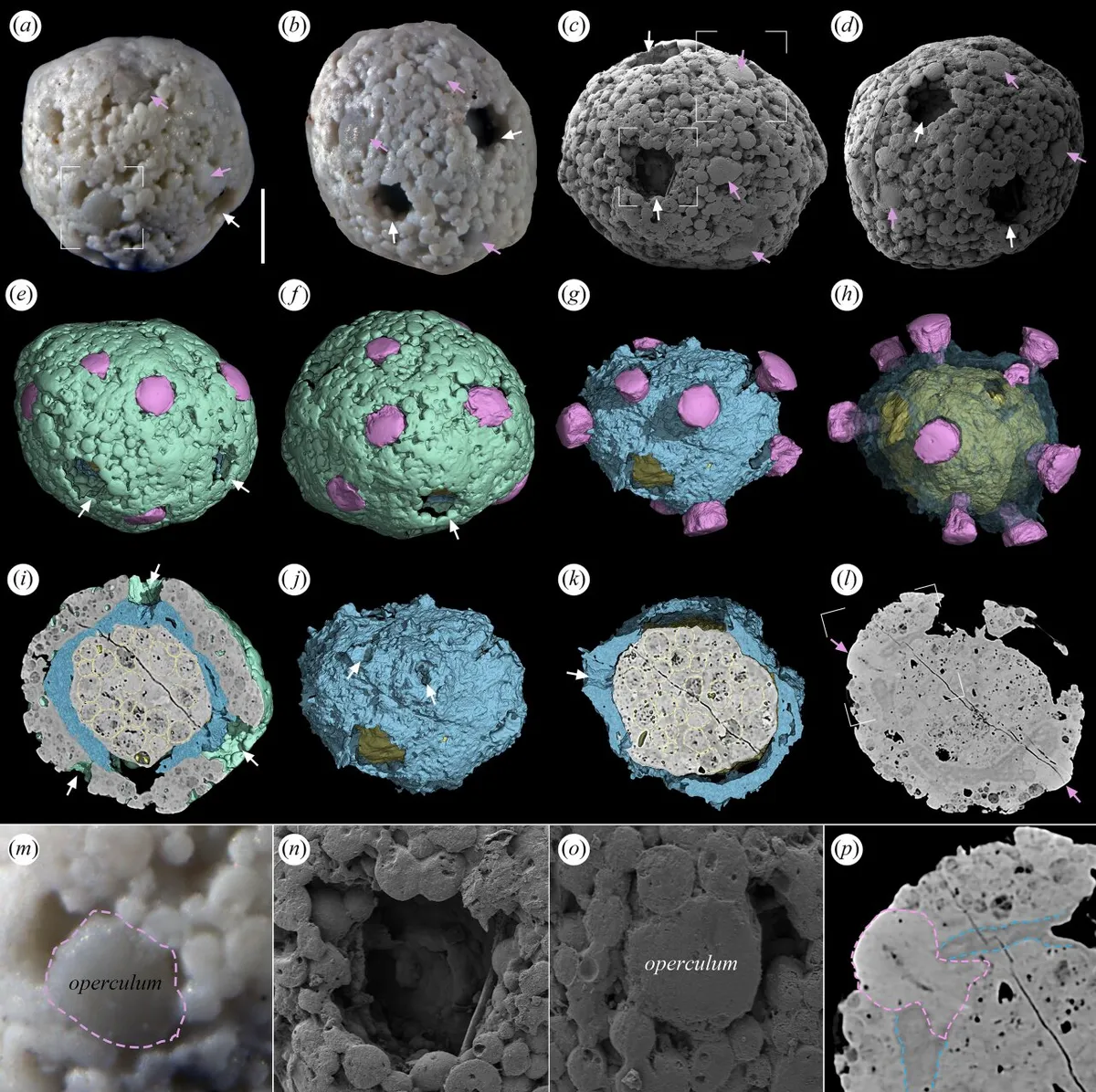
The holotype of Polyostiosphaera operculata gen. et sp. nov. from the early Cambrian Kuanchuanpu Biota (NIGP210977). (a, b) Light microscopy images. (c, d) Scanning electron microscopy images. (e–g, j) Surface renderings; the outer envelope, plug-like opercula, membrane and inner body are indicated by green, pink, blue and yellow, respectively. (h) Transparent model showing the inner body. (i, k) Virtual three-dimensional sections of (f) and (j), respectively. (l) Virtual slice of (f). (m) Close-up view of (a). (n, o) Close-up views of (c). (p) Close-up view of (l), showing the spatial relationships among the plug-like opercula, outer envelope, membrane and internal cells. White arrows, apertures; pink arrows, plug-like opercula. Yellow, blue and pink outline internal cells, the membrane and plug-like opercula, respectively. Scale bars: (a–i, l) 200 μm, (j, k) 180 μm, (m) 66 μm, (n) 60 μm, (o) 64 μm, (p) 37 μm. Credit: Chen et al. (Proceedings of the Royal Society B, 2026). The Cambrian explosion was a major diversification of animal life that unfolded early in the Cambrian period, which began around 538.8 million years ago.
Moon phase today: What the Moon will look like on October 19, 2026 - Mashable
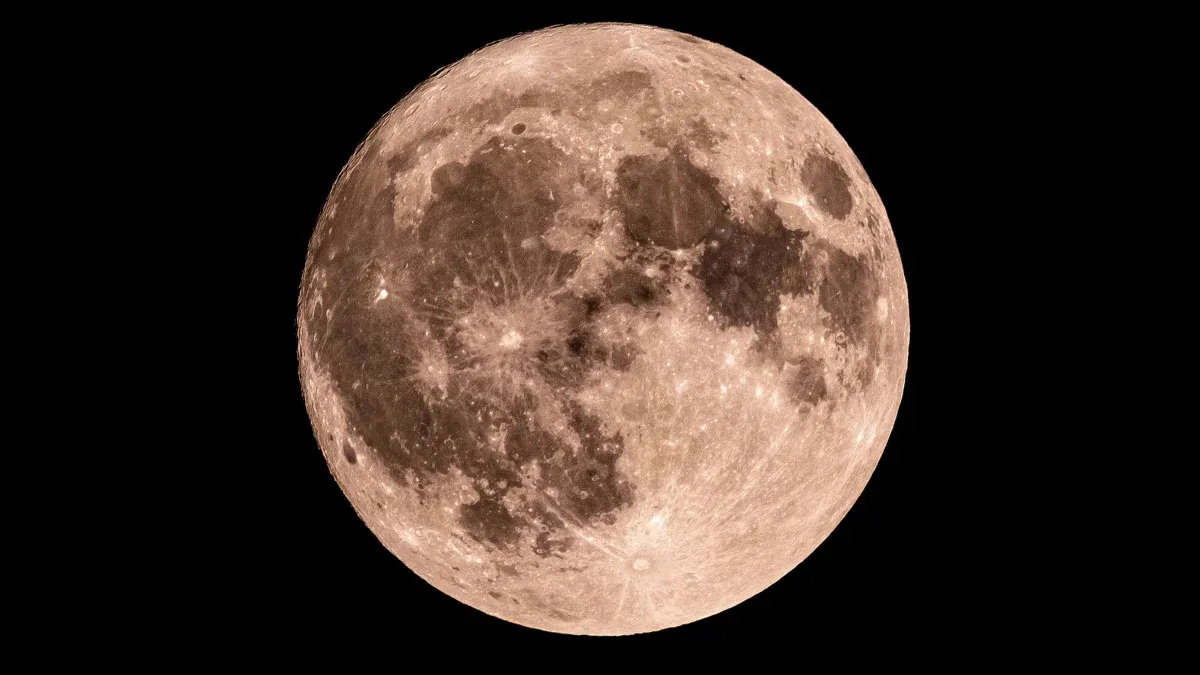
The Moon is getting closer to full, with most of its surface now lit up as it moves through the Waxing Gibbous phase. There's a lot more to see tonight than a week ago, so be sure to look up tonight. What is today's Moon phase? As of Monday, Oct. 19, NASA's Daily Moon Guide tracker tells us the Moon is in the Waxing Gibbous phase, with 56% of its surface visible. Tonight, you should be able to spot the Mare Crisium and Mare Fecunditatis without any visual aids. If you have binoculars you'll also see the Endymion Crater, the Alphonsus Crater, and the Appenine Mountains. Plus, if you have a telescope, you'll also see the Apollo 15 and 16 landing spots, plus the Rima Hyginus. When is the next Full Moon? The next Full Moon will take place on October 25 or 26, depending on your timezone. What are Moon phases? The Moon takes around 29.5 days to travel around Earth, and its appearance changes throughout the month. As it moves around our planet, we see different amounts of its sunlit side, from a slim crescent to the quarter phases and eventually a Full Moon. It then begins the cycle again.
0 comments
No comments yet. Be the first to share your thoughts!