Planetary Scientists Create Classification System and Map of Martian Soils - Sci.News
This story deserves to be shared
Send it to someone who'd care, or post it on your networks.
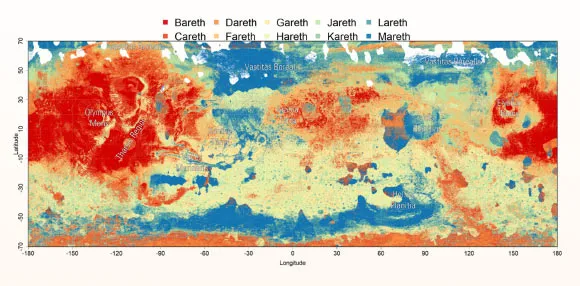
Planetary researchers at the University of Sydney have proposed a new way to classify the soils of Mars, along with a new word for them: areth (the name comes from Ares, the Greek name for Mars).
Classification of realms across the Martian surface. Image credit: McBratney et al., doi: 10.1016/j.catena.2026.110649.
This article is an excerpt. To read the full content, visit the original source. Sci.News
Related articles
Genomes from Coleus comosus and an interspecific hybrid facilitate taxonomic classification - Nature
We’re sharing this article early to provide faster access to peer-reviewed, accepted research. It is citable and carries a permanent DOI. This version is subject to further edits and will be replaced automatically by the final Version of Record. All legal disclaimers apply. AbstractColeus comosus Hochst. ex Gürke is an East African semi-succulent herb widely cultivated for remedial uses and ornamental landscaping. The rich specialised metabolite contents of C. comosus and closely related Coleus species have attracted considerable biochemical interest, but difficulties with accurate identification of species within the genus have hindered the systematic investigation and accurate identification of bioactive constituents. We provide two genome assemblies: a contig-level C. comosus genome assembly and a pseudochromosome-level genome assembly of an interspecific hybrid Coleus accession (Coleus comosus x Coleus neochilus). The C. comosus genome assembly spans 1.57 Gb with a contig N50 of 96.52 Mb. The hybrid Coleus genome is fully phased to 30 pseudochromosomes which sum up to 2.60 Gb, with its scaffold N50 reaching 86.9 Mb.
A robust and reliable method for malware classification using hybrid features and gradient boosting - Nature
We’re sharing this article early to provide faster access to peer-reviewed, accepted research. It is citable and carries a permanent DOI. This version is subject to further edits and will be replaced automatically by the final Version of Record. All legal disclaimers apply. AbstractThe most significant problem facing software security firms in the current cybersecurity system is the fact that new strains of malware keep on appearing. The achievement of successful detection of malicious software based on both static and dynamic data remains unmet despite the further realization of different approaches to deep learning and machine learning. Defects in encryption, packaging, and distribution, the discrepancies between the distribution of malware samples in families, make this issue even worse. To do actual malware research that utilizes deep learning methods, you will require data scientists of appropriate competence, large amounts of computer power (particularly GPUs) and time. In order to overcome such issues, this approach involves a hybrid approach to feature extraction that integrates wavelet and other statistical features based on benchmarked malware image sets.
First comprehensive Mars soil classification offers framework for exploration and future farming - Phys.org
A Ph.D. student at the University of Sydney has produced the first comprehensive classification system and map of Martian soils, creating a new framework that could help scientists compare landscapes across the Red Planet and identify promising locations for future exploration, habitation and food production.
Spatially resolved host and microbiota RNA profiling in the mouse gut using microDBiT - Nature
AcknowledgementsThe authors thank the Yale Department of Pathology and Yale Pathology Tissue Services for technical and tissue-related support. FundingThe research is supported by Maximizing Investigators Research Award (MIRA) for Early-Stage Investigators 1R35GM150838 (to Y. L.). The research is also supported, in part, by Grant #IRG-21-132-60-IRG from the American Cancer Society. We also acknowledge the support of Leslie H. Warner Postdoctoral Fellowship to D. W. Author informationAuthor notesThese authors contributed equally: Bo Tao, Deguang Song, Mingze Dong, Gaocai Li. Authors and AffiliationsDepartment of Pathology, Yale School of Medicine, New Haven, CT, USABo Tao, Mingze Dong, Gaocai Li, Shenjie Wang, Dejiang Wang, Xiangjun Di, Fu Gao, Liyun Lin, Xiaohui Yu, Junyi Xu, Mo Liu, Mariana Kelley, Anthony Y. Feng, Yu Jin, Yuval Kluger & Yang LiuDepartment of Neurology, Yale School of Medicine, New Haven, CT, USABo Tao, Gaocai Li, Shenjie Wang, Dejiang Wang, Xiangjun Di, Fu Gao, Liyun Lin, Xiaohui Yu, Mariana Kelley & Yang LiuDepartment of Immunobiology, Yale School of Medicine, New Haven, CT, USADeguang Song & Noah W.
Algae fossils from Cambrian explosion hint at sophisticated reproductive system - Phys.org
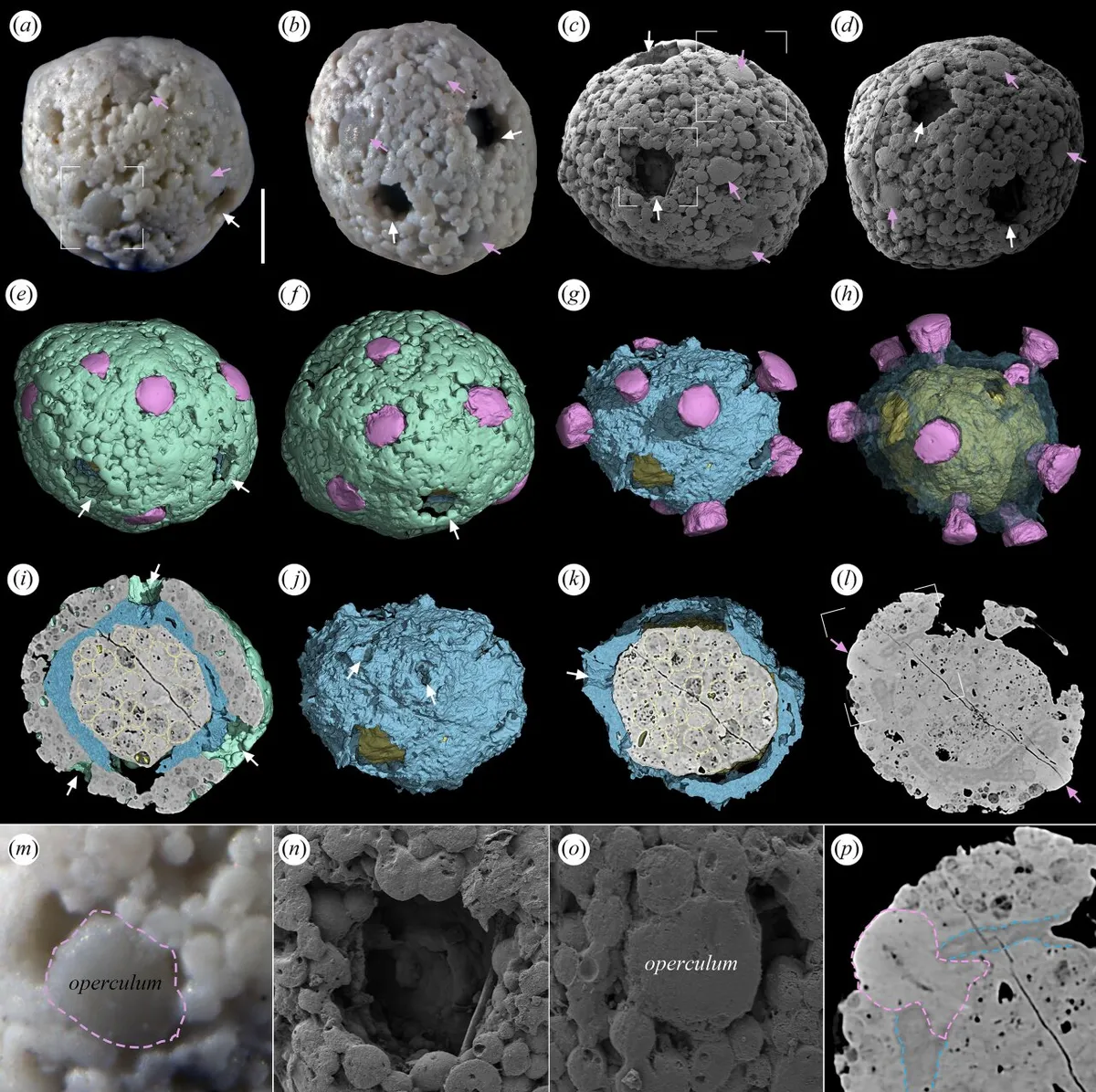
The holotype of Polyostiosphaera operculata gen. et sp. nov. from the early Cambrian Kuanchuanpu Biota (NIGP210977). (a, b) Light microscopy images. (c, d) Scanning electron microscopy images. (e–g, j) Surface renderings; the outer envelope, plug-like opercula, membrane and inner body are indicated by green, pink, blue and yellow, respectively. (h) Transparent model showing the inner body. (i, k) Virtual three-dimensional sections of (f) and (j), respectively. (l) Virtual slice of (f). (m) Close-up view of (a). (n, o) Close-up views of (c). (p) Close-up view of (l), showing the spatial relationships among the plug-like opercula, outer envelope, membrane and internal cells. White arrows, apertures; pink arrows, plug-like opercula. Yellow, blue and pink outline internal cells, the membrane and plug-like opercula, respectively. Scale bars: (a–i, l) 200 μm, (j, k) 180 μm, (m) 66 μm, (n) 60 μm, (o) 64 μm, (p) 37 μm. Credit: Chen et al. (Proceedings of the Royal Society B, 2026). The Cambrian explosion was a major diversification of animal life that unfolded early in the Cambrian period, which began around 538.8 million years ago.
Moon phase today: What the Moon will look like on October 19, 2026 - Mashable
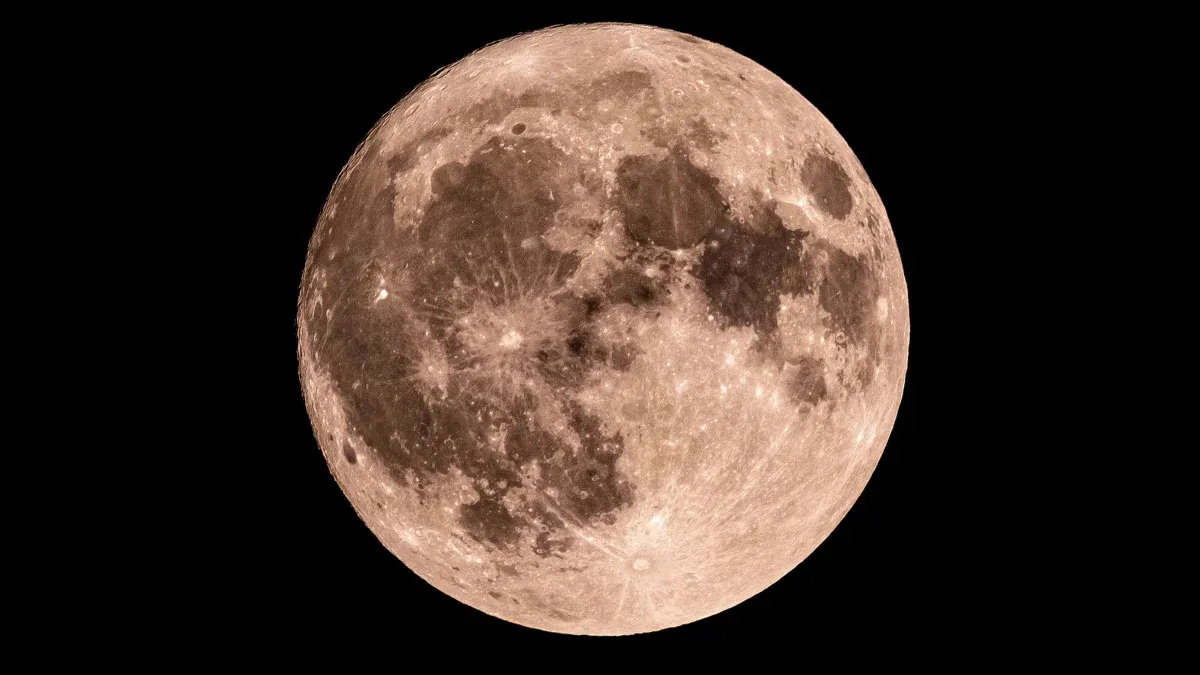
The Moon is getting closer to full, with most of its surface now lit up as it moves through the Waxing Gibbous phase. There's a lot more to see tonight than a week ago, so be sure to look up tonight. What is today's Moon phase? As of Monday, Oct. 19, NASA's Daily Moon Guide tracker tells us the Moon is in the Waxing Gibbous phase, with 56% of its surface visible. Tonight, you should be able to spot the Mare Crisium and Mare Fecunditatis without any visual aids. If you have binoculars you'll also see the Endymion Crater, the Alphonsus Crater, and the Appenine Mountains. Plus, if you have a telescope, you'll also see the Apollo 15 and 16 landing spots, plus the Rima Hyginus. When is the next Full Moon? The next Full Moon will take place on October 25 or 26, depending on your timezone. What are Moon phases? The Moon takes around 29.5 days to travel around Earth, and its appearance changes throughout the month. As it moves around our planet, we see different amounts of its sunlit side, from a slim crescent to the quarter phases and eventually a Full Moon. It then begins the cycle again.
0 comments
No comments yet. Be the first to share your thoughts!