Genomes from Coleus comosus and an interspecific hybrid facilitate taxonomic classification - Nature
This story deserves to be shared
Send it to someone who'd care, or post it on your networks.
We’re sharing this article early to provide faster access to peer-reviewed, accepted research. It is citable and carries a permanent DOI. This version is subject to further edits and will be replaced automatically by the final Version of Record. All legal disclaimers apply.
AbstractColeus comosus Hochst. ex Gürke is an East African semi-succulent herb widely cultivated for remedial uses and ornamental landscaping. The rich specialised metabolite contents of C. comosus and closely related Coleus species have attracted considerable biochemical interest, but difficulties with accurate identification of species within the genus have hindered the systematic investigation and accurate identification of bioactive constituents. We provide two genome assemblies: a contig-level C. comosus genome assembly and a pseudochromosome-level genome assembly of an interspecific hybrid Coleus accession (Coleus comosus x Coleus neochilus). The C. comosus genome assembly spans 1.57 Gb with a contig N50 of 96.52 Mb. The hybrid Coleus genome is fully phased to 30 pseudochromosomes which sum up to 2.60 Gb, with its scaffold N50 reaching 86.9 Mb.
This article is an excerpt. To read the full content, visit the original source. Nature
Related articles
Planetary Scientists Create Classification System and Map of Martian Soils - Sci.News
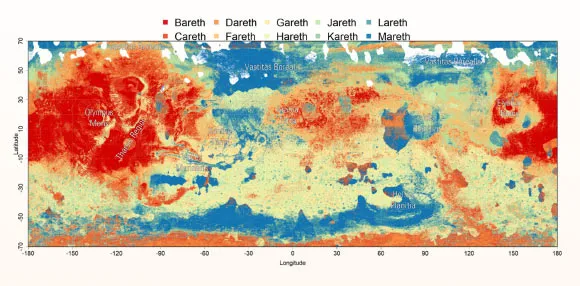
Planetary researchers at the University of Sydney have proposed a new way to classify the soils of Mars, along with a new word for them: areth (the name comes from Ares, the Greek name for Mars). Classification of realms across the Martian surface. Image credit: McBratney et al., doi: 10.1016/j.catena.2026.110649.
A robust and reliable method for malware classification using hybrid features and gradient boosting - Nature
We’re sharing this article early to provide faster access to peer-reviewed, accepted research. It is citable and carries a permanent DOI. This version is subject to further edits and will be replaced automatically by the final Version of Record. All legal disclaimers apply. AbstractThe most significant problem facing software security firms in the current cybersecurity system is the fact that new strains of malware keep on appearing. The achievement of successful detection of malicious software based on both static and dynamic data remains unmet despite the further realization of different approaches to deep learning and machine learning. Defects in encryption, packaging, and distribution, the discrepancies between the distribution of malware samples in families, make this issue even worse. To do actual malware research that utilizes deep learning methods, you will require data scientists of appropriate competence, large amounts of computer power (particularly GPUs) and time. In order to overcome such issues, this approach involves a hybrid approach to feature extraction that integrates wavelet and other statistical features based on benchmarked malware image sets.
First comprehensive Mars soil classification offers framework for exploration and future farming - Phys.org
A Ph.D. student at the University of Sydney has produced the first comprehensive classification system and map of Martian soils, creating a new framework that could help scientists compare landscapes across the Red Planet and identify promising locations for future exploration, habitation and food production.
0 comments
No comments yet. Be the first to share your thoughts!