Physical Review Research - Accepted Paper: Atomic density optimization of quasi-one-dimensional diffuse laser cooling under a two-dimensional magnetic-field gradient - APS Journals
This story deserves to be shared
Send it to someone who'd care, or post it on your networks.
Diffuse laser cooling (DLC) provides a compact, robust, and scalable approach to generating cold-atom ensembles, offering significant potential for ground-based and spaceborne microwave atomic clocks. However, the performance of DLC systems remains limited by the weak atom-light interaction arising from their relatively low atomic density. This limitation is characterized by the optical density (OD), which quantifies the effective interaction strength between the atomic ensemble and the probe light and strongly influences the achievable signal-to-noise ratio (SNR). Although quasi-one-dimensional (quasi-1D) DLC extends the probe interaction length and improves atomic utilization, increasing the local atomic density within the interrogation region remains challenging. Here, we demonstrate a magnetically enhanced quasi-1D DLC system that simultaneously maintains the extended interaction length and increases the atomic density through a two-dimensional magnetic-field gradient.
This article is an excerpt. To read the full content, visit the original source. APS Journals
Related articles
Physical Review Research - Accepted Paper: Anderson noise avalanche and sudden coherence destruction in photonic Su-Schrieffer-Heeger chains with random off-diagonal disorder - APS Journals
Here we discuss manifestations of the photonic noise avalanche in Su-Schrieffer-Heeger chains with static off-diagonal stochastic disorder. We demonstrate that a photonic noise avalanche arises in both the short-time and the long-time regimes. We predict a topology-dependent effect of sudden coherence destruction and appearance of topology-dependent field statistics. We also show that for sufficiently strong noise, when the topological localization is replaced with the Anderson localization, the long-time avalanche might occur withing the field localization region. This gives rise to a possibility of creating strongly super-bunched states.
Could you accidentally meet your future self without realizing it? Experts answer - Futura, le média qui explore le monde
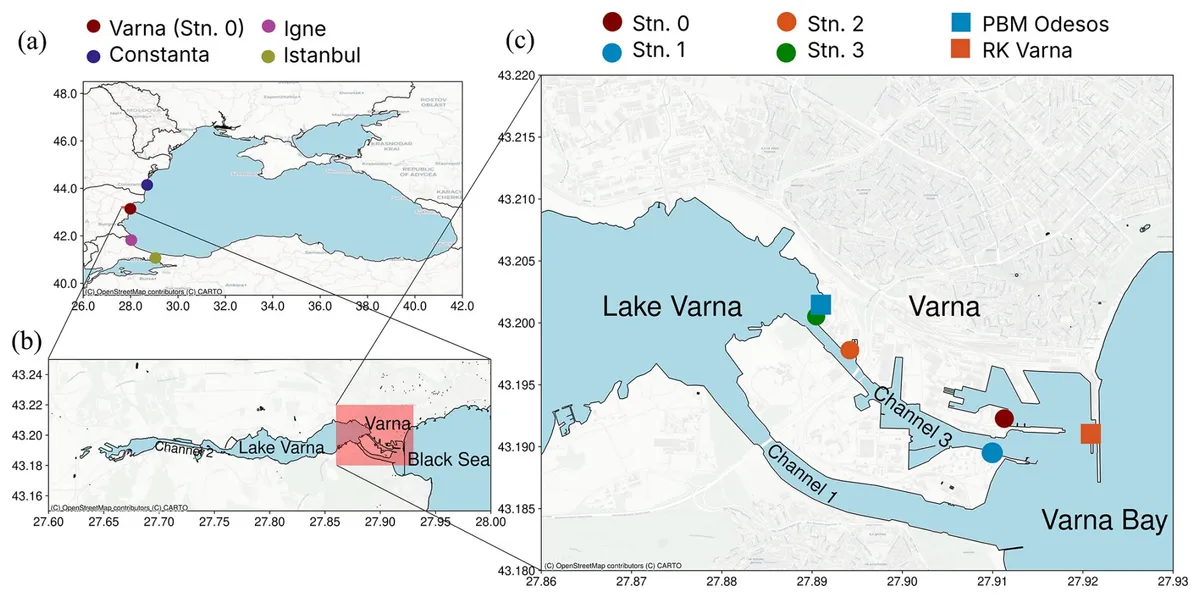
Scientists discover dangerous water oscillations between Lake Varna and Black Sea - Phys.org
Location of the study areas. Credit: Ocean Science (2026). DOI: 10.5194/os-22-2471-2026 For years, pilots have observed strong and unusual currents in the 2.4-kilometer-long (1.5-mile-long), 300-meter-wide (984-foot-wide) canal connecting Lake Varna with the Black Sea. Maarja Kruusmaa, an academician and professor at Tallinn University of Technology, and researcher Laura Piho, working with the Port of Varna, undertook detailed measurements to determine the causes of the phenomenon.
0 comments
No comments yet. Be the first to share your thoughts!