Scientists discover dangerous water oscillations between Lake Varna and Black Sea - Phys.org
This story deserves to be shared
Send it to someone who'd care, or post it on your networks.
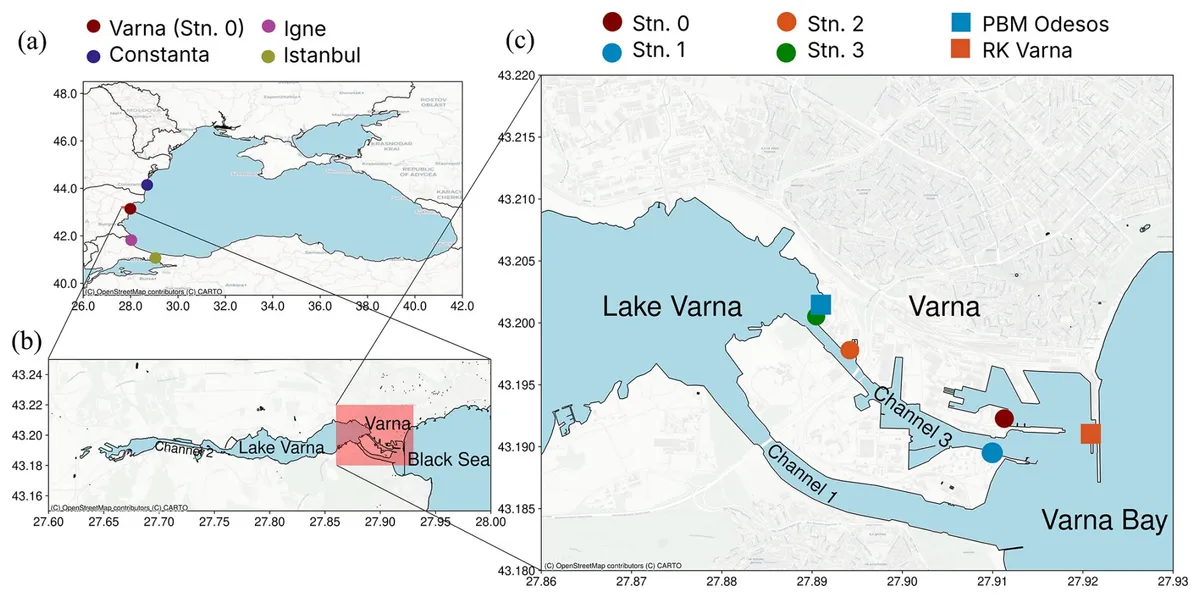
Location of the study areas. Credit: Ocean Science (2026). DOI: 10.5194/os-22-2471-2026
For years, pilots have observed strong and unusual currents in the 2.4-kilometer-long (1.5-mile-long), 300-meter-wide (984-foot-wide) canal connecting Lake Varna with the Black Sea. Maarja Kruusmaa, an academician and professor at Tallinn University of Technology, and researcher Laura Piho, working with the Port of Varna, undertook detailed measurements to determine the causes of the phenomenon.
This article is an excerpt. To read the full content, visit the original source. Phys.org
Related articles

Rhythm and cues: signaling oscillations inform cell differentiation in the intestine - BioTechniques
Original story from Hubrecht Institute (Utrecht, Netherlands). The intestines use the rhythm of a signal to decide which cells to make, improving our understanding of healthy tissue maintenance and disease disruption.
A new route to localized oscillations in networked reaction-diffusion systems - EurekAlert!
video: The video illustrates the emergence of localized oscillations in a complex network. The color and size of each node indicate its dynamical activity, revealing a small group of nodes that undergo sustained oscillations while the rest of the network remains comparatively inactive. In complex systems, collective dynamics do not always unfold uniformly across the entire system. Activity can sometimes become concentrated in specific regions or groups of interacting units. In the cerebral cortex, for example, a small population of neurons may spontaneously develop rhythmic activity while surrounding regions remain comparatively quiet. In Medellín, Colombia, dengue outbreaks can similarly recur as localized hotspots while neighboring areas remain relatively unaffected. Such localized oscillations can arise across diverse complex systems, from neural and ecological networks to chemical and epidemiological systems.

Quantum oscillations defy expectations in this exotic material - Science Daily
A study published in Nature Communications has revealed an unusual form of quantum oscillation in a three-dimensional topological insulator. The findings show that electrons in zirconium pentatelluride (ZrTe5) can behave in unexpected ways when exposed to temperatures close to absolute zero and extremely powerful magnetic fields. The research was led by scientists from the University of São Paulo (USP) in Brazil, Los Alamos National Laboratory, the University of Washington, and other U. S. institutions. The team combined electrical transport experiments performed in magnetic fields as strong as 60 tesla and at temperatures near 0.7 kelvin (-272.45 °C) with detailed theoretical calculations.
WHO establishes a PCR laboratory at the Varna Regional Health Inspectorate, Bulgaria - World Health Organization (WHO)
Quantum Leap For Canadian INRS High-temperature Materials Research - Quantum Zeitgeist
After nearly 40 years since the discovery of cuprates, copper-based compounds promising lossless electricity transmission, the mechanisms behind their superconductivity remain elusive. Researchers at the Institut national de la recherche scientifique (INRS), led by Professor Fabio Boschini, have now published findings in Nature Physics revealing a competition between superconductivity and the pseudogap, a mysterious quantum state. “The pseudogap is one of the greatest mysteries in condensed-matter physics,” says Professor Boschini, a specialist in ultrafast spectroscopy of quantum condensed matter at INRS, adding that understanding its interaction with superconductivity is essential to explaining high-temperature superconductivity. The INRS team used a pulse of light to temporarily suppress superconductivity, observing how the material responded in real time and uncovering previously hidden electronic states.
0 comments
No comments yet. Be the first to share your thoughts!