Pembrolizumab-Associated Adrenal Insufficiency Presenting as Adrenal Crisis: A Case Report - Cureus
This story deserves to be shared
Send it to someone who'd care, or post it on your networks.

Immunotherapy regimens containing the programmed cell death protein 1 (PD-1) inhibitor pembrolizumab are widely utilised in the management of non-small cell lung cancer (NSCLC). However, the administration of pembrolizumab is associated with unique immune-related adverse events. Adrenal insufficiency is a rare, potentially life-threatening endocrinopathy that can manifest even after the cessation of planned treatment. A male in his 50s with metastatic pulmonary adenocarcinoma developed an acute adrenal crisis 12 days after completing a 24-month course of pembrolizumab immunotherapy. Routine outpatient blood tests first identified critical hypocortisolaemia (morning serum cortisol <50 nmol/L), prompting the patient to attend hospital. The patient subsequently developed severe hypotension (58/45 mmHg) and reported malaise, anorexia, and vomiting after oral intake. Septic shock was considered but felt to be less likely given the absence of infective symptoms. The patient was successfully resuscitated in the emergency department with administration of fluids and high-dose intravenous hydrocortisone. Following clinical stabilisation, under the supervision of the endocrinology team, he w
This article is an excerpt. To read the full content, visit the original source. Cureus
Related articles
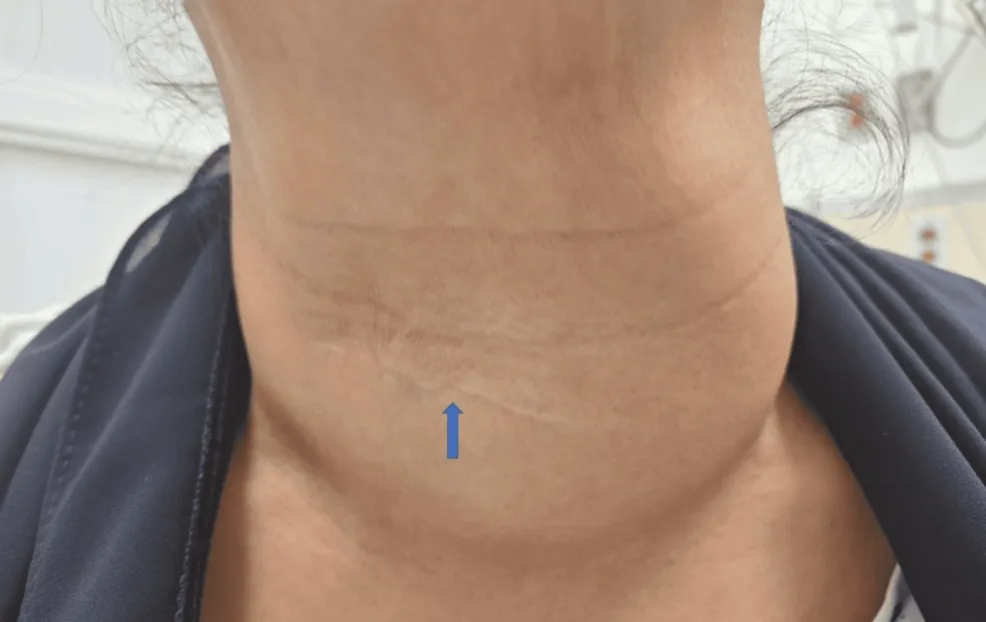
Acute Intrathyroidal Hematoma in a Multinodular Thyroid Presenting With Sudden Neck Swelling and Tracheal Deviation: A Case Report - Cureus
Acute hemorrhage within the thyroid gland is uncommon but can cause rapid neck swelling and, in severe cases, airway compromise. We report a 65-year-old woman with hypertension and a history of partial thyroidectomy performed more than 25 years earlier who presented with painful neck swelling that developed overnight. The swelling was associated with pain on swallowing, without shortness of breath, voice change, drooling, fever, or recent neck trauma. She was hemodynamically stable with an oxygen saturation of 99% on room air. Examination showed marked neck swelling, thyromegaly, thyroid tenderness, and left-sided neck induration. Contrast-enhanced computed tomography (CT) demonstrated a multinodular thyroid with a large heterogeneous mass in the left thyroid lobe causing mass effect and rightward tracheal deviation. Subsequent ultrasonography demonstrated a heterogeneous intrathyroidal collection consistent with hematoma. The patient remained clinically stable and was discharged after approximately five hours of observation. At otolaryngology follow-up 10 days later, repeat ultrasonography showed a progressively enlarging left thyroid nodule, and fine-needle aspiration cytology wa
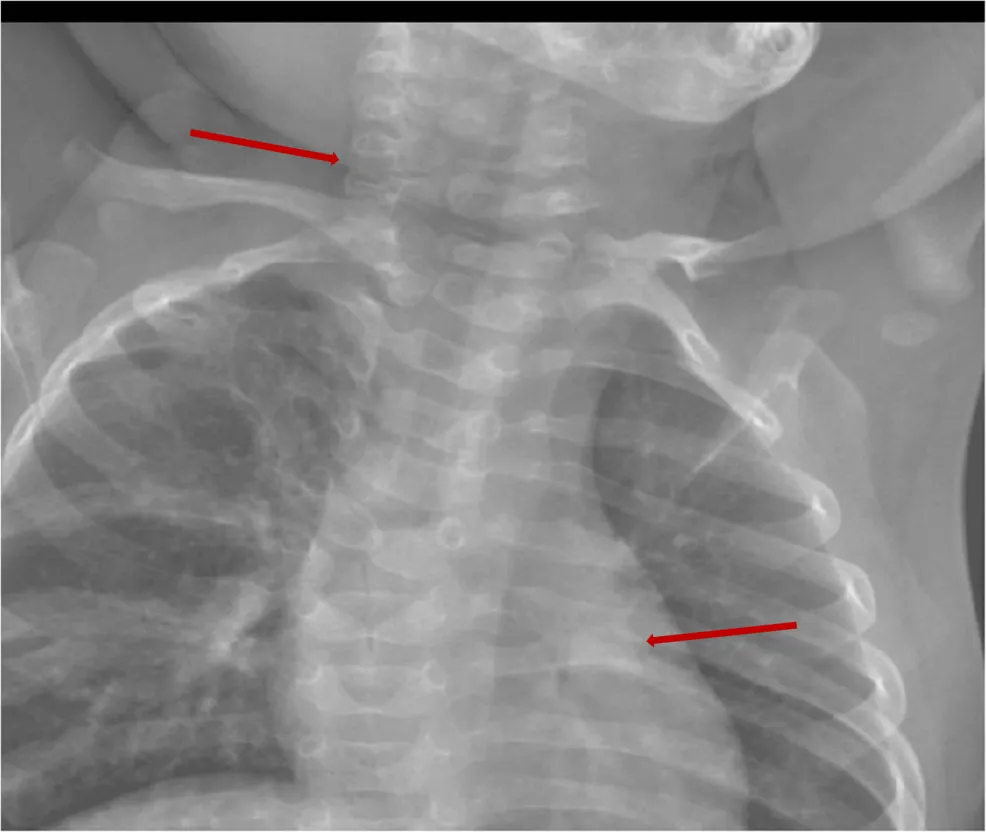
Congenital Cervical Vertebral Segmentation Failure Presenting as Refractory Torticollis in Infancy: A Case of Klippel-Feil Syndrome - Cureus
We present a case of a six-month-old female with a five-month history of right-sided torticollis that showed little improvement despite physical therapy. She presented to the emergency department due to parental concern for pneumonia, with congestion and cough without respiratory distress. Physical examination demonstrated leftward rotation and right lateral flexion of the head and cervical spine, consistent with the previously diagnosed right-sided torticollis. Chest radiographs were obtained in the workup for pneumonia and incidentally revealed segmentation anomalies of the cervical and upper thoracic spine as well as multiple bilateral bifid and fused ribs, more pronounced on the right. The radiographic findings were interpreted as highly suggestive of Klippel-Feil syndrome (KFS). In the setting of refractory torticollis and characteristic congenital vertebral abnormalities, the diagnosis of KFS was made. No acute complication requiring immediate intervention was documented. Referral to appropriate specialists was recommended for further evaluation and longitudinal management. This case highlights the importance of maintaining a broad differential diagnosis when evaluating refra

Clinical Outcomes According to Revascularization Strategy in Patients With Late-Presenting ST-Segment Elevation Myocardial Infarction: A Retrospective Cohort Study - Cureus
Background: Timely reperfusion remains the cornerstone of management in ST-segment elevation myocardial infarction (STEMI). However, a substantial proportion of patients continue to present beyond the recommended reperfusion window, particularly in low- and middle-income countries. The outcomes associated with delayed coronary revascularization in these late presenters remain incompletely defined. This retrospective observational study aimed to compare one-year mortality and left ventricular ejection fraction (LVEF) changes according to treatment strategy among STEMI patients presenting more than 12 hours after symptom onset. Methods: We conducted a retrospective observational cohort study including consecutive patients admitted with STEMI more than 12 hours after symptom onset between January 2020 and December 2025 at Mohammed VI University Hospital, Marrakech, Morocco. Patients were stratified according to treatment strategy into delayed percutaneous coronary intervention (PCI), conservative medical management, and coronary artery bypass grafting (CABG). The primary endpoint was one-year all-cause mortality, and the secondary outcome was change in LVEF. Mortality comparisons were
Synergistic reductive decolorization of waterlogged archaeological wood via a thiourea dioxide–amine borane system - Nature
We’re sharing this article early to provide faster access to peer-reviewed, accepted research. It is citable and carries a permanent DOI. This version is subject to further edits and will be replaced automatically by the final Version of Record. All legal disclaimers apply. AbstractWaterlogged archeological wood (WAW) undergoes lignin oxidation in the presence of air, generating quinones and other conjugated chromophores that cause severe discoloration. As conventional reductants (e.g., Na2S2O4 and NaBH4) struggle to balance between decolorization performance and operational compatibility, a thiourea dioxide (TDO)–amine borane (AB) composite formulation was developed for WAW decolorization. A paper-based solid-phase model with a covalently linked o-quinone motif was constructed for quantitative evaluation. The performances of TDO, dimethylamine borane (DMAB), tert-butylamine borane (TBAB), and their combinations were evaluated on both model and WAW samples. The TDO–AB formulations outperformed single-component treatments in decolorization effect and rate.
0 comments
No comments yet. Be the first to share your thoughts!