Longitudinal ctDNA profiling reveals genomic risk and molecular response to bireociclib in advanced breast cancer - Nature
This story deserves to be shared
Send it to someone who'd care, or post it on your networks.
ORCID: orcid.org/0000-0003-1233-60816, Xinxin Tan7, Jing Bai2, Li Wang8, Xianghui Duan8, Fan Yang8, Jiayu Wang1 & … Binghe Xu
We’re sharing this article early to provide faster access to peer-reviewed, accepted research. It is citable and carries a permanent DOI. This version is subject to further edits and will be replaced automatically by the final Version of Record. All legal disclaimers apply.
This article is an excerpt. To read the full content, visit the original source. Nature
Related articles
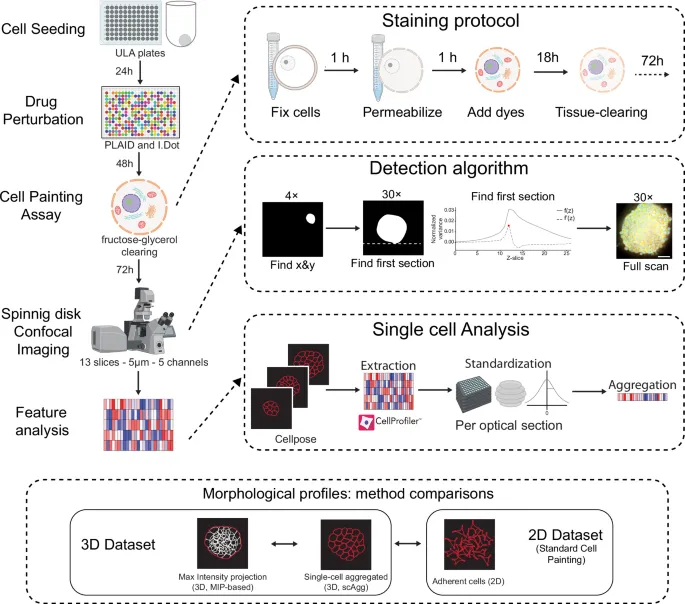
High-content morphological profiling by Cell Painting in 3D spheroids - Nature
IntroductionPhenotypic profiling and cellular assays play important roles in early drug discovery, offering valuable insights that have helped uncover new disease mechanisms1,2. One approach is morphological profiling, where a large number of quantitative metrics (features) – such as cell size, shape, and texture – can be extracted from individual cells within images, creating a unique fingerprint for every given condition3,4. This shift towards large-scale morphological profiling or phenomics allows for the exploration of less-characterized phenotypes, thereby facilitating the discovery of novel disease biomarkers5,6,7. Cell Painting is a widely adopted standardized assay for morphological profiling of 2D monolayer cell cultures. By staining distinct cellular compartments and imaging in multiple channels, it enables the extraction of vast amounts of phenotypic information. This unbiased approach is powerful for predicting mechanisms of action8,9, identifying off-target effects10, and detecting phenotypes of environmental toxicants11,12.
Spatially resolved host and microbiota RNA profiling in the mouse gut using microDBiT - Nature
AcknowledgementsThe authors thank the Yale Department of Pathology and Yale Pathology Tissue Services for technical and tissue-related support. FundingThe research is supported by Maximizing Investigators Research Award (MIRA) for Early-Stage Investigators 1R35GM150838 (to Y. L.). The research is also supported, in part, by Grant #IRG-21-132-60-IRG from the American Cancer Society. We also acknowledge the support of Leslie H. Warner Postdoctoral Fellowship to D. W. Author informationAuthor notesThese authors contributed equally: Bo Tao, Deguang Song, Mingze Dong, Gaocai Li. Authors and AffiliationsDepartment of Pathology, Yale School of Medicine, New Haven, CT, USABo Tao, Mingze Dong, Gaocai Li, Shenjie Wang, Dejiang Wang, Xiangjun Di, Fu Gao, Liyun Lin, Xiaohui Yu, Junyi Xu, Mo Liu, Mariana Kelley, Anthony Y. Feng, Yu Jin, Yuval Kluger & Yang LiuDepartment of Neurology, Yale School of Medicine, New Haven, CT, USABo Tao, Gaocai Li, Shenjie Wang, Dejiang Wang, Xiangjun Di, Fu Gao, Liyun Lin, Xiaohui Yu, Mariana Kelley & Yang LiuDepartment of Immunobiology, Yale School of Medicine, New Haven, CT, USADeguang Song & Noah W.
Cell-specific proteome profiling reveals altered peripheral immune cell communication in early multiple sclerosis - Nature
AbstractBackgroundMultiple sclerosis (MS) is characterized by immune dysregulation, yet the molecular alterations present at disease onset remain incompletely understood. We sought to characterize immune cell-specific proteomic changes before treatment initiation in early MS and assess their impact on immune cell communication. MethodsWe performed high-resolution proteomic profiling of four major peripheral immune cell populations, CD4+ and CD8+ T cells, CD19+ B cells, and CD14+ monocytes, from newly diagnosed, treatment-naïve individuals with MS and matched healthy controls. Differential protein expression, pathway enrichment, genetic overlap, and ligand–receptor analyses were performed. ResultsAll four immune cell populations exhibit distinct proteomic alterations that discriminate individuals with MS from healthy controls. Differentially expressed proteins are enriched in pathways related to coagulation, antigen processing, vesicle trafficking, oxidative phosphorylation, and cellular stress responses. Disease-associated proteins overlap with established MS susceptibility genes, with the strongest enrichments observed in CD14⁺ monocytes and CD19⁺ B cells.
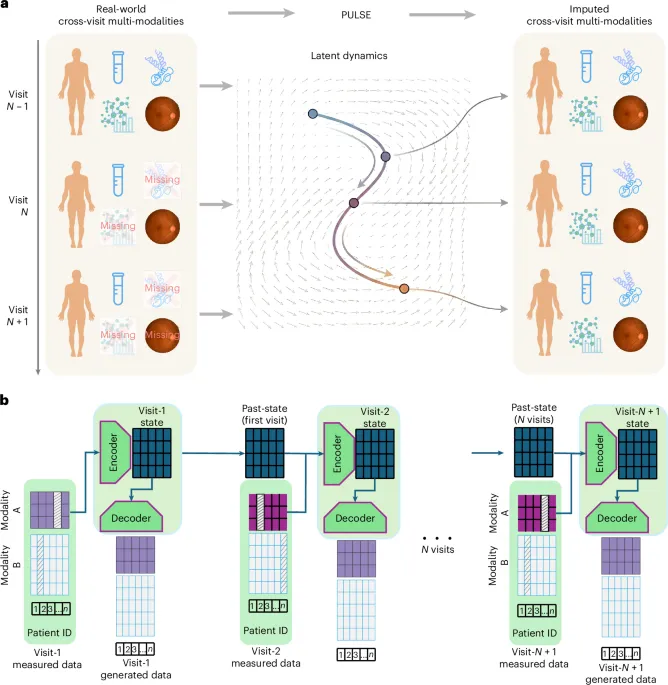
Longitudinal alignments and syntheses of multimodal clinical data for personalized medicine with the PULSE framework - Nature
MainPrecision medicine leverages high-resolution, multimodal measurements to capture human physiological complexity1,2,3,4,5. Deep phenotyping, such as high-throughput proteomics and metabolomics, provides rich functional signatures and when collected longitudinally, reveals within-individual changes invisible in cross-sectional data6,7,8,9, while large-scale efforts such as the UK Biobank demonstrate the value of dense profiling10. However, the cost and operational complexity of repeated deep multimodal profiling limit its use in routine care11, limiting access to well-resourced research settings12,13. Most healthcare systems therefore still rely on sparse laboratory measurements that capture only fragments of an individual’s physiological state. Single-cell multimodal methods offer a conceptual starting point: distinct modalities (transcriptome, chromatin accessibility and surface proteins) are treated as complementary views of a shared biological state.
0 comments
No comments yet. Be the first to share your thoughts!