Genomes of 20 eastern Finnish species provide unique insights into species' adaptations to local conditions - Phys.org
This story deserves to be shared
Send it to someone who'd care, or post it on your networks.
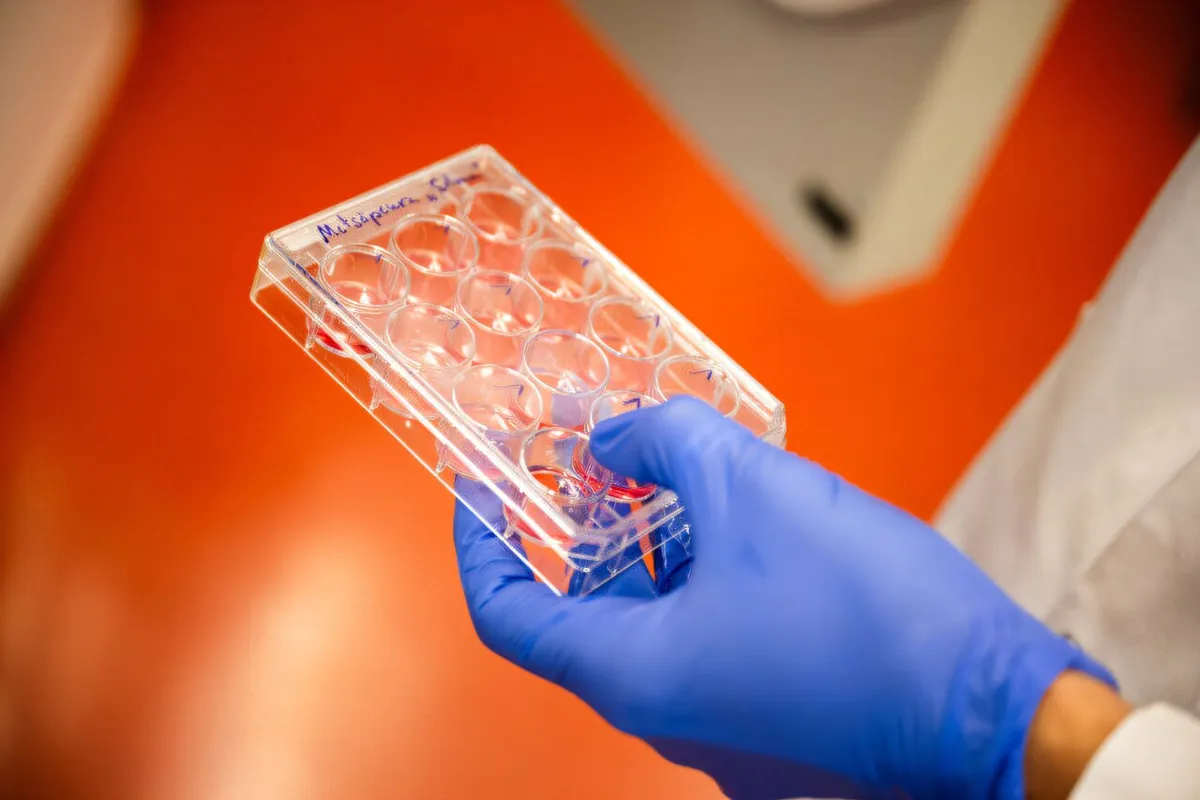
The Finnish forest reindeer genome comes from an animal born at Korkeasaari Zoo in Helsinki. Credit: University of Eastern Finland
In recent years, researchers at the University of Eastern Finland have been both leading and contributing to collaborative genome projects. These efforts have produced reference-quality genome assemblies for the Finnish brown hare and the mountain hare, as well as the Saimaa ringed seal, in collaboration with research partners.
This article is an excerpt. To read the full content, visit the original source. Phys.org
Related articles
Plastics under pressure prevent microplastics - Asia Research News |
Transient response of a cylindrical cavity in three-dimensional elastic space under impact loading: an analytical solution - Nature
Appendix$$ E_{1} = \left( {\lambda k_{1}^{2} - \lambda \gamma^{2} } \right)K_{n} (k_{1} r) + \left( {2\mu k_{1}^{2} + \frac{{2\mu n^{2} }}{{r^{2} }} - \frac{2\mu n}{{r^{2} }}} \right)K_{n} (k_{1} r) + \frac{{2\mu k_{1} }}{r}K_{n + 1} (k_{1} r) $$$$ E_{2} = \left( {\frac{ - 2\mu n}{{r^{2} }} + \frac{{2\mu n^{2} }}{{r^{2} }}} \right)K_{n} (k_{2} r) - \frac{{2\mu nk_{2} }}{r}K_{n + 1} (k_{2} r) $$$$ E_{3} = \left( {2\mu \lambda k_{2}^{2} + \frac{{2\mu n^{2} \lambda }}{{r^{2} }} - \frac{2\mu n\lambda }{{r^{2} }}} \right)K_{n} (k_{2} r) + \frac{{2\mu \lambda k_{2} }}{r}K_{n + 1} (k_{2} r) $$$$ E_{4} = \left( { - \lambda k_{1}^{2} + \lambda \gamma^{2} } \right)K_{n} (k_{1} r) - \left( {2\mu k_{1}^{2} + \frac{{2\mu n^{2} }}{{r^{2} }} - \frac{2\mu n}{{r^{2} }}} \right)K_{n} (k_{1} r) - \frac{{2\mu k_{1} }}{r}K_{n + 1} (k_{1} r) $$$$ E_{5} = \left( {\frac{2\mu n}{{r^{2} }} - \frac{{2\mu n^{2} }}{{r^{2} }}} \right)K_{n} (k_{2} r) + \frac{{2\mu nk_{2} }}{r}K_{n + 1} (k_{2} r) $$$$ E_{6} = \left( { - 2\mu \lambda k_{2}^{2} - \frac{{2\mu n^{2} \lambda }}{{r^{2} }} + \frac{2\mu n\lambda }{{r^{2} }}} \right)K_{n} (k_{2} r) - \frac{{2\mu \lambda k_{2} }}{r}K_{n + 1} (k_{2} r) $$$$ E_{7} = \left(
NIST-Developed Quantum Sensors Improve Nuclear Monitoring - In Compliance Magazine
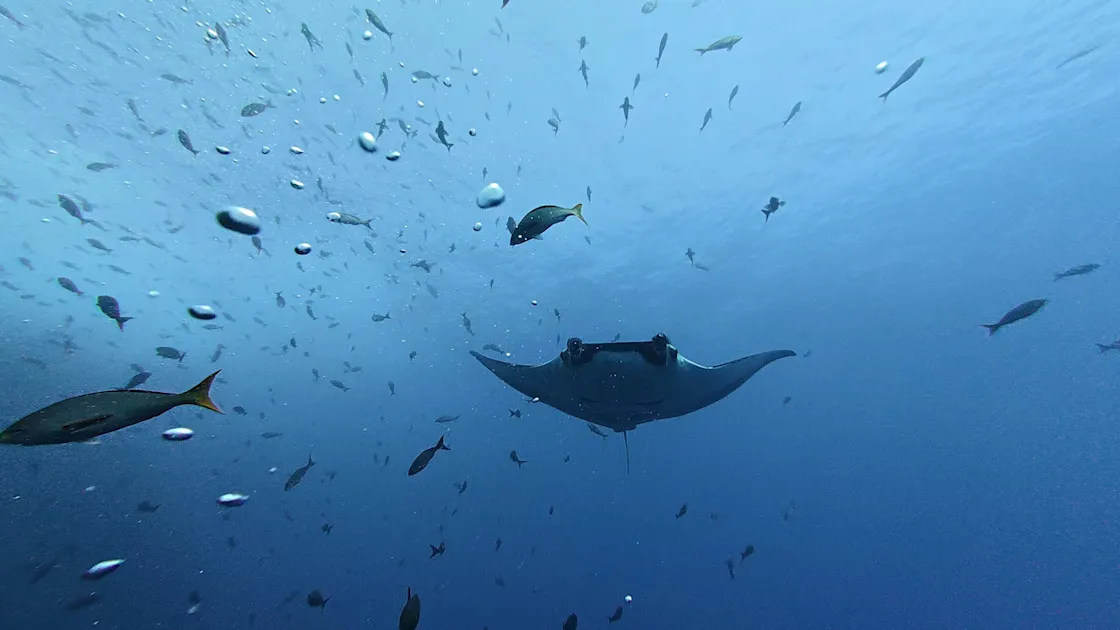
Baby manta rays hunker down close to coasts before facing the open ocean’s dangers - Frontiers
Credit: Jeffry Madrigal. Baby manta rays escape predators by avoiding them until they grow large enough for a face-off, a new study has found. Tracking data shows that young giant manta rays in Central America strictly stick to comparatively safe coastal areas for the first few years of their life. When they’re large enough that natural enemies are a lesser concern, they leave these sanctuaries and embark on journeys spanning hundreds of kilometers. This shift in space use allows mantas to grow in safety before facing another type of danger in the open oceans: industrial fisheries and vessel strikes in unprotected waters. The authors say underwater corridors are needed to protect adult mantas on their treks. Giant manta rays can grow up to nine meters long with a disc size of seven meters across and weigh up to 2,000kg. This size leaves them with very few natural enemies once they reach adulthood at around eight to ten years old. But giant manta ray babies, called pups, cannot rely on their size to protect them from predators that live in the open ocean, including several species of shark and orcas.
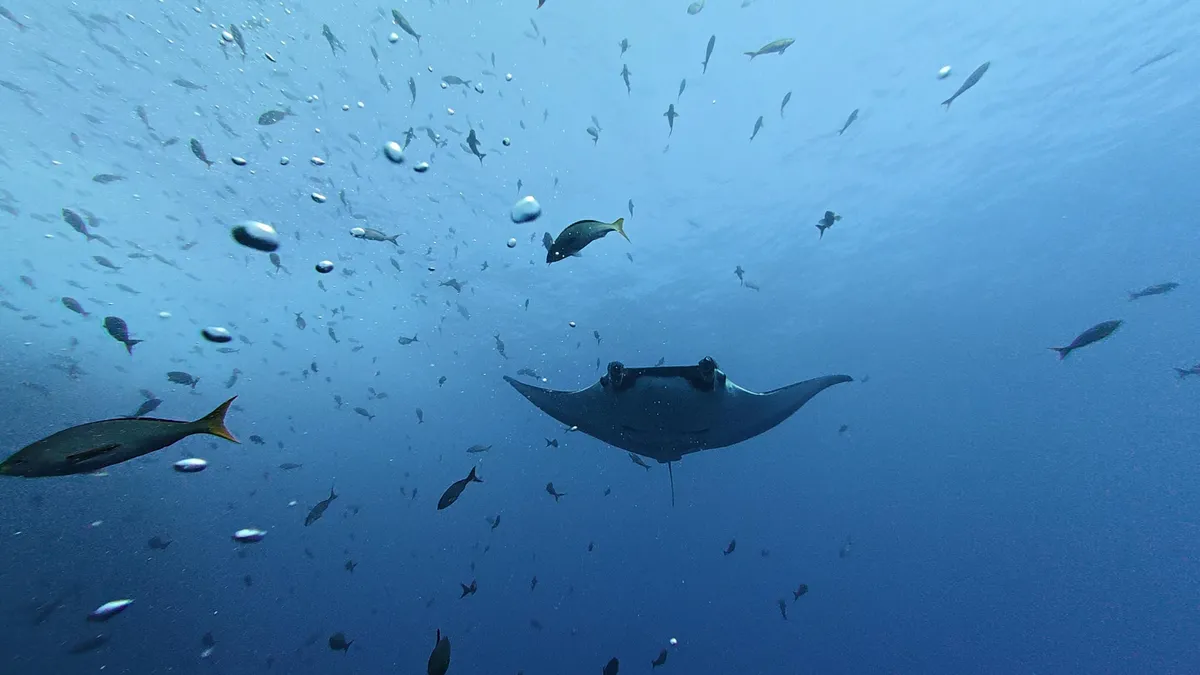
Baby manta rays hunker down close to coasts before facing the open ocean's dangers - Phys.org
One of the manta rays tracked in the study. Credit: Jeffry Madrigal Giant manta rays can grow up to nine meters (30 feet) long with a disk size of seven meters (23 feet) across and weigh up to 2,000 kg (4,400 pounds). This size leaves them with very few natural enemies once they reach adulthood at around eight to 10 years old. But giant manta ray babies, called pups, cannot rely on their size to protect them from predators that live in the open ocean, including several species of shark and orcas.
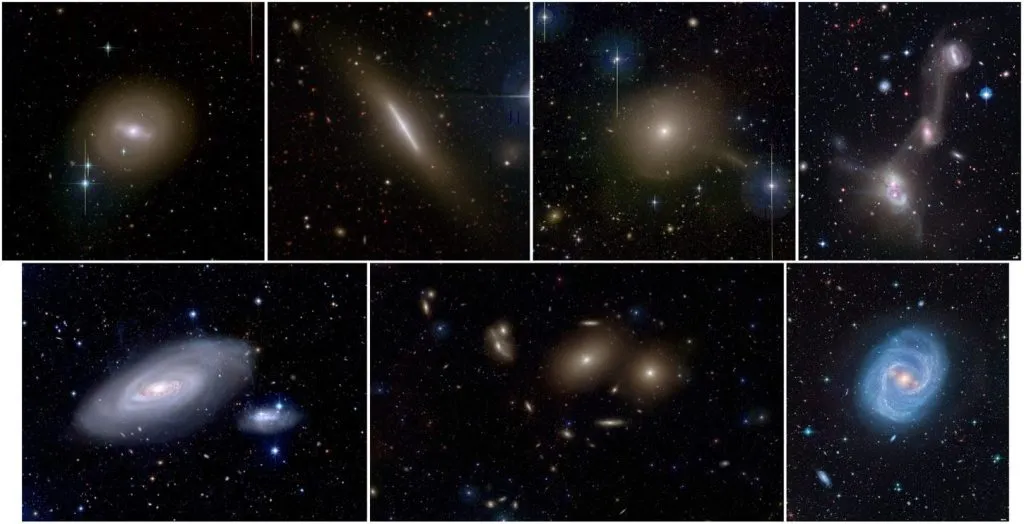
Canada-France-Hawaiʻi Telescope discovers more than 2,100 previously unknown galaxies - Maui Now
Virgo Cluster galaxies captured by the Next Generation Virgo Cluster Survey. Images: NGVS Team, CFHT, Jean-Charles Cuillandre and Giovanni Anselmi (Coelum). Astronomers using the Canada-France-Hawaiʻi Telescope have identified more than 2,100 previously unknown galaxies in the Virgo Cluster, more than doubling its known galaxy population.
0 comments
No comments yet. Be the first to share your thoughts!