Transient response of a cylindrical cavity in three-dimensional elastic space under impact loading: an analytical solution - Nature
This story deserves to be shared
Send it to someone who'd care, or post it on your networks.
Appendix$$ E_{1} = \left( {\lambda k_{1}^{2} - \lambda \gamma^{2} } \right)K_{n} (k_{1} r) + \left( {2\mu k_{1}^{2} + \frac{{2\mu n^{2} }}{{r^{2} }} - \frac{2\mu n}{{r^{2} }}} \right)K_{n} (k_{1} r) + \frac{{2\mu k_{1} }}{r}K_{n + 1} (k_{1} r) $$$$ E_{2} = \left( {\frac{ - 2\mu n}{{r^{2} }} + \frac{{2\mu n^{2} }}{{r^{2} }}} \right)K_{n} (k_{2} r) - \frac{{2\mu nk_{2} }}{r}K_{n + 1} (k_{2} r) $$$$ E_{3} = \left( {2\mu \lambda k_{2}^{2} + \frac{{2\mu n^{2} \lambda }}{{r^{2} }} - \frac{2\mu n\lambda }{{r^{2} }}} \right)K_{n} (k_{2} r) + \frac{{2\mu \lambda k_{2} }}{r}K_{n + 1} (k_{2} r) $$$$ E_{4} = \left( { - \lambda k_{1}^{2} + \lambda \gamma^{2} } \right)K_{n} (k_{1} r) - \left( {2\mu k_{1}^{2} + \frac{{2\mu n^{2} }}{{r^{2} }} - \frac{2\mu n}{{r^{2} }}} \right)K_{n} (k_{1} r) - \frac{{2\mu k_{1} }}{r}K_{n + 1} (k_{1} r) $$$$ E_{5} = \left( {\frac{2\mu n}{{r^{2} }} - \frac{{2\mu n^{2} }}{{r^{2} }}} \right)K_{n} (k_{2} r) + \frac{{2\mu nk_{2} }}{r}K_{n + 1} (k_{2} r) $$$$ E_{6} = \left( { - 2\mu \lambda k_{2}^{2} - \frac{{2\mu n^{2} \lambda }}{{r^{2} }} + \frac{2\mu n\lambda }{{r^{2} }}} \right)K_{n} (k_{2} r) - \frac{{2\mu \lambda k_{2} }}{r}K_{n + 1} (k_{2} r) $$$$ E_{7} = \left(
This article is an excerpt. To read the full content, visit the original source. Nature
Related articles
Coupled analytical and finite element investigation of dynamic and cyclic response in cracked functionally graded beams - Nature
We’re sharing this article early to provide faster access to peer-reviewed, accepted research. It is citable and carries a permanent DOI. This version is subject to further edits and will be replaced automatically by the final Version of Record. All legal disclaimers apply. AbstractOffshore and marine structures increasingly utilise Functionally Graded Materials (FGMs) because of their superior stiffness and enhanced resistance to damage under combined vibration and cyclic loading induced by waves, wind and operational conditions. This study presents a combined analytical and finite element investigation into the dynamic behaviour of a cracked FGM cantilever beam compared with eight conventional offshore structural steels. A fracture-mechanics-based analytical model, incorporating crack-induced flexibility and stiffness degradation under cyclic loading within a continuum damage mechanics framework, was developed to predict the beam’s natural frequencies and validated against finite element results, with deviations below 2%. The postulated cracks were represented by predefined notches to simulate pre-existing structural damage or defects, with crack depth ratios of a/h = 0.233, 0.
How Claude is accelerating protein design and analytical chemistry - Anthropic
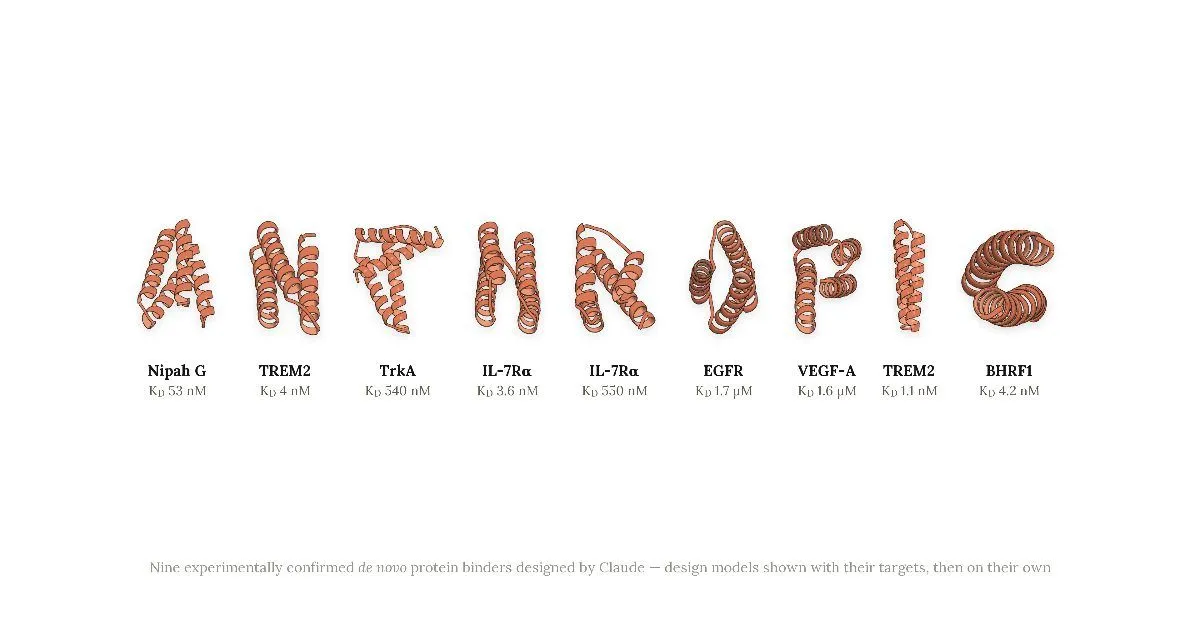
Summary: In this post, we share two results that show how Claude can help life scientists increase the pace of their research. In the first, we tested Claude’s ability to design protein binders from scratch, a key task representative of the early parts of the drug design process and one that has historically taken a specialist weeks or months per target. Claude (Mythos Preview and Opus 4.8) designed protein binders against 15 targets, and succeeded against 14 of them. Between 22% and 35% of its individual designs bound successfully, depending on the setup, compared to the 10-15% that is typical in protein design campaigns today. Some of its strongest designs bound several times more tightly than the best previously published result. In the second example, we evaluated whether Claude can accelerate chemical analysis. Claude Opus 5, a generally available model, was given NMR and LC-MS data (the data that allows chemists to assess the identity and purity of the compounds they work with).
0 comments
No comments yet. Be the first to share your thoughts!