Europe must seize the moment to lead on free and open science - Nature
This story deserves to be shared
Send it to someone who'd care, or post it on your networks.
This article is an excerpt. To read the full content, visit the original source. Nature
Related articles
Star Alliance Wins Top Airline Alliance Award for APAC - Business Traveller
Evolutionary Biologist Wins Prestigious Research Prize - Mirage News
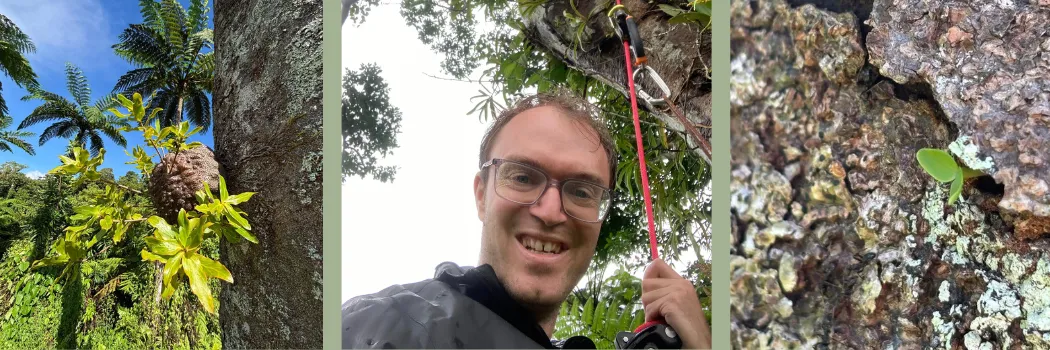
Professor Guillaume Chomicki from our Department of Biosciences has been awarded a prestigious Philip Leverhulme Prize for his internationally recognised research in evolutionary biology. The prizes, awarded by the Leverhulme Trust, recognise outstanding researchers whose work has already gained international recognition and whose future careers show exceptional promise. Guillaume conducts world-leading research into how partnerships between species evolve, persist and break down. He is particularly interested in why different species - such as insects and plants - form partnerships and what causes these relationships to change or break down. Partnerships over millions of years Much of Guillaume's work focuses on the Hydnophytinae, a group of around 100 plants that grow on the branches of rainforest trees across Australasia. They form swollen, hollow stems divided into chambers where ant colonies live. In return, the ants feed the plant with their waste and with the debris they carry home. Some of these plants rely on a single specialist ant, others accept many kinds, and some have given up ants altogether.
Quantifying controller preference reliability under uncertainty in a rotary inverted pendulum benchmark - Nature
We’re sharing this article early to provide faster access to peer-reviewed, accepted research. It is citable and carries a permanent DOI. This version is subject to further edits and will be replaced automatically by the final Version of Record. All legal disclaimers apply. AbstractSimulation-based controller comparisons can report a single winner even when score differences are too small to justify a unique engineering preference. We assessed preference reliability for five fixed controllers on a numerically verified nonlinear rotary inverted pendulum model using two independent Latin-hypercube realizations across matched ± 10%, ± 15%, and ± 20% uncertainty bands (30,000 closed-loop simulations). A four-metric score and a prespecified 5% practical margin quantified controller separation. Under the common uncertainty score, PID had the lowest controller robustness index in every band, but the four leading indices remained within 3.87%. In the pooled ± 15% domain, all ten paired comparisons were detectable after Holm correction, yet 69.40% of 2,000 scenario blocks lacked a unique practical preference.
High-content morphological profiling by Cell Painting in 3D spheroids - Nature
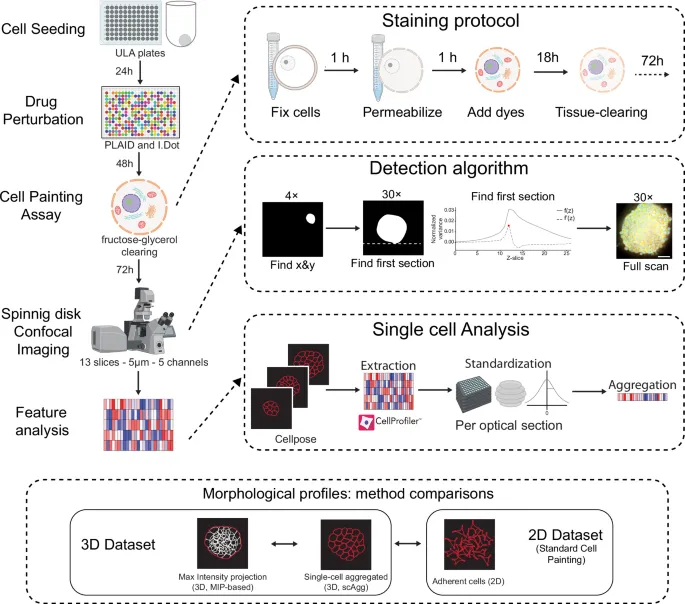
IntroductionPhenotypic profiling and cellular assays play important roles in early drug discovery, offering valuable insights that have helped uncover new disease mechanisms1,2. One approach is morphological profiling, where a large number of quantitative metrics (features) – such as cell size, shape, and texture – can be extracted from individual cells within images, creating a unique fingerprint for every given condition3,4. This shift towards large-scale morphological profiling or phenomics allows for the exploration of less-characterized phenotypes, thereby facilitating the discovery of novel disease biomarkers5,6,7. Cell Painting is a widely adopted standardized assay for morphological profiling of 2D monolayer cell cultures. By staining distinct cellular compartments and imaging in multiple channels, it enables the extraction of vast amounts of phenotypic information. This unbiased approach is powerful for predicting mechanisms of action8,9, identifying off-target effects10, and detecting phenotypes of environmental toxicants11,12.
Longitudinal ctDNA profiling reveals genomic risk and molecular response to bireociclib in advanced breast cancer - Nature
ORCID: orcid.org/0000-0003-1233-60816, Xinxin Tan7, Jing Bai2, Li Wang8, Xianghui Duan8, Fan Yang8, Jiayu Wang1 & … Binghe Xu We’re sharing this article early to provide faster access to peer-reviewed, accepted research. It is citable and carries a permanent DOI. This version is subject to further edits and will be replaced automatically by the final Version of Record. All legal disclaimers apply.
0 comments
No comments yet. Be the first to share your thoughts!