Documented preoperative statin exposure and short-term mortality after aortic valve replacement: a multicohort observational study - Nature
This story deserves to be shared
Send it to someone who'd care, or post it on your networks.
We’re sharing this article early to provide faster access to peer-reviewed, accepted research. It is citable and carries a permanent DOI. This version is subject to further edits and will be replaced automatically by the final Version of Record. All legal disclaimers apply.
AbstractWhether documented preoperative statin exposure is associated with short-term mortality after aortic valve replacement (AVR) is uncertain. This retrospective multicohort study included 5,291 AVR records from SNUH, MIMIC-IV, and eICU. The primary analysis compared no documented versus any documented statin exposure for recorded 30-day mortality in SNUH and MIMIC-IV using overlap weighting and fixed-effect pooling. Exposure-window, recorded 365-day, IPTW, and SNUH available-follow-up analyses were sensitivity analyses; eICU and agent-specific analyses were exploratory. Overlap-weighted 30-day risks with versus without documented exposure were 1.29% versus 2.55% in SNUH and 1.18% versus 2.36% in MIMIC-IV; the pooled HR was 2.01 (95% CI, 0.98 to 4.11; P = 0.056). A 1-day MIMIC-IV window reclassified seven records and, pooled with the SNUH 24-h definition, yielded an HR of 2.29 (95% CI, 1.14 to 4.61; P = 0.
This article is an excerpt. To read the full content, visit the original source. Nature
Related articles

Simple medical card game reduces preoperative anxiety in children - News-Medical
Preoperative anxiety affects about 60% of children and is linked with poorer cooperation at anesthesia induction, greater postoperative pain, and maladaptive behavioral changes. Structured play, role play, and medical-themed games can reduce anxiety and improve coping, but many proven approaches rely on digital platforms or virtual reality (VR), which can be costly and hard to implement in busy wards. Those tools may be difficult to adopt in routine practice because of cost, equipment requirements, and implementation burden, especially in busy hospital wards with limited staff and space. Given these challenges, further research is needed to evaluate scalable, low-cost, non-digital play interventions for children that can be delivered widely in routine pediatric surgical care. Researchers at Children's Hospital, Zhejiang University School of Medicine in China reported (DOI: 10.1007/s12519-026-01097-4) the trial online on 19 September 2026 in World Journal of Pediatrics. In the intervention, a trained nurse led a child-life-informed session on the evening before surgery, individually or in groups of up to three children, lasting 40 minutes.

Preoperative physical activity linked to lower delirium risk after surgery - News-Medical
Staying active before surgery may do more than strengthen the body for recovery - it may protect the brain. Regular physical activity at least seven times a week before cancer surgery was linked to a lower risk of developing postoperative delirium, according to research presented at the ANESTHESIOLOGY® 2026 annual meeting. Postoperative delirium is a sudden state of confusion that affects about 20% of patients undergoing surgery. It is especially common in older adults and can affect attention, memory and thinking. It is also linked to longer hospital stays, delayed recovery and increased risk of death.
Association of phubbing with fear of childbirth and early maternal–infant bonding: a prospective observational study - Nature
We’re sharing this article early to provide faster access to peer-reviewed, accepted research. It is citable and carries a permanent DOI. This version is subject to further edits and will be replaced automatically by the final Version of Record. All legal disclaimers apply. AbstractThis study aimed to evaluate the associations of phubbing with fear of childbirth and early maternal–infant bonding among term pregnant women who delivered vaginally. This single-center prospective observational study included 75 women with term pregnancies (37–42 weeks) who delivered vaginally. The Wijma Delivery Expectancy/Experience Questionnaire-A (W-DEQ A) and Generic Scale of Phubbing (GSP) were administered before active labor, and the Mother-to-Infant Bonding Scale (MIBS) was completed on postpartum day 2. MIBS items were recoded so that higher scores indicated more favorable bonding. Associations were assessed using Spearman correlation and multiple linear regression with heteroskedasticity-consistent HC3 standard errors. The mean age was 27.1 ± 4.3 years.
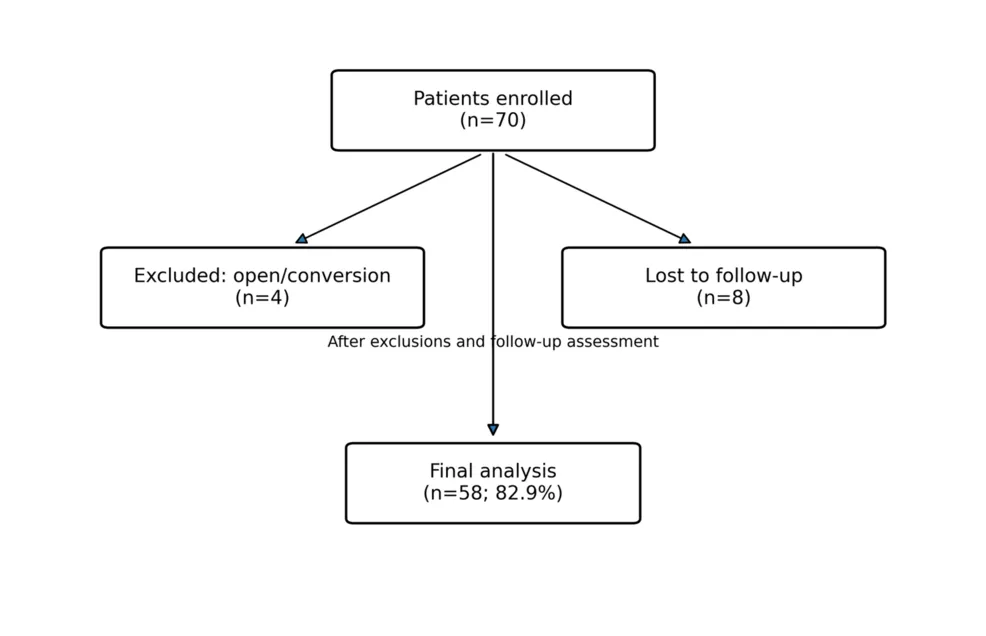
Persistence of Symptoms Following Laparoscopic Cholecystectomy for Symptomatic Cholelithiasis: A Prospective Observational Study - Cureus
Introduction: Laparoscopic cholecystectomy is the standard surgical treatment for symptomatic cholelithiasis, but a proportion of patients continue to experience abdominal or gastrointestinal symptoms after surgery. This study evaluated the frequency of persistent symptoms and the resolution pattern of individual gastrointestinal symptoms following laparoscopic cholecystectomy. Methods: This prospective longitudinal observational study was conducted at Pushpagiri Institute of Medical Sciences and Research Centre, Thiruvalla, Kerala. Eligible patients undergoing laparoscopic cholecystectomy for symptomatic cholelithiasis were prospectively enrolled and followed for one to six months after surgery through outpatient visits or telephone follow-up. Symptoms were recorded using a predefined structured proforma; no separate validated gastrointestinal symptom score was used. Of 70 enrolled patients, four who underwent open cholecystectomy were excluded, and eight were lost to follow-up, leaving 58 patients for final analysis. Paired preoperative and postoperative symptom status was compared using the exact McNemar test. Results: Among the 58 patients who completed follow-up, 39 were femal
0 comments
No comments yet. Be the first to share your thoughts!