Webb image reveals young stars brewing in a nebulous cauldron - Phys.org
This story deserves to be shared
Send it to someone who'd care, or post it on your networks.
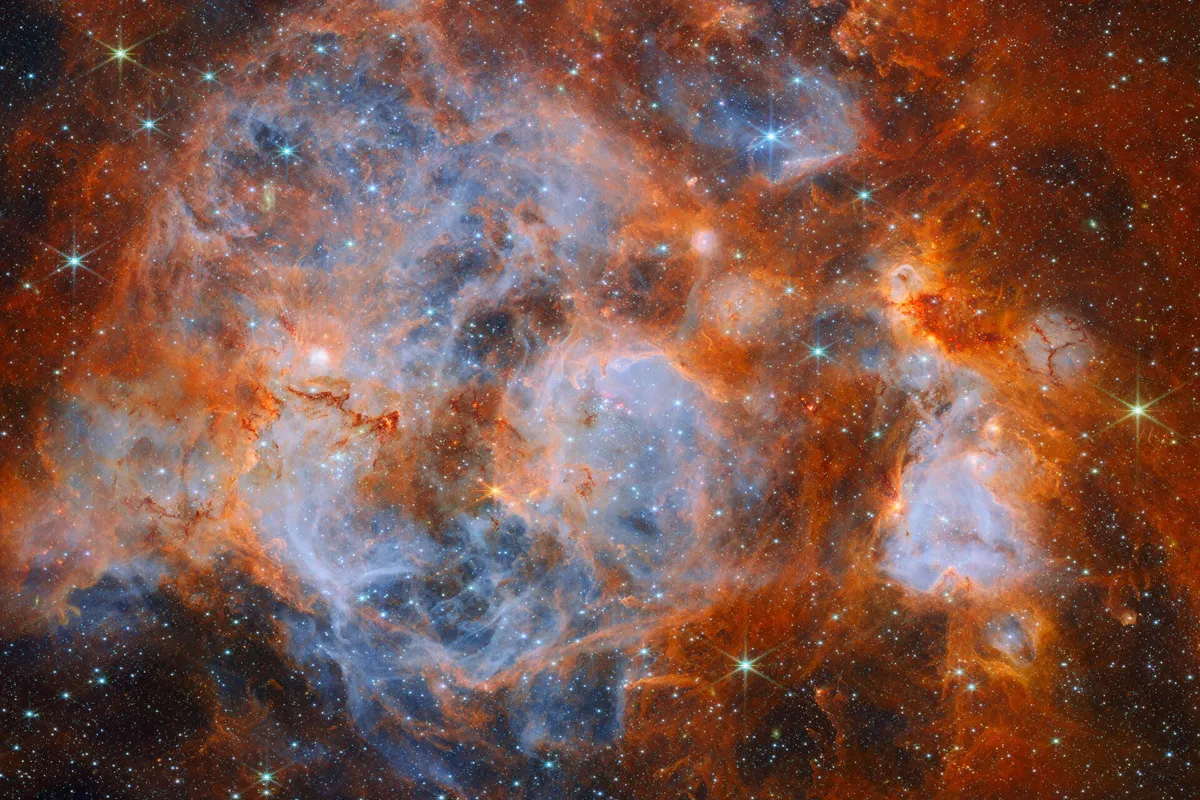
A nebula made of clouds of gas and dust with stars forming within. In the center and out to the left it is filled with thin, wispy blue gas that forms delicate layers. Around this are thicker orange clouds with dark ridges. Thin red filaments of gas cross the center of the nebula. Glowing bubbles in the gas contain dense, very bright clusters of stars. At the edges, distant stars are visible as bright points on a dark background. Credit: European Space Agency
In this Picture of the Month from the NASA/ESA James Webb Space Telescope, we visit a turbulent cauldron of star formation to see what is brewing inside dense clumps of gas. This is a star-forming region named LHA 120-N 159, or simply N159, located 161,000 light-years away in the Large Magellanic Cloud (LMC), one of the satellite galaxies orbiting the Milky Way galaxy. This image spans about 230 light-years across.
This article is an excerpt. To read the full content, visit the original source. Phys.org
Related articles

Ozone worsens other deadly health effects of globally generated wildfires - World Socialist Web Site
One of the very dangerous consequences of global warming is the growing incidence of wildfires. Not only do they cause extensive physical destruction, but they put huge quantities of smoke into the atmosphere, severely impacting human health. This pollution can travel long distances from the direct effects of such fires, as witnessed earlier this year in the northeastern US due to wildfire smoke originating in western Canada and the US. This smoke includes a witches’ brew of gases and particles that can have deleterious consequences for human health. Among these are small particles called PM2.5, which can penetrate lung tissue and cause respiratory and cardiovascular harm, including aggravated asthma, decreased lung function, heart attacks, strokes and increased premature mortality. This has been known for some time. A less well-known but also dangerous component of wildfire smoke is ozone, which is a highly reactive molecule composed of three oxygen atoms (O3), as opposed to naturally occurring two-atom oxygen—O2.
Cambridge Scientists Create $10 Wearable Medical Lab Chip - Mirage News
A new optical sensor costing just $10 could bring laboratory-level precision to wearable health monitors, potentially allowing people to track blood glucose without needles. The technology could also transform food testing, industrial quality control, and environmental monitoring. Researchers at the University of Cambridge and GlitterinTech (a start-up founded by the same research group) have developed a new type of optical spectrometer that combines exceptional accuracy with a remarkably small size and low cost. Measuring just centimeters across, the device could be incorporated into portable electronics and wearable health technology. Its potential applications range from monitoring important health markers in real time to identifying materials and detecting changes in chemical composition. Optical spectrometers work by analyzing light to reveal information about the substances it interacts with. They are essential tools in medicine, manufacturing, chemical testing, and environmental research. However, making these instruments smaller has traditionally meant compromising their performance.

Nearly 3,000 exploding stars challenge our understanding of the Universe - Science Daily
The largest collection of exploding white dwarf stars ever compiled is providing fresh evidence that dark energy, the mysterious force responsible for the Universe’s accelerating expansion, may change over time. The findings challenge a central assumption of modern cosmology and could help scientists better understand how the Universe evolves. An international research team led by scientists at the University of Queensland’s School of Mathematics and Physics brought together observations of 2,884 Type Ia supernovae. These powerful stellar explosions serve as important tools for measuring distances across the Universe, allowing astronomers to trace its expansion history.
Cambridge scientists create a $10 chip that could put a medical lab on your wrist - Science Daily
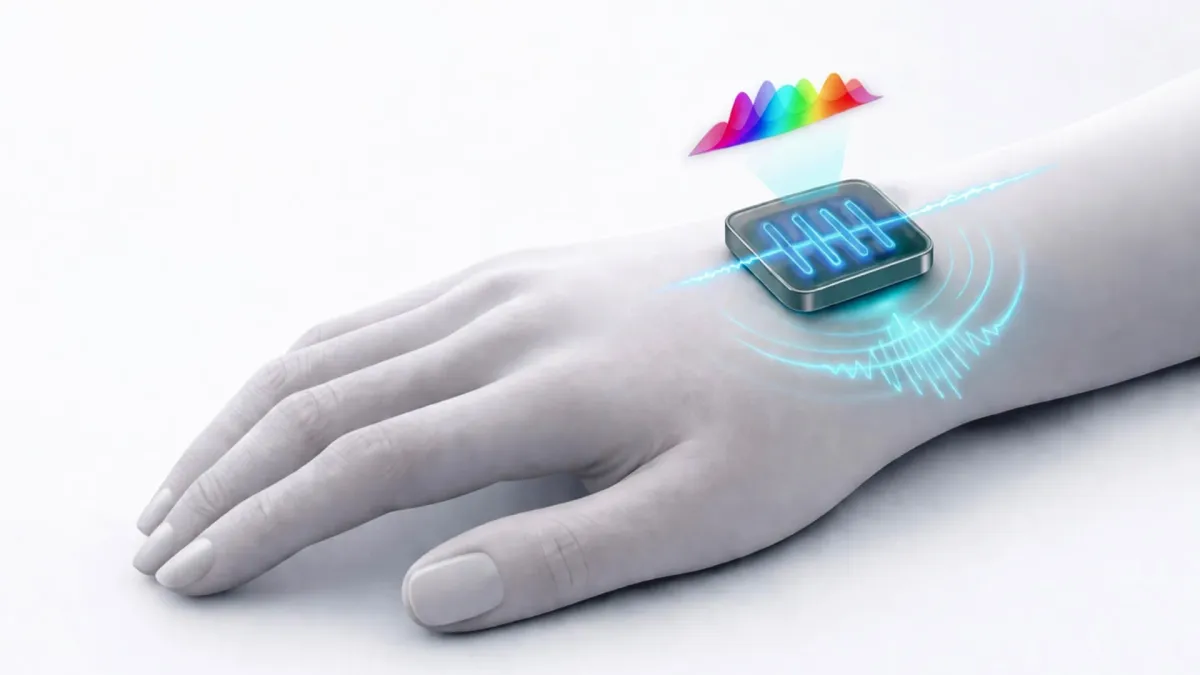
A new optical sensor costing just $10 could bring laboratory-level precision to wearable health monitors, potentially allowing people to track blood glucose without needles. The technology could also transform food testing, industrial quality control, and environmental monitoring. Researchers at the University of Cambridge and GlitterinTech (a start-up founded by the same research group) have developed a new type of optical spectrometer that combines exceptional accuracy with a remarkably small size and low cost. Measuring just centimeters across, the device could be incorporated into portable electronics and wearable health technology. Its potential applications range from monitoring important health markers in real time to identifying materials and detecting changes in chemical composition.
Autonomous triangular modules could build tomorrow's mega-observatories - Phys.org
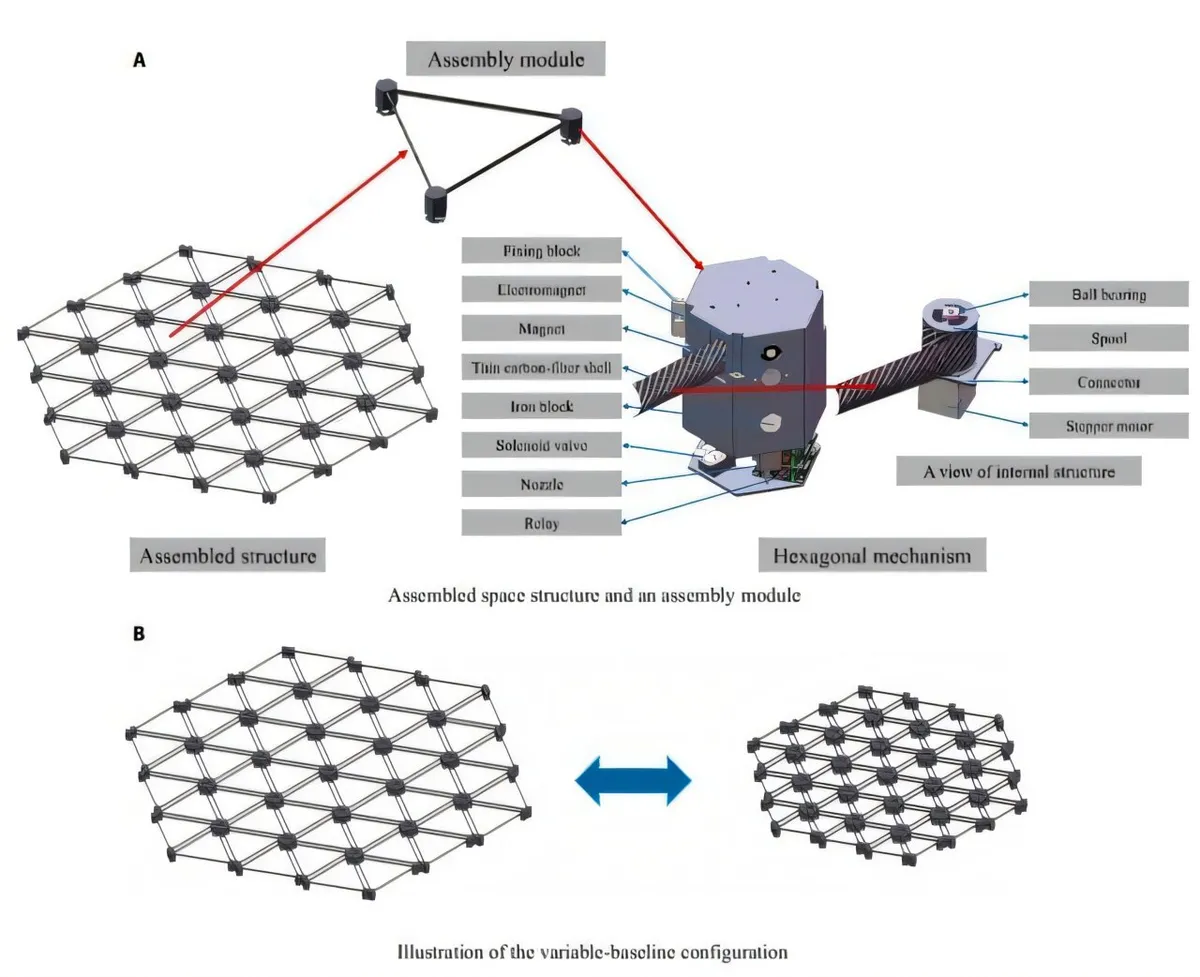
Private companies are getting better at launching more mass into space with larger rockets. But there is still a major constraint on the size of objects we can get into orbit—fairing size. This places physical constraints on the overall shape of what we can launch and severely limits the sizes of, say, a communications array or a power satellite. But a new paper from researchers at Nanjing University of Aeronautics and Astronautics and the Beijing Institute of Technology offers a solution—a self-shaping, deployable module that can fine-tune both its positioning and its own dimensions. The findings are published in the journal Space: Science & Technology. To understand how that offers an advantage, it's best to look at how engineers currently solve this problem. Typically, they use a rollable deployable boom—a stiff, thin strip of carbon fiber that can coil up like a tape measure, then unwind to snap straight once deployed in microgravity. The problem is that these systems almost never deploy perfectly in real environments, and when talking about snapping together multiple modules, even a few millimeters of error can cause the entire mission to fail.
0 comments
No comments yet. Be the first to share your thoughts!