Synthesizability, hardness, and stacking order in multicomponent transition metal carbides from machine-learned potentials - Nature
This story deserves to be shared
Send it to someone who'd care, or post it on your networks.
We’re sharing this article early to provide faster access to peer-reviewed, accepted research. It is citable and carries a permanent DOI. This version is subject to further edits and will be replaced automatically by the final Version of Record. All legal disclaimers apply.
AbstractMulticomponent transition metal carbides are promising for extreme-environment applications, but identifying compositions that are both synthesizable and hard remains challenging. We fine-tune the MACE machine-learned interatomic potential on approximately 28,000 density functional theory calculations spanning the composition space of groups 4–6 transition metals and carbon to predict the thermodynamic stability and elastic properties of multicomponent carbides. The fine-tuned model achieves formation energy errors of ~10 meV/atom for thermodynamically relevant structures with only 20% of the training data. We screen over 1500 equiatomic compositions across rocksalt, hexagonal, and hcp prototypes, combining free energy models with elasticity-based hardness surrogates. Synthesizability predictions at 1500 °C agree well with experimental reports for both single-phase and multiphase carbides.
This article is an excerpt. To read the full content, visit the original source. Nature
Related articles
HIP: Hessian Interatomic Potentials without derivatives - Nature
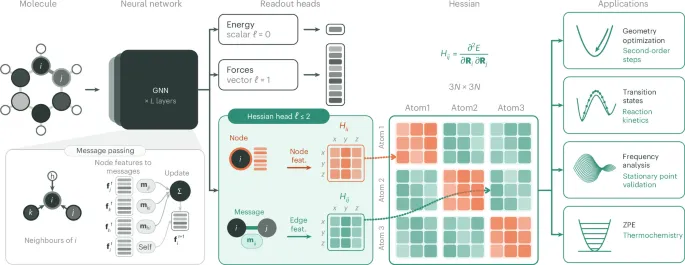
MainMolecular simulation is a cornerstone of material discovery and molecular design. While the prediction of energy and forces is often sufficient for structural dynamics, advanced computational chemistry workflows often depend on the molecular Hessian1,2. By describing the local curvature of the potential energy surface (PES), the Hessian is foundational to many computational workflows. Second-order geometry optimization relies on the curvature information to rapidly and reliably converge to equilibrium structures3. Transition state searches and extrema classification depend on the Hessian to correctly identify saddle points and reaction barriers, which are essential for parameterizing reaction rates and microkinetic models for longer time- and length-scale simulations4. Furthermore, mode-following transition state search methods directly leverage the curvature information to locate the transition states5. Finally, vibrational analysis uses Hessian eigenvalues to compute zero-point energy (ZPE) corrections and thermodynamic free energies bridging the gap from static molecules to nonzero temperature observables6.

Apple reveals iPhone Duo battery size, screen hardness details - Mashable
With the iPhone Duo launch imminent (and the device backordered until January), we're now getting concrete information from Apple regarding some specifications that were previously unconfirmed. Apple recently released an EU energy label for the company's first-ever foldable smartphone, and we now know just how big the iPhone Duo's battery is. The iPhone Duo will be equipped with a 4,883 mAh battery. This matches previous reports based on leaks that said the iPhone Duo would utilize two battery cells, one 2,962 mAh and one 1,921 mAh battery, which combined add up to 4,883 mAh. This means that the iPhone Duo will have a bigger battery than its closest foldable competitors, such as the Samsung Galaxy Z Fold 8 and Google Pixel 11 Pro Fold.
How enzymes locally block cell wall repair, allowing cells to fuse in an irreversible manner - Phys.org
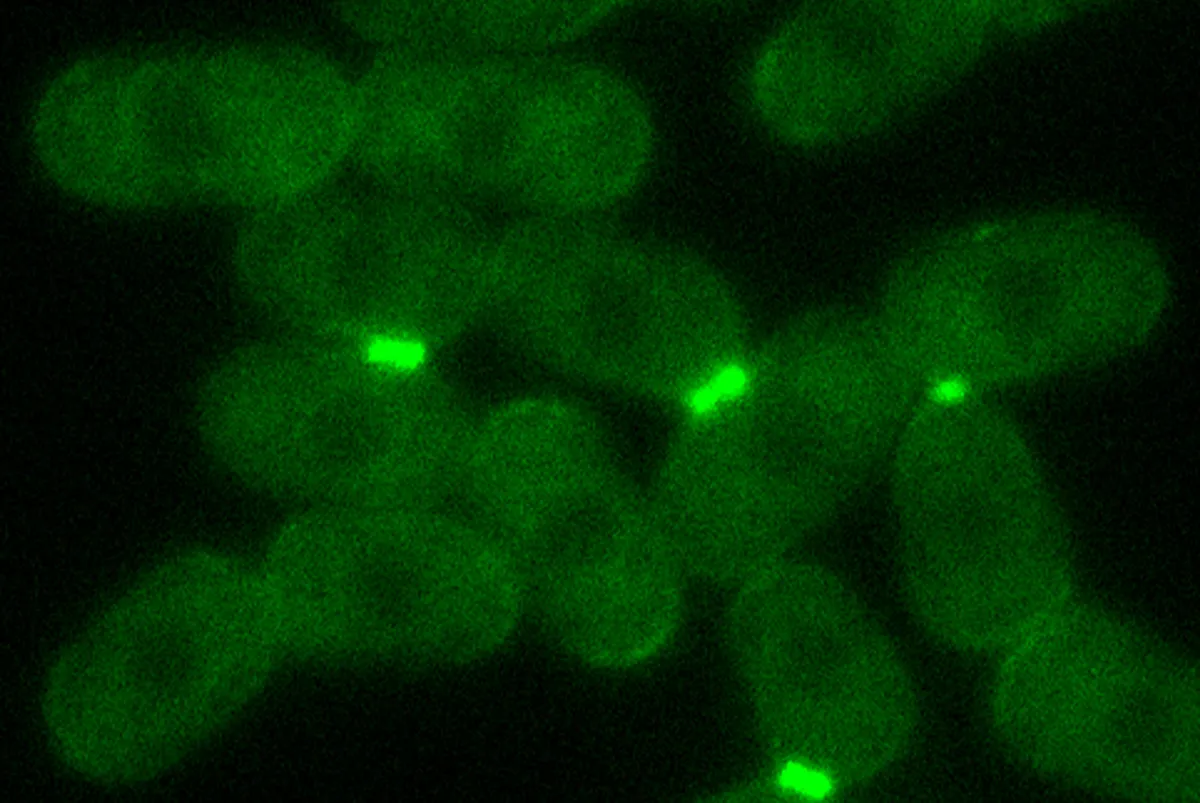
Yeast cells undergoing sexual reproduction, observed by fluorescence microscopy; the green signal reveals a cell wall damage sensor at the site of fusion. Credit: J. Coronas-Serna, UNIGE The fusion of two cells is a decisive event in the sexual reproduction of many organisms. In fungi, cells must not only bring their membranes together and merge them, but also locally open their protective cell wall.
0 comments
No comments yet. Be the first to share your thoughts!