Suspicious Citation Counts Flag Possible Paper Mill Slop - Mirage News
This story deserves to be shared
Send it to someone who'd care, or post it on your networks.
The likely manipulation of citation numbers by research paper mills in high-impact cancer journals has been uncovered by an international team of academic researchers.
Analysis of 33,159 cancer journal articles discerned tell-tale patterns of fake citation numbers in 4000 paper mill articles.
This article is an excerpt. To read the full content, visit the original source. Mirage News
Related articles

'It's where you're balding that counts': What your hairline can reveal about your health - BBC Science Focus Magazine
There are few things more common, or more quietly dreaded, than a receding hairline. Up to 80 per cent of men experience some degree of male pattern baldness over their lifetimes. It’s so normal that we barely count it as a medical event at all – just one of the standard-issue indignities of getting older, filed somewhere between reading glasses and a dodgy knee.
Planetary Scientists Create Classification System and Map of Martian Soils - Sci.News
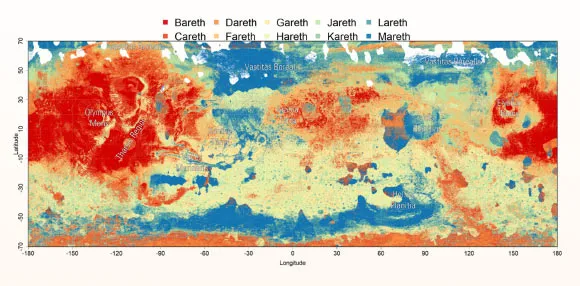
Planetary researchers at the University of Sydney have proposed a new way to classify the soils of Mars, along with a new word for them: areth (the name comes from Ares, the Greek name for Mars). Classification of realms across the Martian surface. Image credit: McBratney et al., doi: 10.1016/j.catena.2026.110649.
Spatially resolved host and microbiota RNA profiling in the mouse gut using microDBiT - Nature
AcknowledgementsThe authors thank the Yale Department of Pathology and Yale Pathology Tissue Services for technical and tissue-related support. FundingThe research is supported by Maximizing Investigators Research Award (MIRA) for Early-Stage Investigators 1R35GM150838 (to Y. L.). The research is also supported, in part, by Grant #IRG-21-132-60-IRG from the American Cancer Society. We also acknowledge the support of Leslie H. Warner Postdoctoral Fellowship to D. W. Author informationAuthor notesThese authors contributed equally: Bo Tao, Deguang Song, Mingze Dong, Gaocai Li. Authors and AffiliationsDepartment of Pathology, Yale School of Medicine, New Haven, CT, USABo Tao, Mingze Dong, Gaocai Li, Shenjie Wang, Dejiang Wang, Xiangjun Di, Fu Gao, Liyun Lin, Xiaohui Yu, Junyi Xu, Mo Liu, Mariana Kelley, Anthony Y. Feng, Yu Jin, Yuval Kluger & Yang LiuDepartment of Neurology, Yale School of Medicine, New Haven, CT, USABo Tao, Gaocai Li, Shenjie Wang, Dejiang Wang, Xiangjun Di, Fu Gao, Liyun Lin, Xiaohui Yu, Mariana Kelley & Yang LiuDepartment of Immunobiology, Yale School of Medicine, New Haven, CT, USADeguang Song & Noah W.
Algae fossils from Cambrian explosion hint at sophisticated reproductive system - Phys.org
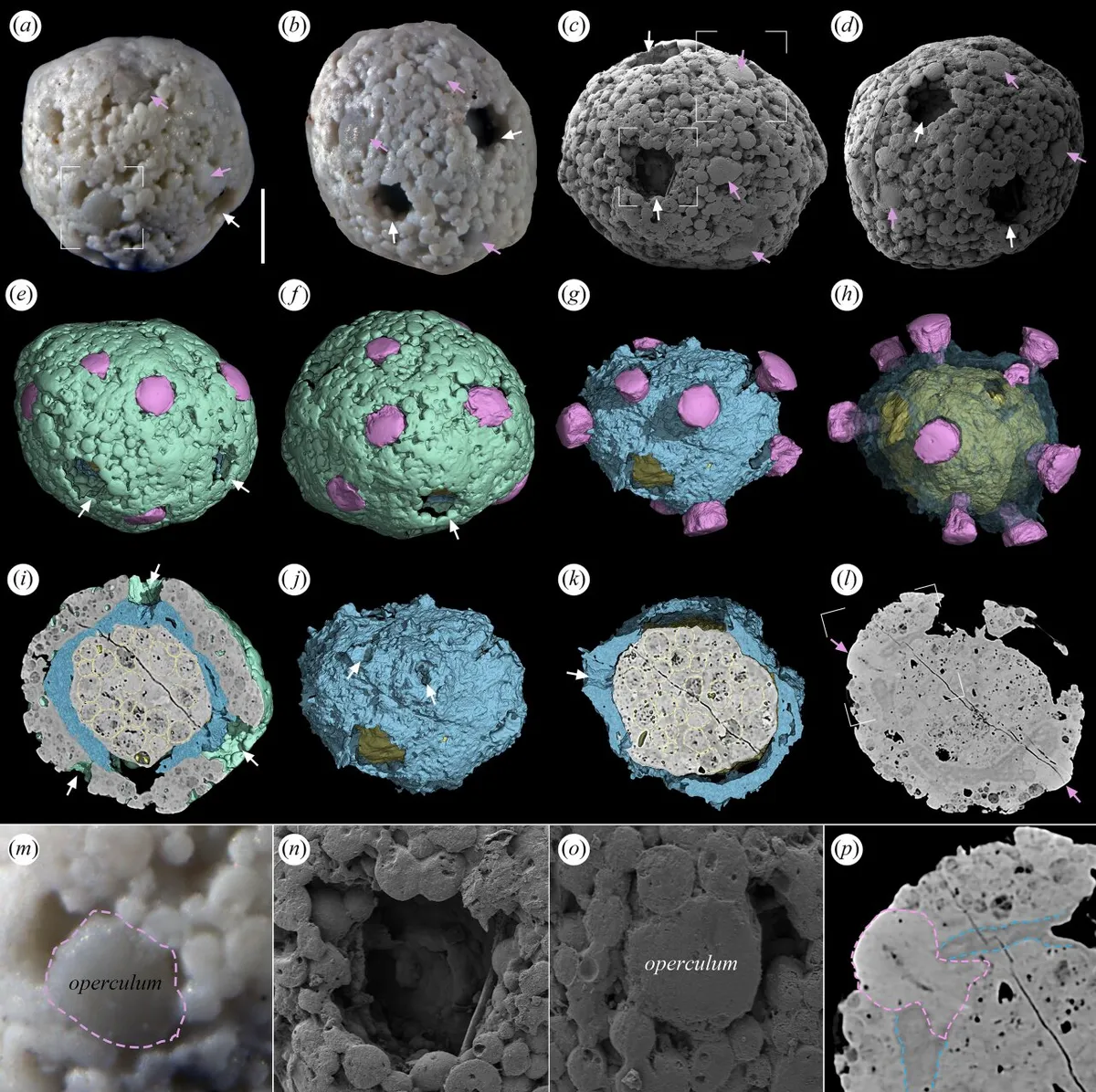
The holotype of Polyostiosphaera operculata gen. et sp. nov. from the early Cambrian Kuanchuanpu Biota (NIGP210977). (a, b) Light microscopy images. (c, d) Scanning electron microscopy images. (e–g, j) Surface renderings; the outer envelope, plug-like opercula, membrane and inner body are indicated by green, pink, blue and yellow, respectively. (h) Transparent model showing the inner body. (i, k) Virtual three-dimensional sections of (f) and (j), respectively. (l) Virtual slice of (f). (m) Close-up view of (a). (n, o) Close-up views of (c). (p) Close-up view of (l), showing the spatial relationships among the plug-like opercula, outer envelope, membrane and internal cells. White arrows, apertures; pink arrows, plug-like opercula. Yellow, blue and pink outline internal cells, the membrane and plug-like opercula, respectively. Scale bars: (a–i, l) 200 μm, (j, k) 180 μm, (m) 66 μm, (n) 60 μm, (o) 64 μm, (p) 37 μm. Credit: Chen et al. (Proceedings of the Royal Society B, 2026). The Cambrian explosion was a major diversification of animal life that unfolded early in the Cambrian period, which began around 538.8 million years ago.
0 comments
No comments yet. Be the first to share your thoughts!