Risk assessment of insulator contamination in thermal power plants by integrating dynamic physical priors and spatiotemporal heterogeneous graphs - Nature
This story deserves to be shared
Send it to someone who'd care, or post it on your networks.
We’re sharing this article early to provide faster access to peer-reviewed, accepted research. It is citable and carries a permanent DOI. This version is subject to further edits and will be replaced automatically by the final Version of Record. All legal disclaimers apply.
AbstractTo address the problem of predicting insulator fouling risks at thermal power plants resulting from the combined effects of various source-side facilities and meteorological conditions, we propose the Causal-STHGN model. This spatiotemporal heterogeneous graph model integrates dynamic physical priors. This paper first constructs a semantic graph of power plant entities. Source-side facility nodes are mapped to insulator monitoring points as heterogeneous nodes. Then, by integrating spatial geometric relationships, wind field directionality, source-side state characteristics, and moisture condition modulation, the model calculates dynamic physical causal priors and edge-weight priors. Furthermore, it constrains spatial dependency learning through a prior-bias graph attention mechanism. A parallel temporal structure is employed to jointly model short-term disturbances and long-term evolutionary trends.
This article is an excerpt. To read the full content, visit the original source. Nature
Related articles
Self-selected motion of overlaid droplets on heterogeneous surfaces via competitive wetting - Nature
We’re sharing this article early to provide faster access to peer-reviewed, accepted research. It is citable and carries a permanent DOI. This version is subject to further edits and will be replaced automatically by the final Version of Record. All legal disclaimers apply. AbstractDroplets would move following the designed wettability gradient on the surface, toward the position with high surface energy, which is vital for various applications like ink printing, biological detection, and water collection. Anomalously, here we have found that the core of the overlaid droplet shows anti-wettability-gradient movement on the wettability boundary. The core droplet would perform different directional motions after the impact on the same established surface, depending on the impact dynamics and the composition ratio of the overlaid droplet. The macroscopic motion preference of the overlaid droplet is related to the wetting preference of the overlayer on the heterogeneous surface. Competitive wetting/dewetting of different components of the overlayer droplet induces a special shuttle motion of the core droplet.
Spatiotemporal remodeling in habenula marks the onset of depression-related phenotypes - Nature
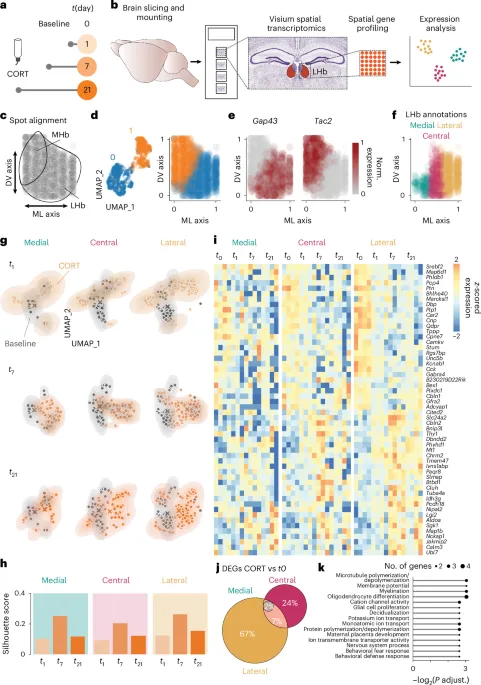
MainDepression is characterized by alternating episodes of persistent low mood and diminished coping capacity, interspersed with periods of apparent wellness1. Although antidepressant treatments are available, they are effective in only a fraction of individuals, partly due to challenges in timely diagnosis and treatment initiation2,3,4,5. This requires an understanding of the trajectories of the depressive state and their underlying mechanisms to ultimately tailor therapies within defined temporal windows6,7,8. In humans, repeated exposure to stressful events and the consequent prolonged elevation of stress mediators (for example, cortisol) can lead to the emergence of depressive episodes9,10,11. Similarly, in rodents, paradigms that chronically elevate stress hormones, including protracted restraint, social defeat or administration of corticosterone (CORT)8,12,13, recapitulate core behavioral features of human depression13,14,15. However, most research has focused on the consequences of prolonged stress exposure only at a late timepoint.
Multiplexed sensor arrays for high-spatiotemporal decoding of complex physiological networks - Nature
We’re sharing this article early to provide faster access to peer-reviewed, accepted research. It is citable and carries a permanent DOI. This version is subject to further edits and will be replaced automatically by the final Version of Record. All legal disclaimers apply. AbstractMultiplexed sensor arrays expand biomedical interfaces by allowing independently recoverable sensing sources to share limited transmission, addressing, readout, acquisition, and computational resources. This Review compares time-, frequency-, spatial-, optical-, code-, and hybrid-multiplexing through a requirement–resource framework. We examine how signal integrity, front-end electronics, calibration, materials, mechanics, power, and data handling constrain source-specific recovery and outline architecture-selection principles for reliable physiological sensing and bidirectional biointerfaces.
Spatiotemporal terahertz emission nanoscopy of spintronic photocurrent | Light: Science & Applications - Nature
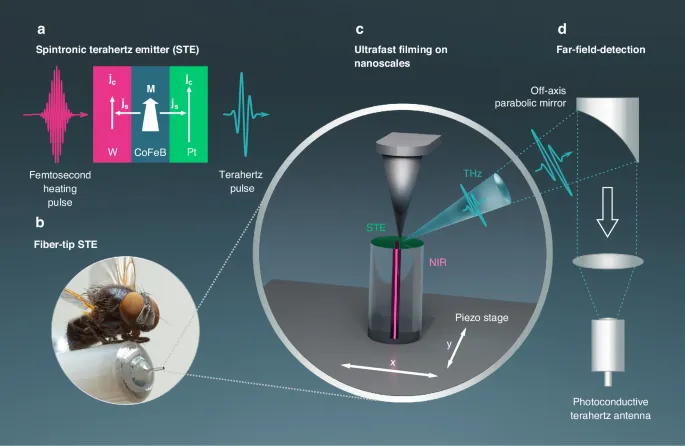
IntroductionGaining a detailed understanding of ultrafast charge and spin currents is vital for the development of next-generation technologies, from highly efficient solar cells and optimized light-driven chemical reactions to terahertz (THz) data-processing devices1,2,3. In this context, the femtosecond (fs) time and nanometer (nm) length scales are of particular importance. These spatiotemporal scales not only match the dimensions of modern electronic and spin-orbitronic devices that are envisioned to operate at ultrafast THz rates but also coincide with the native ranges that govern the relaxation of electronic systems in terms of energy, as well as linear and angular momentum4. Despite this, experimental approaches that combine such resolutions are scarce5, often providing only indirect insights through experimentally demanding setups6,7,8. Consequently, there is an urgent need for probes capable of simultaneously capturing fs charge and spin transport at the nanoscale9. An established tool to measure ultrafast spin and charge photocurrents with fs time resolution is far-field THz-emission spectroscopy (TES)10.
Multi-spatiotemporal projection enables single-shot ultrafast compressed imaging - Nature
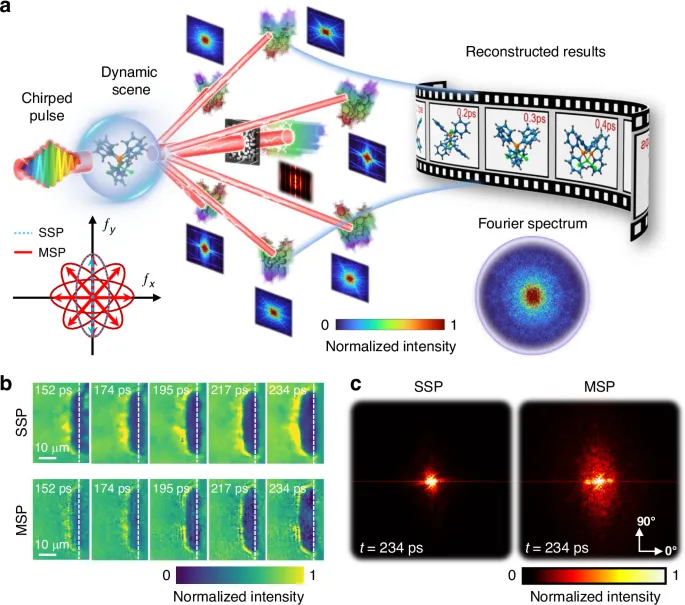
Ultrafast imaging technology plays a pivotal role in observing transient events across physics, biology, and materials science, as well as in unraveling their underlying mechanisms1. Although traditional multi-shot pump-probe techniques can achieve extremely high spatiotemporal resolutions, they rely on repetitive measurements and are applicable only to reproducible phenomena2. To capture non-repeatable or difficult-to-reproduce transient processes, single-shot ultrafast imaging technologies have emerged and rapidly evolved3. Among existing approaches, a notable technique is single-shot compressed streak imaging, which synergizes compressed sensing with streak imaging to record transient events in a single exposure with extraordinary imaging speed of up to hundreds of trillions of frames per second and a sequence depth of hundreds of frames4,5,6,7,8,9,10,11. Despite its blooming development, existing single-shot compressed streak imaging systems are still limited by anisotropy in spatial resolution.
0 comments
No comments yet. Be the first to share your thoughts!