RIKEN Demonstrates High-Fidelity Simultaneous Control of Silicon Spin Qubits Above 99.9% Threshold - Quantum Computing Report
This story deserves to be shared
Send it to someone who'd care, or post it on your networks.
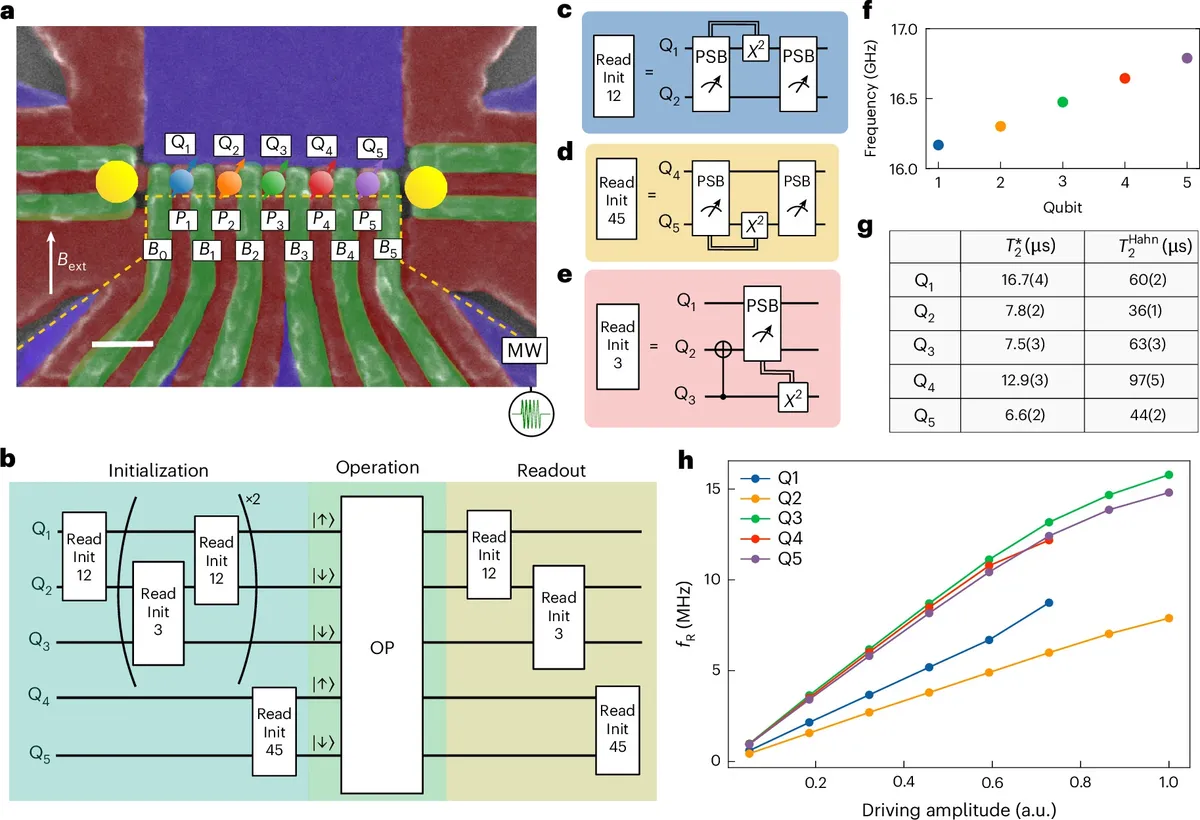
In a study published in Nature Physics, researchers from RIKEN, National Taiwan University, ETH Zurich, and TU Delft have demonstrated simultaneous high-fidelity single-qubit operations across a five-qubit silicon (28Si/SiGe) quantum dot array using a single, shared microwave control line.
Detailed in the paper (“Simultaneous high-fidelity single-qubit gates in a spin qubit array“, the team identified AC-Stark shifts as the main source of parallel drive crosstalk and introduced an N(N-1) pairwise calibration protocol that preserves gate fidelities above 99.9% during simultaneous 5-qubit operation.
This article is an excerpt. To read the full content, visit the original source. Quantum Computing Report
Related articles

Astronomers identify 2% threshold for delayed black hole jets — ScienceDaily - UA.NEWS
Astronomers have found that supermassive black holes can launch delayed jets of matter when their rate of matter accretion falls to about 2% of the Eddington limit. The same relative threshold was previously associated with jet formation in much smaller black holes in the Milky Way, ScienceDaily reports. The study’s results were published in Nature Astronomy. The work was led by astrophysicist Adele Goodwin of the Curtin University node of the International Centre for Radio Astronomy Research, together with Andrew Mummery of the Institute for Advanced Study in Princeton. The scientists studied why, after a star is destroyed by a supermassive black hole, a radio jet sometimes appears almost immediately and sometimes only months or years later. Data on stellar disruptionsThe researchers analyzed 20 tidal disruption events — phenomena in which a star passes too close to a supermassive black hole and is torn apart by its gravity. Part of the stellar debris falls into the black hole, temporarily increasing its feeding rate. More current news is available on the UA. News Telegram channel Telegram.
0 comments
No comments yet. Be the first to share your thoughts!