Prioritizing heat stress indices for cognitive performance assessment using a Fuzzy Delphi–FAHP framework - Nature
This story deserves to be shared
Send it to someone who'd care, or post it on your networks.
We’re sharing this article early to provide faster access to peer-reviewed, accepted research. It is citable and carries a permanent DOI. This version is subject to further edits and will be replaced automatically by the final Version of Record. All legal disclaimers apply.
AbstractOccupational heat exposure induces physiological strain and can impair cognitive performance, exacerbating occupational error and accident risks. Although numerous heat stress indices exist, their theoretical and practical suitability for cognitive-related assessments remains ambiguous. This study established a structured multicriteria decision-making framework integrating the Fuzzy Delphi Method (FDM) and Fuzzy Analytic Hierarchy Process (FAHP) to prioritize candidate heat stress indices for occupational cognitive risk evaluation. Candidate indices and screening criteria identified via literature review and expert consensus (\(n=25\)) were evaluated using FDM, followed by FAHP with Chang’s extent analysis to derive criteria weights and overall index priorities. A one-at-a-time \(+10\%\) sensitivity analysis was performed to verify model stability.
This article is an excerpt. To read the full content, visit the original source. Nature
Related articles
Development of a transparent reporting tool for AI-based diagnostic prediction models of disease and syndrome in Chinese medicine (TRAPODS-CM): a Delphi study - Nature
Jieyun Li1,2,3,4 na1, Wei Song Seetoh5 na1, Jiekee Lim1,2, Xin’ang Xiao1,2, Cuncun Lu6, Kehu Yang7,8, Si Yong Yeo9,10,11, Boyun Sun5,12, Wen Jiao13, Jinhua Liu9,10,11, Zhaoxia Xu1,2, Jiahui Lu3,4 & … Linda Zhong5 We’re sharing this article early to provide faster access to peer-reviewed, accepted research. It is citable and carries a permanent DOI. This version is subject to further edits and will be replaced automatically by the final Version of Record. All legal disclaimers apply.
Transient response of a cylindrical cavity in three-dimensional elastic space under impact loading: an analytical solution - Nature
Appendix$$ E_{1} = \left( {\lambda k_{1}^{2} - \lambda \gamma^{2} } \right)K_{n} (k_{1} r) + \left( {2\mu k_{1}^{2} + \frac{{2\mu n^{2} }}{{r^{2} }} - \frac{2\mu n}{{r^{2} }}} \right)K_{n} (k_{1} r) + \frac{{2\mu k_{1} }}{r}K_{n + 1} (k_{1} r) $$$$ E_{2} = \left( {\frac{ - 2\mu n}{{r^{2} }} + \frac{{2\mu n^{2} }}{{r^{2} }}} \right)K_{n} (k_{2} r) - \frac{{2\mu nk_{2} }}{r}K_{n + 1} (k_{2} r) $$$$ E_{3} = \left( {2\mu \lambda k_{2}^{2} + \frac{{2\mu n^{2} \lambda }}{{r^{2} }} - \frac{2\mu n\lambda }{{r^{2} }}} \right)K_{n} (k_{2} r) + \frac{{2\mu \lambda k_{2} }}{r}K_{n + 1} (k_{2} r) $$$$ E_{4} = \left( { - \lambda k_{1}^{2} + \lambda \gamma^{2} } \right)K_{n} (k_{1} r) - \left( {2\mu k_{1}^{2} + \frac{{2\mu n^{2} }}{{r^{2} }} - \frac{2\mu n}{{r^{2} }}} \right)K_{n} (k_{1} r) - \frac{{2\mu k_{1} }}{r}K_{n + 1} (k_{1} r) $$$$ E_{5} = \left( {\frac{2\mu n}{{r^{2} }} - \frac{{2\mu n^{2} }}{{r^{2} }}} \right)K_{n} (k_{2} r) + \frac{{2\mu nk_{2} }}{r}K_{n + 1} (k_{2} r) $$$$ E_{6} = \left( { - 2\mu \lambda k_{2}^{2} - \frac{{2\mu n^{2} \lambda }}{{r^{2} }} + \frac{2\mu n\lambda }{{r^{2} }}} \right)K_{n} (k_{2} r) - \frac{{2\mu \lambda k_{2} }}{r}K_{n + 1} (k_{2} r) $$$$ E_{7} = \left(
NIST-Developed Quantum Sensors Improve Nuclear Monitoring - In Compliance Magazine
Baby manta rays hunker down close to coasts before facing the open ocean's dangers - Phys.org
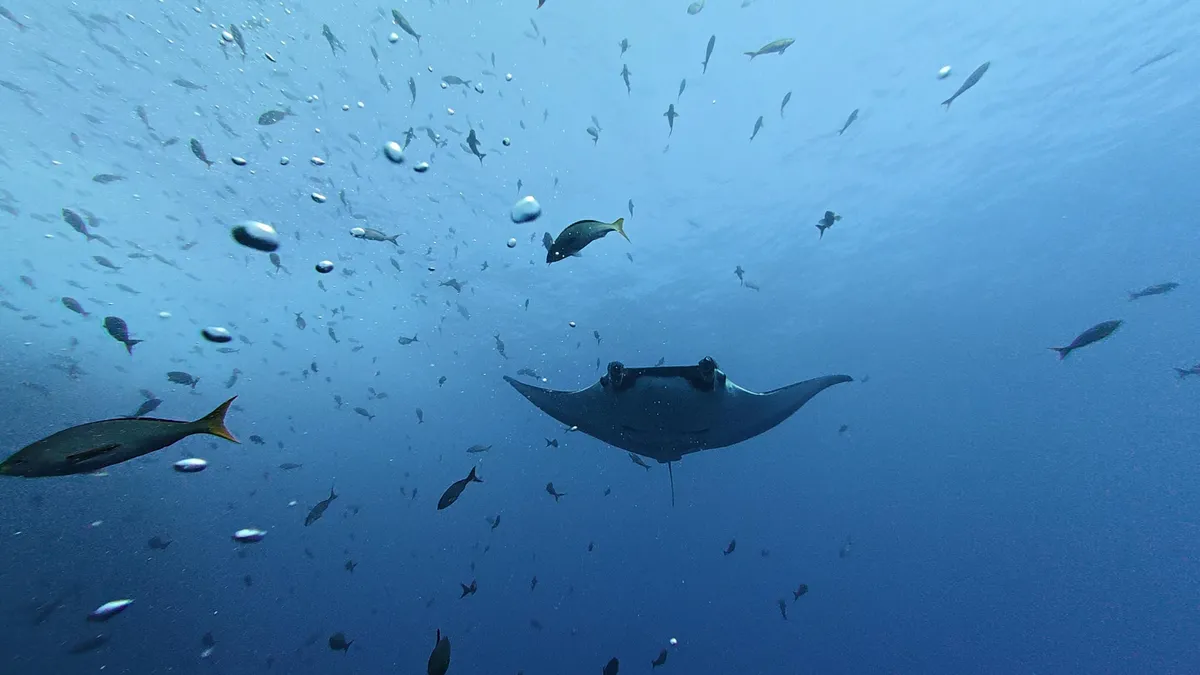
One of the manta rays tracked in the study. Credit: Jeffry Madrigal Giant manta rays can grow up to nine meters (30 feet) long with a disk size of seven meters (23 feet) across and weigh up to 2,000 kg (4,400 pounds). This size leaves them with very few natural enemies once they reach adulthood at around eight to 10 years old. But giant manta ray babies, called pups, cannot rely on their size to protect them from predators that live in the open ocean, including several species of shark and orcas.
Canada-France-Hawaiʻi Telescope discovers more than 2,100 previously unknown galaxies - Maui Now
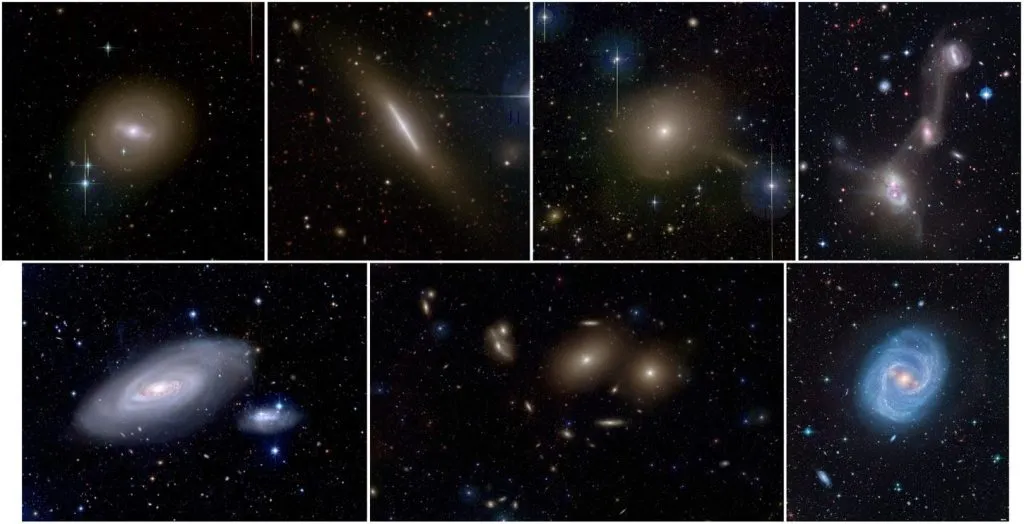
Virgo Cluster galaxies captured by the Next Generation Virgo Cluster Survey. Images: NGVS Team, CFHT, Jean-Charles Cuillandre and Giovanni Anselmi (Coelum). Astronomers using the Canada-France-Hawaiʻi Telescope have identified more than 2,100 previously unknown galaxies in the Virgo Cluster, more than doubling its known galaxy population.
0 comments
No comments yet. Be the first to share your thoughts!