Photometric and Spectroscopic Observations of Comet 2P/Encke's Nucleus in the Mid-Infrared Wavelength Region - Astrobiology Web
This story deserves to be shared
Send it to someone who'd care, or post it on your networks.
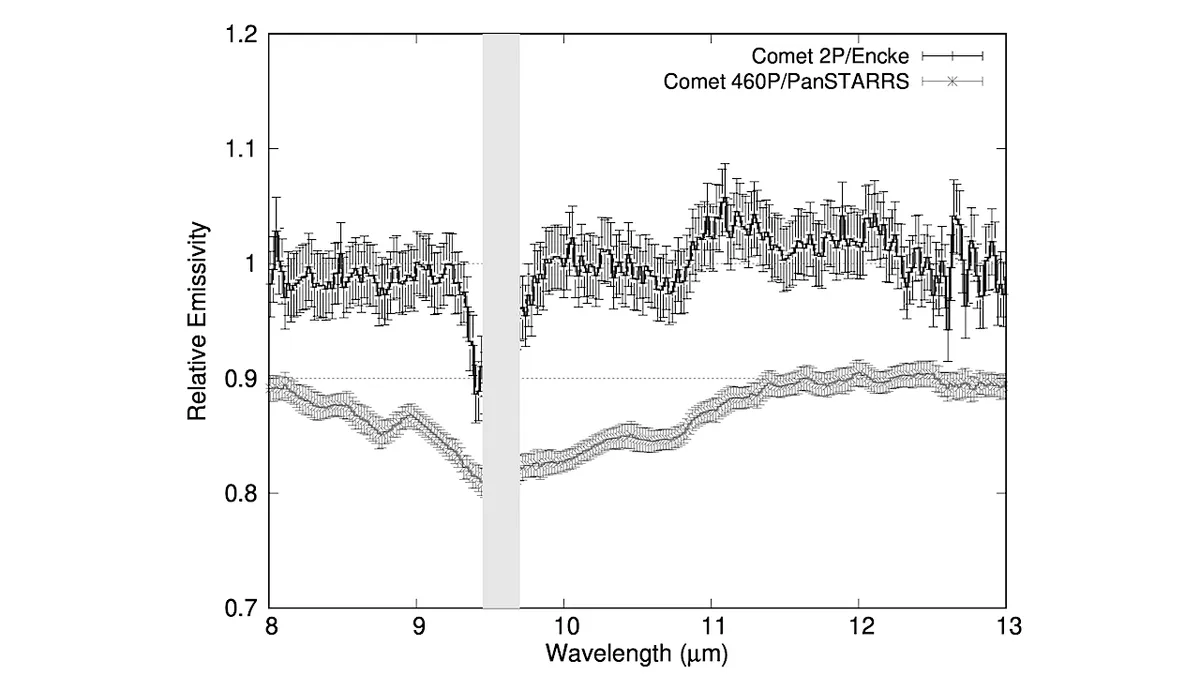
Relative emissivity spectrum of 2P/Encke’s nucleus obtained by the COMICS observations, in comparison with that of 460P/PanSTARRS (T. Ootsubo et al. 2021). The spectrum of 460P/PanSTARRS (in grey) is shifted by 0.1 for the readability. The grey hatched area is the wavelength region influenced by the telluric ozone absorption. -- [astro-ph. EP]
[astro-ph. EP] We observed comet 2P/Encke with the Cooled Mid-Infrared Camera and Spectrometer (COMICS) on the Subaru telescope on UT 2003 November 12.3, when the comet was at heliocentric and geocentric distances of 1.09 and 0.27 au, respectively.
This article is an excerpt. To read the full content, visit the original source. Astrobiology Web
Related articles
Sub-micron IR spectroscopic imaging for cellular and biomolecular research - News-Medical
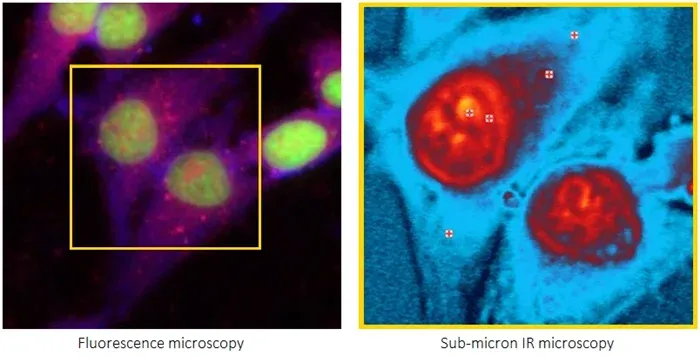
Submicron IR microscopy is opening new opportunities in biological sciences with the development of a new technique: optical photothermal infrared (O-PTIR) spectroscopy. Developments in life sciences research are playing an increasingly important role in global health, and advancements in technology have the potential to offer new and improved approaches to support the health and wellbeing of people worldwide.

PRIMA far-infrared survey mission: French expertise serving world science - Centre national d'études spatiales (CNES)
While space-based astronomy is bringing new insights into our universe every day, there are still places that remain shrouded in mystery. Among these are the very cold objects visible in the far-infrared portion of the spectrum, like newly forming planets or the interstellar medium, but invisible to the naked eye. It is precisely to better understand how these systems evolve that NASA has selected PRIMA (PRobe far-Infrared Mission for Astrophysics). The mission’s European partners, coordinated from CNES by Olivier La Marle, Head of Universe Sciences, and Florent Canourgues, Project Lead for phase A of the French contribution and PRIMAger Project Manager, are supplying two complementary instruments, one of which is PRIMAger, an innovative cooled thermal camera.
Waterloo Infrared Free Electron Laser Facility - University of Waterloo
A comprehensive transcriptome and metabolome dataset for Erigeron breviscapus (Asteraceae) response to different light intensities - Nature
We’re sharing this article early to provide faster access to peer-reviewed, accepted research. It is citable and carries a permanent DOI. This version is subject to further edits and will be replaced automatically by the final Version of Record. All legal disclaimers apply. AbstractErigeron breviscapus is a widely utilized medicinal herb in traditional Chinese medicine, characterized by high annual demand and notable pharmacological activities. Light intensity is a critical environmental factor influencing secondary metabolism in medicinal plants. However, the effects of light intensity on the accumulation of active ingredients in E. breviscapus remain largely unexplored. In this study, we examined the transcriptomic and metabolomic responses of E. breviscapus to five levels of light intensity (50, 100, 200, 400, 800 μmol·m−2·s−1). The results revealed that higher light intensity (EB-L800) significantly increased the accumulation of scutellarin, chlorogenic acid, isochlorogenic acid A, and isochlorogenic acid C. A total of 1,334 metabolites were detected, and 127.10 Gb of high-quality clean data were generated through transcriptomic sequencing.
0 comments
No comments yet. Be the first to share your thoughts!