Integrated stimulation technology for ultra deep tight sandstone gas reservoirs with ultra low permeability in Sichuan Xujiahe formation - Nature
This story deserves to be shared
Send it to someone who'd care, or post it on your networks.
This article is an excerpt. To read the full content, visit the original source. Nature
Related articles
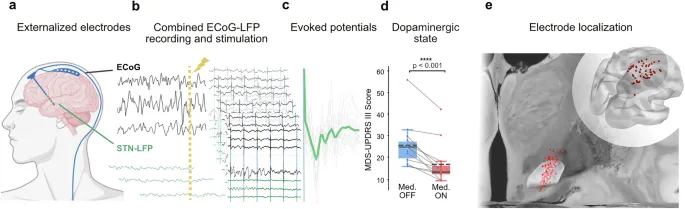
Dopamine amplifies subthalamic long-latency responses to cortical stimulation in patients with Parkinson’s disease - Nature
IntroductionParkinson’s disease (PD) is the most rapidly expanding neurodegenerative condition1,2, characterized by the progressive degeneration of dopaminergic neurons within the substantia nigra3. Dopamine replacement therapy with levodopa, together with high-frequency deep brain stimulation (DBS) of the subthalamic nucleus (STN), remain the most effective interventions for alleviating PD-related motor symptoms4,5. Yet despite their widespread clinical use, the neural circuit mechanisms through which these treatments exert their therapeutic effects are still not fully understood6. One of the proposed target circuits of STN-DBS is the monosynaptic cortico-subthalamic hyperdirect pathway, which has been implicated in rapid movement cancellation, in the emergence of pathological synchronization, and as a key substrate through which STN-DBS may influence network dynamics7,8,9,10. Although computational models and animal experiments have highlighted the importance of this pathway11,12,13, direct causal evidence for how dopaminergic state shapes hyperdirect STN excitation in humans remains scarce9,14.

AI-based hologram technology to advance multi-focal brain stimulation - healthcare-in-europe.com
Simulation of multi-focal ultrasound stimulation based on a human skull modelImage source: DGIST DGIST and GIST achieve multi-site brain stimulation using a single ultrasound transducer and demonstrate improvements in neuropathic pain
Permeability heterogeneity controls fluid migration and microseismicity evolution in The Geysers geothermal field, California - Nature
We’re sharing this article early to provide faster access to peer-reviewed, accepted research. It is citable and carries a permanent DOI. This version is subject to further edits and will be replaced automatically by the final Version of Record. All legal disclaimers apply. AbstractFracture networks directly govern the efficiency of geothermal energy extraction and play a critical role in fluid migration and microearthquake generation. Using deep learning and Markov clustering, we build a high-resolution microseismic catalog covering the past decade for The Geysers geothermal field, California. Our observations reveal distinctive clustering patterns and inferred fracture systems tightly correlated with injection operations. Source mechanism analyses and pore pressure simulations indicate that the inferred connected fracture network provides pathways for rapid and directional pore pressure diffusion, highlighting that heterogeneous permeability controls the localized migration of fluids and the associated microseismic response.
0 comments
No comments yet. Be the first to share your thoughts!