Dopamine amplifies subthalamic long-latency responses to cortical stimulation in patients with Parkinson’s disease - Nature
This story deserves to be shared
Send it to someone who'd care, or post it on your networks.
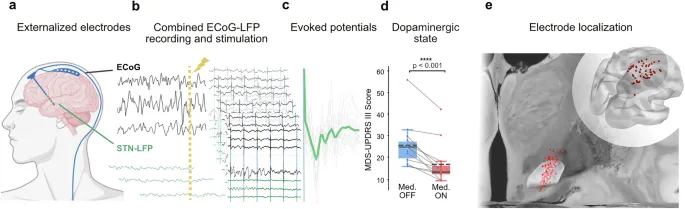
IntroductionParkinson’s disease (PD) is the most rapidly expanding neurodegenerative condition1,2, characterized by the progressive degeneration of dopaminergic neurons within the substantia nigra3. Dopamine replacement therapy with levodopa, together with high-frequency deep brain stimulation (DBS) of the subthalamic nucleus (STN), remain the most effective interventions for alleviating PD-related motor symptoms4,5. Yet despite their widespread clinical use, the neural circuit mechanisms through which these treatments exert their therapeutic effects are still not fully understood6. One of the proposed target circuits of STN-DBS is the monosynaptic cortico-subthalamic hyperdirect pathway, which has been implicated in rapid movement cancellation, in the emergence of pathological synchronization, and as a key substrate through which STN-DBS may influence network dynamics7,8,9,10. Although computational models and animal experiments have highlighted the importance of this pathway11,12,13, direct causal evidence for how dopaminergic state shapes hyperdirect STN excitation in humans remains scarce9,14.
This article is an excerpt. To read the full content, visit the original source. Nature
Related articles
AI-based hologram technology to advance multi-focal brain stimulation - healthcare-in-europe.com

Microsoft Restores App-V Server Support Through 2029 - Petri IT Knowledgebase
Microsoft has restored App-V Server to extended support through October 9, 2029. The extended support period provides continuity and security updates but does not include new features.
Solesca adds 3D terrain modeling to latest design software - Solar Power World
Commercial and community solar design service Solesca is launching the second version of its software, which will now add terrain variability and slopes for designing ground-mounted and rooftop solar projects. “A lot of the expensive surprises on solar projects come from decisions made early with incomplete information,” said Sam Schierloh, CEO and co-founder of Solesca. “Terrain is one of the big ones. We’ve been working on v2 for more than two years, and it gives developers a much clearer picture of a site before they commit to it, which means less time and money spent on projects that were never going to work.”
0 comments
No comments yet. Be the first to share your thoughts!