HRDPath: an explainable multi-model deep learning architecture for predicting homologous recombination deficiency from histopathology images - Nature
This story deserves to be shared
Send it to someone who'd care, or post it on your networks.
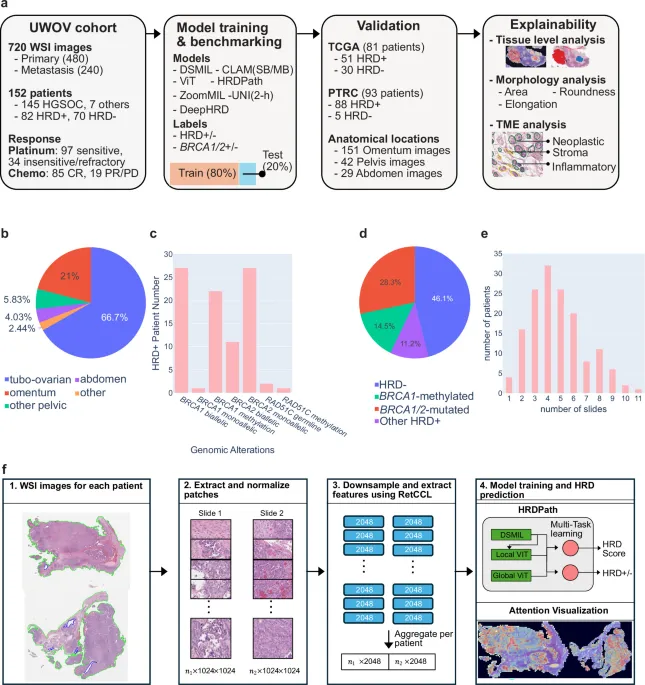
IntroductionHigh-grade serous tubo-ovarian carcinoma (HGSOC) is a highly aggressive malignancy with a paucity of available biomarkers for therapeutic intervention. HGSOC exhibiting homologous recombination deficiency (HRD) demonstrates marked sensitivity to targeted treatments such as platinum-based chemotherapy and Poly ADP-Ribose polymerase (PARP) inhibitors1,2,3. Specifically, PARP inhibitors demonstrate synthetic lethality in HRD-positive cancers by inhibiting the repair of damaged DNA, significantly extending progression-free survival and improving long-term outcomes in patients with HRD-positive ovarian cancer4,5,6. Given the significant relationship between HRD status and patient treatment outcomes, the identification of HRD is crucial for precision therapy. Existing HRD tests analyze both mutations in DNA repair genes, such as BRCA1/2, and genomic instability.
This article is an excerpt. To read the full content, visit the original source. Nature
Related articles
A multi task deep learning framework for automated health condition prediction from retinal fundus images using hybrid attention and explainable AI - Nature
We’re sharing this article early to provide faster access to peer-reviewed, accepted research. It is citable and carries a permanent DOI. This version is subject to further edits and will be replaced automatically by the final Version of Record. All legal disclaimers apply. AbstractAlthough retinal fundus imaging is a non-invasive tool to assess systemic and fundus pathology, current deep learning algorithms are mostly single-task, lack clinical interpretability and are unable to handle acquisition variation between different domains. These constraints limit their clinical utility: when a patient comes to the clinic for fundus screening, they could also be diabetic, have glaucoma, AMD, and increased cardiovascular risk, with each disease having retinal vascular biomarkers that require a patient to be tested for in the clinic, which must be managed within a framework of common, interpretable, and generalizable models rather than a pipeline of independent models.
Explainable machine learning reveals a compact, low-dimensional geometric basis underlying sheet and skeletal TPMS architected materials - Nature
Georgios Mermigkis1,3, Chrysovalantis-Michail Liakopoulos1, Dimitrios C. Rodopoulos1, Panagiotis Hadjidoukas3 & … Nikolaos Karathanasopoulos1,2 We’re sharing this article early to provide faster access to peer-reviewed, accepted research. It is citable and carries a permanent DOI. This version is subject to further edits and will be replaced automatically by the final Version of Record. All legal disclaimers apply.
0 comments
No comments yet. Be the first to share your thoughts!