Evaluating Adherence to iRefer Guidelines and Barriers to Implementation Among Non-consultant Hospital Doctors in a Model 3 Hospital: A Mixed-Methods Study - Cureus
This story deserves to be shared
Send it to someone who'd care, or post it on your networks.

Background The Royal College of Radiologists' (RCR) iRefer guidelines are an established evidence-based clinical decision support tool intended to optimise diagnostic imaging referrals, reduce unnecessary radiation exposure, and improve radiology workflow efficiency. In Ireland, imaging referrals also carry statutory weight: Statutory Instrument (S.I.) No. 256 of 2018 places defined duties on referrers regarding the justification of medical exposures, and Health Service Executive (HSE) guidance requires referrers to have access to iRefer or an equivalent decision support tool. Awareness and use of iRefer among non-consultant hospital doctors (NCHDs) in smaller, high-turnover hospital settings are poorly described. Aim To evaluate awareness, utilisation, and accessibility of the iRefer guidelines among NCHDs in a Model 3 hospital and to identify the systemic, technological, and cultural barriers preventing routine use. Methods A sequential explanatory mixed-methods design was employed. Phase 1 comprised an in-person, anonymous cross-sectional audit questionnaire developed by the authors for this study, administered to NCHDs to assess awareness, decision-making sources, and guideline
This article is an excerpt. To read the full content, visit the original source. Cureus
Related articles

Radiation Omission in Favorable Breast Cancer Hinges on Endocrine Adherence - CancerNetwork
Leah Katz, MD, MPH, discusses long-term IDEA trial data on omitting radiation and why endocrine therapy tolerance matters in this decision. In an interview with CancerNetwork® at the 2026 American Society for Radiation Oncology (ASTRO) Annual Meeting, Leah Katz, MD, MPH, vice chair of Faculty Development and an attending radiation oncologist in the Department of Radiation Oncology at the University of Miami Leonard M. Miller School of Medicine, discussed long-term follow-up from the prospective, single-arm phase 2 IDEA trial (NCT02400190). Katz served as the discussant for the breast cancer Science Highlights session at the meeting. The trial enrolled 200 postmenopausal patients aged 50 to 69 years with biologically favorable, stage I, estrogen receptor–positive, HER2-negative breast cancer and a 21-gene recurrence score of 18 or lower who received endocrine therapy without radiotherapy after breast-conserving surgery. At a median follow-up of 7.93 years, freedom from recurrence was 99% at 5 years and 94% at 8 years, and most ipsilateral breast events occurred after 5 years.
Bilateral Sensorineural Hearing Loss as the Sentinel Presentation of Granulomatosis With Polyangiitis - Cureus
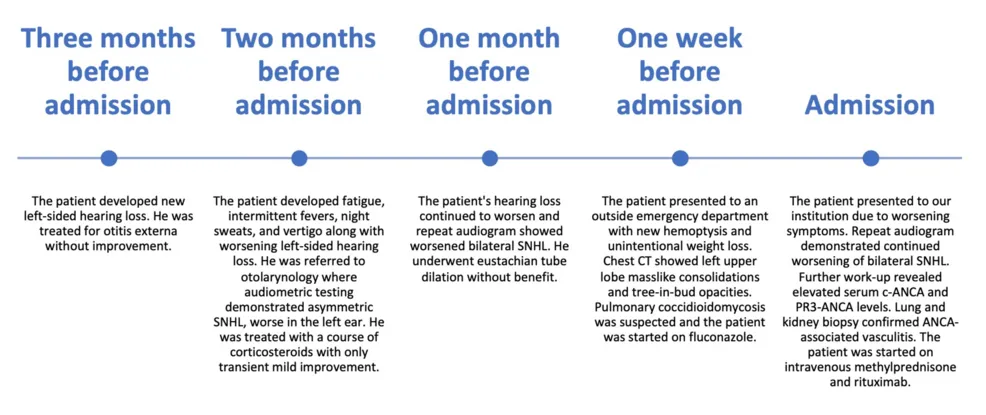
Granulomatosis with polyangiitis (GPA) is a systemic necrotizing granulomatous vasculitis classically involving the upper and lower respiratory tracts and kidneys. Timely diagnosis requires a high index of suspicion for the presenting symptoms. Otolaryngologic manifestations are commonly reported but most often involve the nasal and paranasal sinuses. Sensorineural hearing loss (SNHL) as the sole initial manifestation of GPA is uncommon and may contribute to diagnostic delay. We report a case of a 67-year-old male who presented with rapidly progressive bilateral SNHL that preceded pulmonary and renal manifestations by several months, during which the patient was treated for otitis externa and Eustachian tube dysfunction without improvement. Development of pulmonary symptoms prompted additional workup, which demonstrated markedly elevated cytoplasmic anti-neutrophil cytoplasmic antibody (c-ANCA) and proteinase 3-anti-neutrophil cytoplasmic antibody (PR3-ANCA), raising concern for GPA. Histopathology then confirmed the diagnosis. The patient was treated with high-dose corticosteroids and rituximab with serologic remission; however, his hearing loss was largely irreversible. This case

Modern neuroscience is rediscovering a surprising idea freud had 130 years ago - Science Daily
What if the human brain works in ways that Sigmund Freud began describing more than 130 years ago? A new scientific analysis suggests that some of his ideas about the mind share surprising similarities with one of the most influential theories in modern neuroscience. Published in the scientific journal Entropy, the paper explores connections between Freud's original theories, later developments in psychoanalysis, and a modern approach to brain research known as the prediction paradigm.
Tailoring Pulmonary Rehab to Close the COPD Gap, With Omid Pourshahid, MD - HCPLive
At CHEST 2026, Pourshahid argued for matching patients to center-based, hybrid, or virtual pulmonary rehab based on a structured assessment. Arguing the pro side of a debate at the American College of Chest Physicians (CHEST) 2026 Annual Meeting in Phoenix, Omid Pourshahid, MD, MPH, FCCP, Medical Director, Pulmonary Rehabilitation, Temple University Hospital, said pulmonary rehabilitation should be tailored to each patient’s clinical status and barriers to care rather than delivered through a single center-based model.¹The position builds on a long-standing gap in pulmonary rehabilitation uptake. In a retrospective cohort of 197,376 Medicare beneficiaries hospitalized for COPD in 2014, only 2721 (1.5%) initiated pulmonary rehabilitation within 90 days of discharge.² Initiation within the 90-day window was associated with a lower risk of death at 1 year (hazard ratio [HR], 0.63; 95% CI, 0.57-0.69; P <.001).

You don't need 10,000 steps a day to benefit your heart, cardiologists say - News-Medical
From daily step counts to exercise after a cardiac event, new guidance examines how doctors can tailor physical activity to individual needs and what patients should know about exercising safely. Exercise Prescriptions for Cardiovascular Health in Adults: 2026 ACC Scientific Statement: A Report of the American College of Cardiology. Image Credit: 19 STUDIO / Shutterstock
0 comments
No comments yet. Be the first to share your thoughts!