A multimodal dataset of causal mechanisms in materials science literature - Nature
This story deserves to be shared
Send it to someone who'd care, or post it on your networks.
This article is an excerpt. To read the full content, visit the original source. Nature
Related articles
French urban tree dataset with age, dimensions and species - Nature
We’re sharing this article early to provide faster access to peer-reviewed, accepted research. It is citable and carries a permanent DOI. This version is subject to further edits and will be replaced automatically by the final Version of Record. All legal disclaimers apply. AbstractUrban trees deliver ecosystem services and generate environmental pressures that evolve over a lifespan of decades to centuries. Quantifying these effects over time relies on relationships between tree age and dimensions, yet most urban tree datasets record dimensions without age. This dataset presents 464,705 individual urban trees in France, compiled by harmonizing 16 municipal inventories published as open data by local authorities. Each record reports the contributing inventory, harmonized genus and species, the original taxonomic entries, diameter at breast height, height, estimated age, a location category, and coordinates, though completeness varies across records and inventories. Age is derived from planting dates recorded by the data producers rather than inferred from allometric models.
Early Cambrian Fossil Rewrites Starfish Family Tree - Sci.News
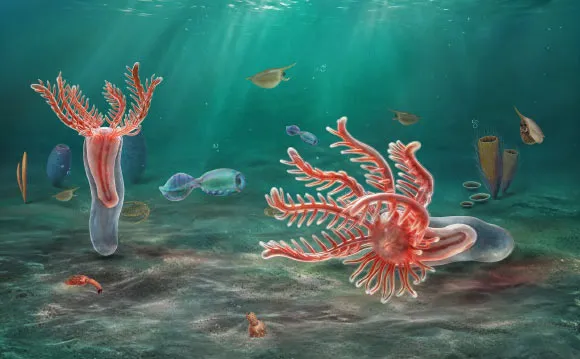
A 518-million-year-old ambulacrarian fossil from China suggests that the common ancestor of starfish and their relatives was not a burrowing worm; it was probably a tentacled animal that fed from the water around it. An artist’s impression of Yujingia glutenotunica. Image credit: He et al., doi: 10.1016/j.cub.2026.08.053.
NASA advances lunar rover development for future Moon Base - Xinhua
LOS ANGELES, Oct. 20 (Xinhua) -- NASA on Tuesday provided an update on the development of crewed and robotic lunar rovers to support its planned Moon Base initiative, highlighting efforts to develop the surface mobility capabilities needed for future exploration and sustained human operations on the Moon. NASA's Volatiles Investigating Polar Exploration Rover is scheduled to embark on a mission to the lunar South Pole region in 2027 to explore permanently shadowed craters in search of water and other potentially valuable resources that could support sustainable lunar exploration. The rover will be delivered to the lunar surface by Blue Origin's Blue Moon Mark 1 lander and is expected to travel more than 30 kilometers, collecting data on local temperatures, lighting conditions and terrain. NASA said the data could help scientists better understand the origin and distribution of water on the Moon and assess how lunar resources might be used to support future exploration.
From cryptic exons to neuronal dysfunction: combinatorial antisense makes sense in TAR DNA-binding protein-43 (TDP-43) pathology - Nature
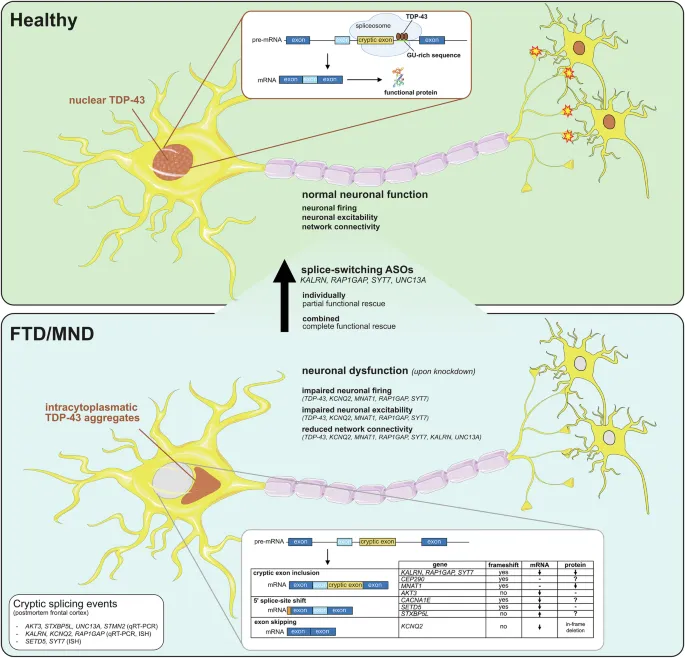
In a recent study published in Science Translational Medicine, Guo et al.1 shed further light on TDP-43 pathology by demonstrating that several transcripts involved in synaptic function and membrane excitability are aberrantly spliced upon depletion of TDP-43. Simultaneous treatment with antisense oligonucleotides targeting these transcripts corrected the splicing abnormalities and restored neuronal function, suggesting that combination therapy could be a promising approach in TDP-43 proteinopathies.1TDP-43 is an RNA-binding protein involved in key aspects of pre-mRNA splicing, particularly in the repression of cryptic exons that could lead to frameshifts and premature stop codons. While physiologically localized in the nucleus, TDP-43 forms cytoplasmic aggregates in almost all cases of amyotrophic lateral sclerosis (ALS), the most common form of motor neuron disease (MND), and roughly half of the cases of frontotemporal dementia (FTD), leading to a de facto loss of the protein’s function. TDP-43 pathology is thus regarded as the common downstream event onto which probably multiple pathogenetic mechanisms converge. But what lies even more downstream?
0 comments
No comments yet. Be the first to share your thoughts!