From cryptic exons to neuronal dysfunction: combinatorial antisense makes sense in TAR DNA-binding protein-43 (TDP-43) pathology - Nature
This story deserves to be shared
Send it to someone who'd care, or post it on your networks.
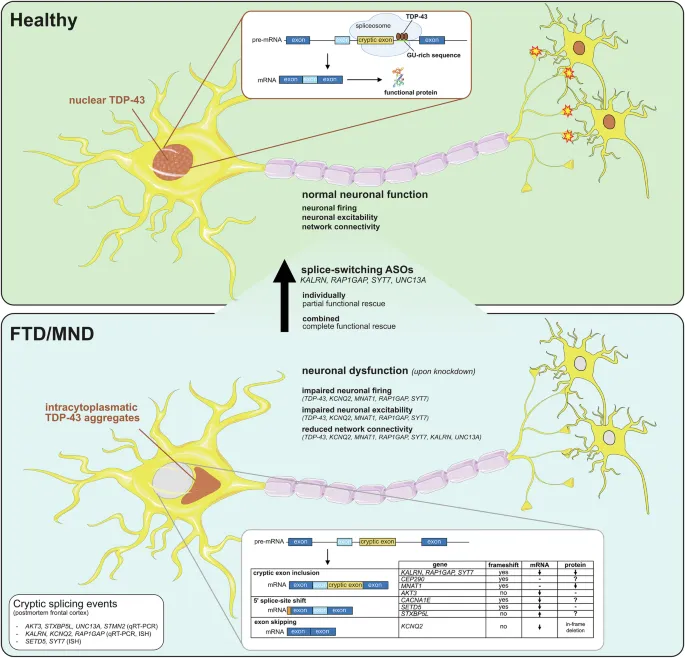
In a recent study published in Science Translational Medicine, Guo et al.1 shed further light on TDP-43 pathology by demonstrating that several transcripts involved in synaptic function and membrane excitability are aberrantly spliced upon depletion of TDP-43. Simultaneous treatment with antisense oligonucleotides targeting these transcripts corrected the splicing abnormalities and restored neuronal function, suggesting that combination therapy could be a promising approach in TDP-43 proteinopathies.1TDP-43 is an RNA-binding protein involved in key aspects of pre-mRNA splicing, particularly in the repression of cryptic exons that could lead to frameshifts and premature stop codons. While physiologically localized in the nucleus, TDP-43 forms cytoplasmic aggregates in almost all cases of amyotrophic lateral sclerosis (ALS), the most common form of motor neuron disease (MND), and roughly half of the cases of frontotemporal dementia (FTD), leading to a de facto loss of the protein’s function. TDP-43 pathology is thus regarded as the common downstream event onto which probably multiple pathogenetic mechanisms converge. But what lies even more downstream?
This article is an excerpt. To read the full content, visit the original source. Nature
Related articles
Chronic XBP1s signaling promotes B cell dysfunction and anergy - Nature
We’re sharing this article early to provide faster access to peer-reviewed, accepted research. It is citable and carries a permanent DOI. This version is subject to further edits and will be replaced automatically by the final Version of Record. All legal disclaimers apply. AbstractB cells are central mediators of humoral immunity, and their development is tightly regulated to prevent autoreactivity. The unfolded protein response (UPR) plays a crucial role in supporting the high biosynthetic demands of B cells. The transcription factor XBP1s, a key effector of the UPR’s IRE1α branch, has been implicated in plasma cell differentiation, but its role in early B cell development and tolerance remains unclear. Here we demonstrate that sustained activation of XBP1s shapes anergic B cell development and peripheral tolerance. We generated a B cell-specific XBP1s knock-in mouse model that induces chronic XBP1s expression. We find that chronic XBP1s overexpression drives the accumulation of anergic transitional 3 B cells, which exhibits attenuated activation responses to both BCR and TLR stimulation.
Want more muscle? Erectile dysfunction drug may be where it’s at - Toronto Sun
Skip to Content Subscribe FAQ My Account News Toronto & GTA Ontario Canada World Crime True Crime Weird Money Technology Tech Essentials Gaming Gadgets Weather Podcasts Opinion Editorials Columnists Editorial Cartoons Letters Send Letter to the Editor Sports Hockey PWHL Toronto Maple Leafs NHL Soccer Toronto FC MLS Baseball Toronto Blue Jays MLB Basketball Toronto Raptors NBA WNBA Football Toronto Argonauts CFL NFL Golf Other Sports Olympics Curling Tennis Horse Racing Wrestling Entertainment Celebrity Movies Music Television TV Listings Life Eat Fashion & Beauty Relationships Advice Sex Files Health Healthing Diet & Fitness Homes Travel Travel International Travel USA Travel Canada Ontario Travel Travel Essentials Contests Lives Told Tails Told Shopping Savings Toronto Sun Store Driving Vehicle Research Reviews News Gear Guide Obituaries Place an Obituary Place an In Memoriam Advertising Advertising With Us Advertising Solutions Postmedia Ad Manager Sponsorship Requests Classifieds Place an Ad Business Card Directory Celebrations Working Business Ads This Week's Flyers ePaper SUNShine Girls Become a Sunshine Girl Puzzmo Diversions Comics Puzzles Horoscopes Newsletters Manage Print

Gone Too Hard? Regular Erectile Dysfunction Drug Use Raises Risk of Vision Loss, Study Finds - ScienceAlert
Some myths refuse to die, especially when they mix sex and shame. For generations, young people were warned that sexual activity could make them blind. Science has long dismissed the claim. But a new study has brought the old myth back in an unexpected form. This time, sex is not under suspicion. A pill is. Tadalafil, best known by the brand name Cialis, is widely used to treat erectile dysfunction, or difficulty getting or maintaining an erection. It is also prescribed regularly for urinary problems associated with an enlarged prostate. Now, a large study has linked long-term tadalafil use to an increased risk of glaucoma, a group of eye diseases where optic nerve damage causes vision loss. The reassurance: The study does not show that sex harms the eyes or that occasional tadalafil use causes blindness. The study focused on men over 40 who regularly took tadalafil for urinary symptoms, such as frequent or urgent urination or a weak stream. Researchers used the TriNetX Analytics Network, a platform containing anonymized health records from across 21 countries. Its scale let them search for an uncommon pattern beyond a single hospital.
0 comments
No comments yet. Be the first to share your thoughts!