Heart has redesigned its electric regional aircraft around a turbogenerator-based series-hybrid powertrain.
FAA Backs Heart’s Turbogenerator Development Startup Heart Aerospace has received $2.9 million in funding from the FAA to support development of the turbogenerator at the core of its planned 36-passenger hybrid-electric regional aircraft, the ES-36. The funding was awarded under Phase IV of the FAA...
Inside this issueThe October 2026 issue of Global Mining Review is here, packed full of the latest mining insights on key topics – ranging from drones and milling to underground mining operations, electrification, digitalisation, CAS, safety, measuring, and monitoring. It features a cover and lead article from Gebr. Pfeiffer, along with a special report by Benchmark Mineral Intelligence on Asia’s rare earth mining industry. Top article contributors include Aramine, Sandvik, ABB, Epiroc, Hexagon, and more. More about Global Mining ReviewIn this issueEditorial commentRegister & Subscribe
By Ryan SciroccoBusiness Development Director, Advanced Effects, Missile SolutionsFor decades, the defense industry has been built around a familiar model: The government defines a mission need, establishes a detailed set of requirements and industry develops a solution specifically to meet them. That model has produced some of the most sophisticated defense technology in the world. However, today's fluid operating environment is challenging industry and government to think differently about when that approach is necessary, and when it is not. Threats are evolving faster and technology cycles are contracting. Demand is increasing across critical capability areas. At the same time, the Department of War is placing greater emphasis on speed, production capacity and solutions that can move into the hands of warfighters faster. Recent acquisition reforms have emphasized industry-driven solutions and commercial products, along with more flexible approaches to getting capability into the field. For industry, that creates an opportunity to rethink not only what we develop, but how we do so. Read Full Article in 'Breaking Defense'
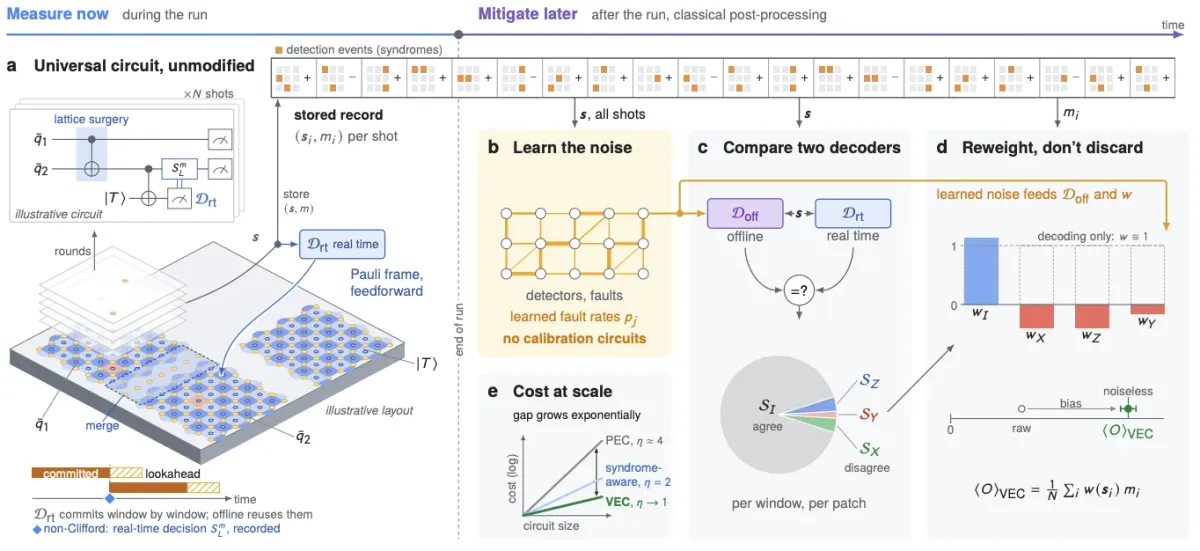
Google Quantum AI researchers developed a method that uses saved error-correction records to reduce distortion in quantum results after a calculation, achieving more than 1,000-fold suppression in simulations.
The method compares a fast decoder with a more accurate offline decoder and adjusts how much each measurement counts toward the answer, avoiding separate calibration experiments or changes to quantum circuits.
I do not find it terribly amusing that Rockstar is one of the only third-party AAA (AAAA?) developers to release Grand Theft Auto 6 only on console without a PC companion release, but according to a new report, we may not have to wait all that long for GTA 6 to make it to that platform. A new report from GamesBeat says that the PC version of GTA 6 will arrive within the first quarter of 2027, so January through March. Rockstar, of course, has not commented on this, but it would be extremely close to the game's November 19, 2026 release, and would reach the platform far more quickly than we saw with GTA 5GTA 5 released on September 17, 2013 on PS3 and Xbox 360. It did not come to PC until April 14, 2015, 19 months later. If this report pans out, we're talking about a potential 2-4 month gap instead. What's changed? Well, the PC market is enormous and has only grown larger over the last 13 years, with Steam hitting new concurrent playercounts monthly. Rockstar may see pros and cons here. Pros: With separate releases it can always count on many players double-dipping by purchasing on both consoles. Cons: It could lower initial sales if players are waiting for the PC release instead.
Analysts have been eager to weigh in on the Technology sector with new ratings on Jabil (JBL), ASML Holding (ASML) and Accenture (ACN). Jabil (JBL)Stifel Nicolaus analyst Ruben Roy maintained a Buy rating on Jabil today and set a price target of $460.00. The company’s shares closed last Friday at $306.28. According to TipRanks.com, Roy is a top 25 analyst with an average return of 54.2% and a 71.8% success rate. Roy covers the Technology sector, focusing on stocks such as Advanced Micro Devices, Lattice Semiconductor, and Skyworks Solutions. ;'>The word on The Street in general, suggests a Strong Buy analyst consensus rating for Jabil with a $435.00 average price target, which is a 43.6% upside from current levels. In a report issued on September 30, TipRanks – PerPlexity also upgraded the stock to Buy with a $356.00 price target. See the top stocks recommended by analysts >>ASML Holding (ASML)In a report released today, C J Muse from Cantor Fitzgerald reiterated a Buy rating on ASML Holding, with a price target of EUR2500.00. The company’s shares closed last Friday at $1780.34.
SolarEdge solid-state transformer technology and data center powertrain concept is featured as the company advances development of a medium-voltage-to-800 VDC, grid-to-rack architecture for AI infrastructure SolarEdge Technologies, Inc. (NASDAQ: SEDG) today announced that its MVAC-to-800 VDC AI Factory Power Technology for AI data centers is being featured at the NVIDIA AI Factory MGX Ecosystem Showcase during the 2026 Open Compute Project (OCP) Global Summit, October 12–15, at the San Jose McEnery Convention Center in San Jose, California. The showcase features a SolarEdge solid-state transformer (SST) cell and a 3D-printed model of the company's containerized data center power architecture, illustrating key elements of the power conversion system SolarEdge is developing for next-generation AI infrastructure. SolarEdge is developing a full DC powertrain spanning medium-voltage conversion, 800 VDC distribution, protection and monitoring to the rack power input. The three-phase MVAC-to-800 VDC AI Factory Power Technology conversion stage is operating under load in SolarEdge engineering labs, with system-level validation of the full power path underway.
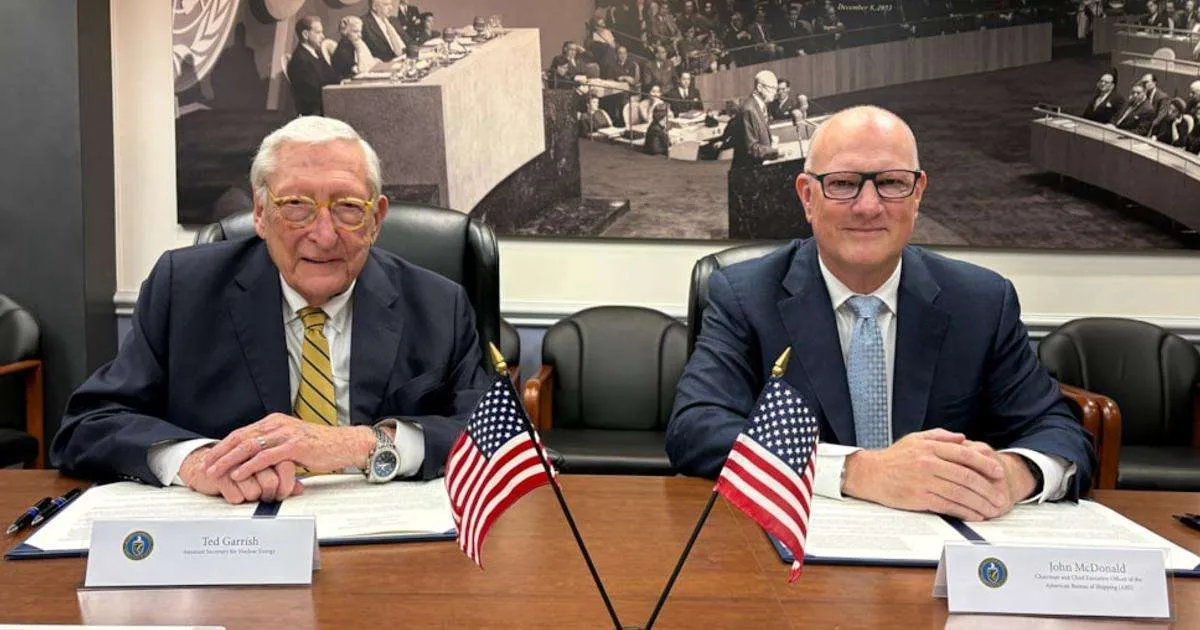
ABS and the US Department of Energy's (DOE) Office of Nuclear Energy have signed a memorandum of understanding to advance modern commercial nuclear technology at sea. The agreement spans floating power solutions, nuclear-powered vessels, and the development of the ports, shipyards, and industrial base needed to build and sustain them.
Left to right: Ted Garrish, United States Assistant Secretary for Nuclear Energy, and John McDonald, ABS Chairman and CEO. (Image credit: ABS)