XRP Ledger bug fix moved to November after validator support dipped for two hours
This story deserves to be shared
Send it to someone who'd care, or post it on your networks.

SummaryA brief drop in validator support reset the XRP Ledger bug fix’s required 14-day approval period, delaying activation from Oct. 23 to Nov. 4. Support for the fix has risen to 31 of 35 trusted validators, two more than the 29 needed to maintain the network’s approval threshold. The patch closes a token-creation loophole and adjusts vault and lending calculations, though the broader lending system has not secured enough validator support to begin its own activation countdown. A two-hour wobble in validator support has pushed the XRP Ledger’s latest bug fix back to November, less than two days before it was due to switch on. Validators are the independent servers that agree on which transactions count. Changing the network’s rules needs backing from more than 80% of the 35 the network trusts by default, which works out to 29. That support gets checked roughly every 15 minutes, and it has to hold at every single check for 14 days straight. Miss once, even briefly, and the clock goes back to zero. The fix, called fixCleanup3_4_0, had no room for that. It sat at exactly 29 votes on Monday, with activation penciled in for 09:34 UTC on Oct. 23.
This article is an excerpt. To read the full content, visit the original source. CoinDesk
Related articles

Bitcoin ETFs bag another $528M, taking 3-day haul past $1B
US spot Bitcoin ETFs drew $1.08 billion over three trading sessions to push October flows back above water. US spot Bitcoin exchange-traded funds (ETFs) attracted $528 million in net inflows on Wednesday as Bitcoin briefly surged above $84,700 before retreating. The funds extended their inflow streak to three sessions, adding $23 million on Tuesday and $526.6 million on Monday, according to SoSoValue data. The three sessions drew in a combined $1.08 billion. Wednesday’s inflows brought October’s net inflows to approximately $461 million, while year-to-date net inflows reached $1.34 billion. According to Farside Investors data, BlackRock’s iShares Bitcoin Trust (IBIT) led Wednesday’s inflows with $235 million, followed by the Fidelity Wise Origin Bitcoin Fund (FBTC) with around $213 million. The latest inflows followed two consecutive weeks of withdrawals, with Bitcoin ETFs shedding $228 million last week and $681 million the week before. Bitcoin’s rally on Wednesday took it to an intraday high of $84,777 before it pulled back to $82,485 at the time of publication, according to CoinGecko. Altcoin ETFs also recorded modest inflows.

Top HSBC strategist has a warning for retail investors chasing the AI rally
Maxx Kettner, HSBC’s chief multiasset strategist, says the investors need to understand the goal posts are constantly moving with AI investing.

China seeks to seize 61,800 BTC tied to $5.7 billion fraud scheme
Skip to main contentCrypto NewsOct 22, 2026, 2:24 a.m. EDT2 min readSummaryChinese prosecutors are seeking to confiscate more than 61,800 BTC and other assets linked to an alleged $5.7 billion fraud that affected more than 102,000 investors. Prosecutors say Qian Zhimin’s company sold unlicensed wealth-management products, used investors’ money to repay earlier participants and buy assets, and left victims with nearly 20 billion yuan in losses. A British court ruled that Chinese law should govern victims’ claims to the Bitcoin seized in Britain, while a Chinese court has opened a six-month period for interested parties to join the confiscation case. Chinese prosecutors have moved to seize more than 61,800 Bitcoin linked to a massive fraud case worth over 40 billion yuan, roughly $5.7 billion, according to reporting by Chinese outlet The Paper. The case centers on Qian Zhimin, the alleged controller of Tianjin Lantian Gree Electronic Technology. Prosecutors say that from 2014 to 2017, the company sold unlicensed wealth-management products across China, promising guaranteed principal and high returns.

Move over memecoins: Crypto ‘meme games’ coming, bagholders and all
AI could unleash a flood of short-lived crypto “meme games,” attracting the same speculative traders who helped push memecoins to record highs in late 2024, according to Illuvium co-founder Kieran Warwick. Speculative crypto games such as Wolf Game and Fishing Frenzy, where players compete for financial rewards, once took months to develop. But Warwick says AI tools have reduced the time and cost of creating similar games to just days and around $1,000. He predicts as many as 100,000 such games could launch within a year, with many designed to survive for only a few days — long enough for their creators to turn a profit. “Like you have serial deployers of memes, you’ll get serial deployers of games,” Warwick told Cointelegraph. But whether that flood would benefit crypto gaming and the broader industry is less clear. Cheaper development could make niche games viable and revive attention across the sector, but a wave of disposable crypto games could leave a lot of speculators “holding the bag.”“There will be ridiculous gains, and people will get absolutely f****ing rinsed,” Warwick wrote on X on Monday. A memecoin-style boom… and bust?

Solana’s biggest network change since 2020 is live. Here’s how users benefit
Skip to main contentCrypto NewsUpdated Oct 22, 2026, 1:31 a.m. EDTPublished Oct 22, 2026, 1:24 a.m. EDT2 min readSolana completes Alpenglow upgrade. Here’s what it means for users. (Solana)SummarySolana activated its Alpenglow upgrade Wednesday, targeting transaction finality in about 150 milliseconds under normal network conditions, down from several seconds. The upgrade allows validators to exchange votes directly and combine them into certificates, enabling blocks to become final after one or two voting rounds. Wallets, fees and applications remain unchanged, but network dashboards may show lower transaction totals because validator votes are no longer recorded as blockchain transactions. Solana switched on its Alpenglow upgrade Wednesday, introducing a new voting system designed to make payments and trades final in a fraction of a second. The upgrade targets about 150 milliseconds before the network considers a transaction locked in, replacing the multi-second wait under its previous system. That point is called finality, when an application can treat the payment as settled.
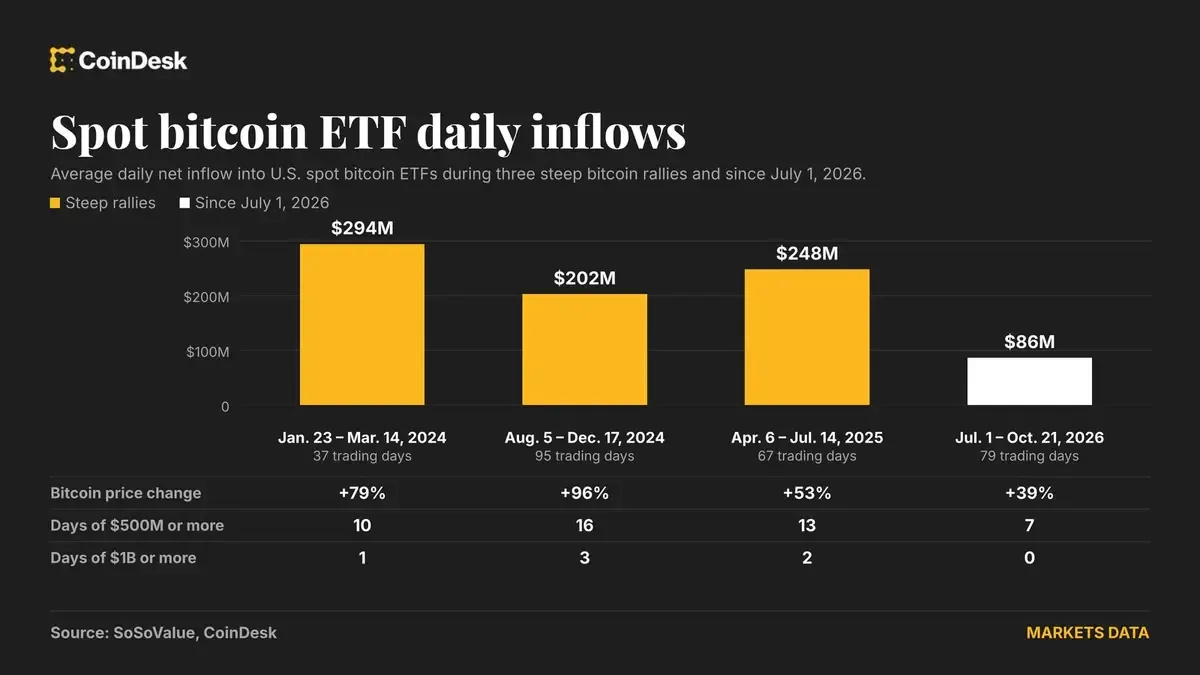
Bitcoin ETFs attract $1.08 billion in 3 days but it may not be enough for a steep rally
Skip to main contentCrypto NewsOct 22, 2026, 12:41 a.m. EDT2 min readSpot bitcoin ETFs: Daily inflows. (SoSoValue/CoinDesk)SummaryU. S.-listed spot bitcoin exchange-traded funds attracted more than $1 billion this week, signaling renewed but still tentative institutional demand. Bitcoin’s three steep rallies since January 2024 coincided with average daily ETF inflows above $200 million, compared with about $86 million a day since July 1. A sustained bitcoin rally may require stronger, steadier ETF inflows, though futures trading and direct purchases can also drive prices higher. Bitcoin BTC$84,459.46 exchange-traded funds (ETFs) are back in favor, but not yet at the pace that has historically fueled steep rallies. These U. S.-listed funds have pulled in over $1 billion in investor money this week, according to SoSoValue data. Analysts are calling it a sign of renewed institutional bid for the cryptocurrency, with a warning that the pace must remain robust for a sustained uptick in bitcoin's price. "Institutional demand shows tentative improvement.
0 comments
No comments yet. Be the first to share your thoughts!