Western University - Marginalized patients have increased risk of early death from newly diagnosed metastatic breast cancer, study finds - Education News Canada
This story deserves to be shared
Send it to someone who'd care, or post it on your networks.
People who are marginalized or lack access to a primary care provider are at greater risk of early death from newly diagnosed metastatic breast cancer, according to research in CMAJ (Canadian Medical Association Journal).
The Ontario study found nearly one-quarter of people with stage four metastasized breast cancer that has already spread to other sites in the body when it is found - also known as de novo breast cancer - died within six months of diagnosis.
This article is an excerpt. To read the full content, visit the original source. Education News Canada
Related articles

Riboscience to Present First Overall Survival and Immune Activation Data from Phase 1b Study of ENPP1 Inhibitor RBS2418 as Monotherapy and in Combination in Advanced Metastatic Cancers Including MSS CRC, at ESMO 2026 - Morningstar
PALO ALTO, Calif., Oct. 19, 2026 /PRNewswire/ -- Riboscience, a clinical-stage biotechnology company developing first-in-class immunotherapies, today announced that Phase 1b data for RBS2418, its lead oral ENPP1 inhibitor, will be presented in a poster at the European Society for Medical Oncology (ESMO) Congress 2026, held October 23–27 in Madrid, Spain. Title: Overall survival and intratumoral immune activation in subjects with advanced metastatic solid tumors, by Thomas U. Marron, Jamal G. Misleh, Michael Gordon, Zev A. Wainberg, Christopher T. Chen, Daniel Johnson, Alexander I. Spira, Jordan Berlin, Won Jin Ho, John T. Hamm, Ralph V. Boccia, Seol Hee Im, Stephan Rogalla, Juergen Schanzer, Ningwu Huang, Sayantanee Paul, Edward Pham, Buer Song, Jeffrey S. Glenn, Hirak Der-Torossian, Klaus Klumpp and Aaron J. Scott

Real-World Outcomes After Selective RET Inhibitor Failure in Metastatic Lung Cancer - Oncodaily
A new study published in Clinical Cancer Research Title: Second- and third-line outcomes after selective RET inhibitor failure in RET fusion-positive metastatic lung cancer: A real-world analysis from the RET-MAP registry

Retifanlimab Versus Avelumab for Metastatic Merkel Cell Carcinoma: Comparative Analysis Insights - DocWireNews
Results from a recent matching-adjusted indirect comparison (MAIC) analysis indicated clinical favorability of retifanlimab versus avelumab for the treatment of metastatic Merkel cell carcinoma (MCC), which investigators described as “a rare and aggressive skin cancer with poor prognosis and low survival rate. A team of researchers from Italy conducted the study and published their findings in Advances in Therapy. Both retifanlimab and avelumab are classified as monoclonal immune checkpoint inhibitor (ICI) antibodies, and investigators highlighted that both medications are approved for the treatment of metastatic or locally advanced recurrent MCC. They explained that the goal of their research was to assess clinical outcomes of both ICIs via a MAIC analysis of data from the phase 2 POD1UM-201 trial and part B of the phase 2 JAVELIN Merkel 200 trial. Patient data from each trial were used in the analysis, with data from POD1UM-201 informing the retifanlimab group and aggregate data from JAVELIN Merkel 200 informing the avelumab treatment group. Investigators also underscored that the data cutoff of POD1UM-201 was July 2024.

Diagnosed at 46, Quebec woman with stage 4 breast cancer calls for earlier screening - CityNews Montreal
Eugénie Lacroix, a Quebec woman diagnosed with breast cancer at 46 years old, is urging the province to expand access to earlier screening as advocates call for changes to a program that currently targets women aged 50 to 74. Now living with stage 4 breast cancer, Lacroix hopes sharing her experience will push Quebec’s next government to act on recommendations to extend organized screening to younger women.
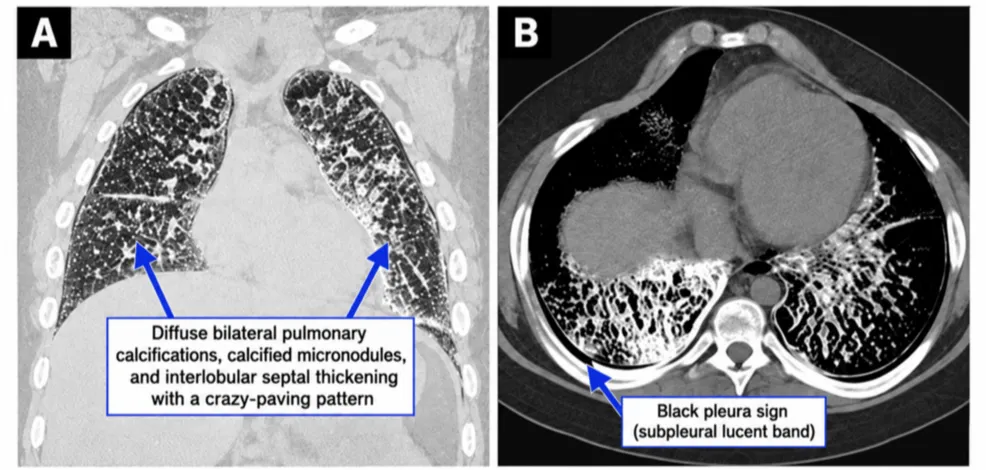
Pulmonary Alveolar Microlithiasis Diagnosed by High-Resolution Computed Tomography, Bronchoalveolar Lavage, and Genetic Testing in a Young Adult - Cureus
We report the case of a 19-year-old Saudi man who presented with a four-day history of cough, whitish sputum, and shortness of breath. Despite relatively mild symptoms and preserved oxygen saturation, chest imaging showed extensive bilateral pulmonary calcification. High-resolution computed tomography demonstrated diffuse sand-like calcified micronodules, interlobular septal thickening with a crazy-paving pattern, and the black pleura sign. Bronchoalveolar lavage cytology revealed microliths with multinucleated giant cells, while genetic testing identified a pathogenic variant in the SLC34A2 gene, supporting the diagnosis. In this patient, the relatively mild clinical presentation contrasted with the extensive radiological abnormalities. The complementary findings from imaging, bronchoalveolar lavage cytology, and the available genetic result supported the diagnosis without the need for surgical lung biopsy. Following completion of the diagnostic workup, the patient was referred for lung transplantation evaluation, and genetic screening of family members was recommended.
0 comments
No comments yet. Be the first to share your thoughts!