Webb Photographs a ‘Turbulent Cauldron of Star Formation’ - PetaPixel
This story deserves to be shared
Send it to someone who'd care, or post it on your networks.
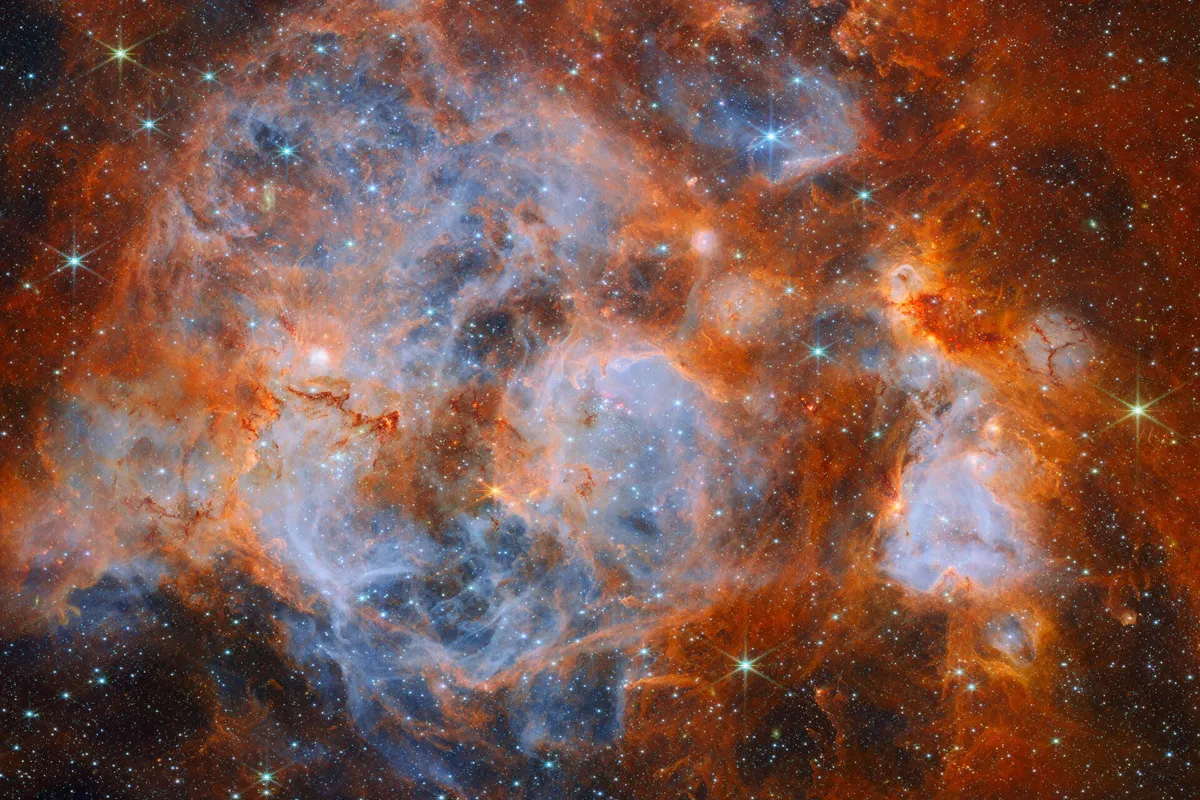
The James Webb Space Telescope's (JWST) newest Picture of the Month shows what the European Space Agency (ESA) describes as a "turbulent cauldron of star formation." The star-forming region named LHA 120-N 159, also known as N159, is located 161,000 light-years away in the Large Magellanic Cloud (LMC). [ Read More ]
This article is an excerpt. To read the full content, visit the original source. PetaPixel
Related articles
Webb image reveals young stars brewing in a nebulous cauldron - Phys.org
A nebula made of clouds of gas and dust with stars forming within. In the center and out to the left it is filled with thin, wispy blue gas that forms delicate layers. Around this are thicker orange clouds with dark ridges. Thin red filaments of gas cross the center of the nebula. Glowing bubbles in the gas contain dense, very bright clusters of stars. At the edges, distant stars are visible as bright points on a dark background. Credit: European Space Agency In this Picture of the Month from the NASA/ESA James Webb Space Telescope, we visit a turbulent cauldron of star formation to see what is brewing inside dense clumps of gas. This is a star-forming region named LHA 120-N 159, or simply N159, located 161,000 light-years away in the Large Magellanic Cloud (LMC), one of the satellite galaxies orbiting the Milky Way galaxy. This image spans about 230 light-years across.

Child-led citizen science helps Ecuadorian community tackle beach pollution and shape environmental decisions - Phys.org
Graphical summary of the project's key results. Credit: Fernández B., Bustos M., Vera T., Palacios M., Hill D. & Astudillo D. Pollution from human-generated waste in marine ecosystems has reached critical levels, with cigarette butts (CBs) among the most persistent and harmful pollutants. Globally, an estimated 4.5 trillion cigarette butts are discarded annually, making them the most common type of litter on beaches over the past three decades.

Shared meiosis proteins show surprising functional differences across animals - News-Medical
Every egg cell and sperm cell depends on meiosis, a tightly choreographed process in which chromosomes find their partners, exchange genetic material, and then divide. When meiosis goes awry in humans, the consequences can include infertility, miscarriage, and birth defects. A new study from the Stowers Institute for Medical Research, published in Science Advances, shows that the molecular machinery guiding this process is more widely shared across animals than expected, and more flexible. The surprise was that familiar-looking parts were not always doing the same jobs, revealing an unexpected flexibility in how meiosis works across evolution.

Stargazers gather in Paris for astronomy night - The Spec
Over 40 people attended the County of Brant and the Royal Astronomical Society of Canada Hamilton Centre club’s Astronomy: The Sky Tonight event on Monday, Oct. 19, 2026.

NASA's Perseverance Just Broke The Off-World Driving Record, While Mostly Steering Itself - ScienceAlert
The Perseverance rover's first selfie, snapped with the WATSON camera on its robotic arm, on April 6, 2021. (NASA/JPL-Caltech/Kevin M. Gill) When we look up at Mars, many millions of miles away, it's inspiring to think that someone may be looking back at us – not any heat-ray-equipped aliens, thankfully, but one of humanity's greatest accomplishments: NASA's Perseverance rover. In July of 2020, the affectionately nicknamed Percy left Earth forever in a bright flash of hope during some of modern history's darkest days. It, and we, have come a long way since then. Earth (our "pale blue dot") playing peek-a-boo behind Mars' moon Phobos, as observed by Perseverance on July 2, 2026. (NASA/JPL-Caltech/ASU/MSSS/SSI)In fact, Perseverance has recently achieved something completely unique: it has traveled farther across the surface of another world than any previous entity. As its interplanetary odometer ticked off 45.22 kilometers (28.10 miles) on October 11, it graciously surpassed the record set by its older sibling Opportunity, which traversed 45.16 kilometers of dusty, red, rocky Martian expanse from 2004 to 2018. Perseverance is a product of its predecessors.
0 comments
No comments yet. Be the first to share your thoughts!