Seismology meets botany: Geologist applies vibration science to saguaros - Phys.org
This story deserves to be shared
Send it to someone who'd care, or post it on your networks.
This article is an excerpt. To read the full content, visit the original source. Phys.org
Related articles
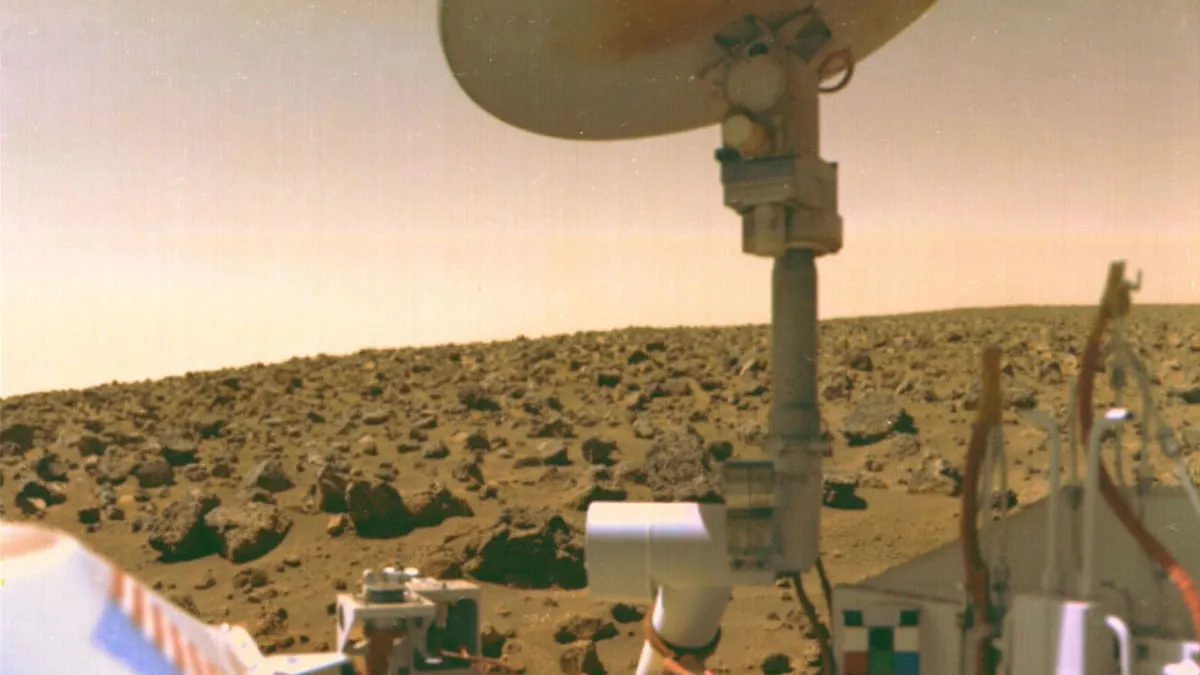
InSight into Seismology on the Red Planet - Eos
The Viking 2 lander taking a self-portrait on the surface of Mars. Credit: NASA/JPL-Caltech Earthquakes and the seismic waves they generate provide some of the best clues to Earth’s interior. To extend that success to other worlds, scientists placed seismometers on the Apollo missions to the Moon and on the Viking Mars landers, which reached Mars in 1976. Though the Apollo detectors proved a resounding success, Viking’s results on Mars were less clear: Viking 1’s seismometer failed to deploy properly, and Viking 2 recorded only two ambiguous events.
Research on the vibration frequency range of vibratory soil cutting system and experimental verification - Nature
We’re sharing this article early to provide faster access to peer-reviewed, accepted research. It is citable and carries a permanent DOI. This version is subject to further edits and will be replaced automatically by the final Version of Record. All legal disclaimers apply. AbstractTo address the wide variation in vibration frequencies used in existing vibratory soil cutting tools and the lack of a unified frequency selection criterion, this study investigated the natural vibration characteristics of soil in an indoor soil bin. Based on single-degree-of-freedom (SDOF) resonance theory, the empirical method, half-power bandwidth method, and amplitude magnification factor method were used to analyze the resonance bandwidth and vibration-energy proportion of the first-order soil vibration mode. On this basis, a frequency selection method for vibratory soil cutting tools was developed. The results show that the first-order natural vibration frequency f0 of the soil is 29.492 Hz, with a damping ratio of 0.142. The resonance frequency bands determined by the empirical method and the amplitude amplification factor β = 2 are 0.75 f0 ∼ 1.25 f0 and 0.717 f0 ∼ 1.207 f0, respectively.

Experiments in Sports Seismology for the World Cup - Pacific Northwest Seismic Network
Recently, PNSN welcomed a camera crew from Football Case Study to the SeismoLab to provide seismological context for their portrait of Lumen Field—which is now transforming to “Seattle Stadium” to host six World Cup matches in Seattle. Watch it here: Our field crew installed six seismic sensors throughout the stadium back in January, ahead of the NFL playoff games, and later added a seventh. These instruments record the structural shaking created by tens of thousands of fans jumping and cheering in unison. The stations are located on the ground floor tunnel by the pitch itself, on all four corners of the stadium’s 300 level, and up at the top of the Hawks Nest. They join our permanent station KDK, which is located across the street and recorded the original Beastquake back in 2011. PNSN also previously deployed seismic instruments during Seahawks playoff games in 2014, 2015, and 2017, and at T-Mobile Park for the Mariners home games during American League Division Series in 2025. These experiments are a fun way to inform the public about how we record ground motions from seismic and volcanic activity across the region—and a reminder that we live in earthquake country.
Scientists probe link between early brain development and conditions such as autism - Financial Times
Venture will harness clinical data and laboratory tissue models in quest for potential new therapies
0 comments
No comments yet. Be the first to share your thoughts!