Scientists redetermine a key strontium frequency with 50 times better precision for quantum technologies - Phys.org
This story deserves to be shared
Send it to someone who'd care, or post it on your networks.
This article is an excerpt. To read the full content, visit the original source. Phys.org
Related articles

Photonic Grating Chip Reduces Strontium Frequency Uncertainty Over Fifty Times - AZoM
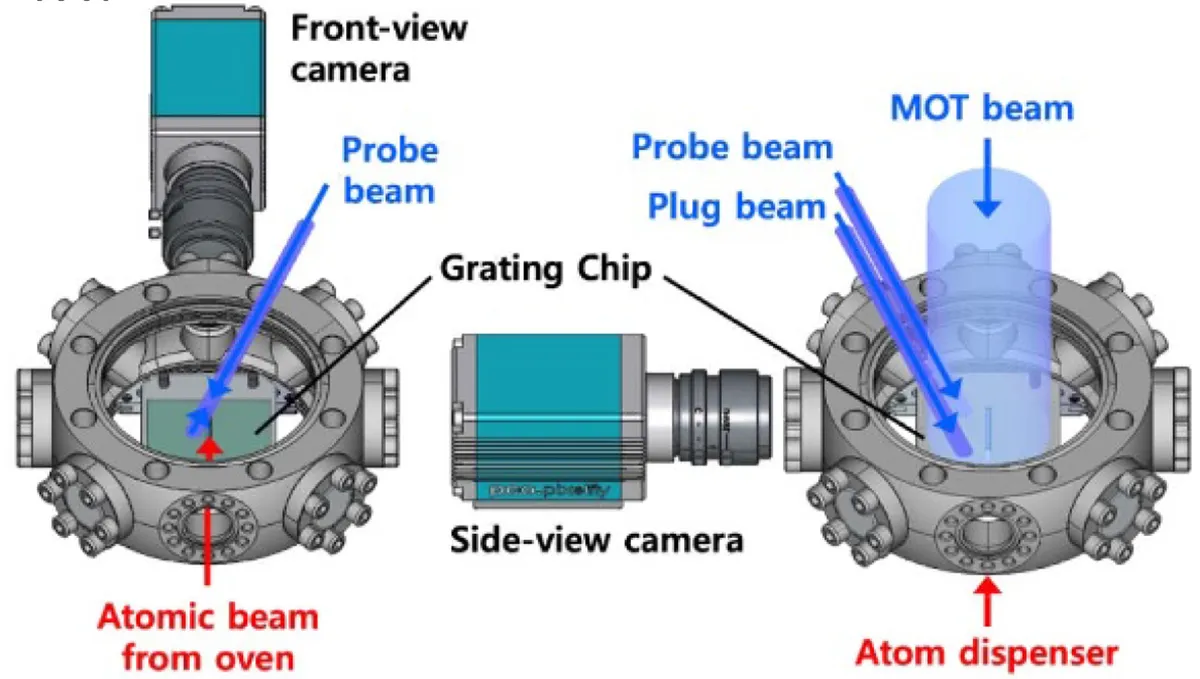
The Korea Research Institute of Standards and Science (KRISS, President Dr. Ho Seong Lee) has re-measured a key transition frequency of the strontium (Sr) atom for the first time in 88 years since 1938, using a photonic grating chip, and has established a new absolute frequency value with a measurement uncertainty reduced by more than 50 times. By securing an accurate reference value needed for next-generation quantum technologies ahead of time, this achievement is expected to greatly contribute to the precise control and miniaturization of quantum devices, including atomic clocks and neutral-atom quantum computers. Strontium is an atom widely used in precision quantum technologies such as optical lattice clocks and quantum sensors. To use strontium in these technologies, fast-moving atoms must be slowed down and trapped with precisely tuned lasers, and for this, it is essential to know exactly the resonant frequency of the laser light for the atomic transition.
After 88 Years, KRISS Redetermines a Key Strontium Frequency with 50 Times Better Precision | Newswise - Newswise
Newswise — The Korea Research Institute of Standards and Science (KRISS, President Dr. Ho Seong Lee) has re-measured a key transition frequency of the strontium (Sr) atom for the first time in 88 years since 1938, using a photonic grating chip, and has established a new absolute frequency value with a measurement uncertainty reduced by more than 50 times. By securing an accurate reference value needed for next-generation quantum technologies ahead of time, this achievement is expected to greatly contribute to the precise control and miniaturization of quantum devices, including atomic clocks and neutral-atom quantum computers. Strontium is an atom widely used in precision quantum technologies such as optical lattice clocks and quantum sensors. To use strontium in these technologies, fast-moving atoms must be slowed down and trapped with precisely tuned lasers, and for this, it is essential to know exactly the resonant frequency of the laser light for the atomic transition.

The Sky Today on Tuesday, October 20: Lovely spiral NGC 7331 - Astronomy.com
The biggest galaxy in the Deer Lick Group, galaxy NGC 7331 has lots to offer through a telescope, so track it down tonight. Looking for a sky event this week? Check out our full Sky This Week column.
0 comments
No comments yet. Be the first to share your thoughts!