Scientists Found Human Speech-Like Patterns in Sperm Whale Clicks - ScienceAlert
This story deserves to be shared
Send it to someone who'd care, or post it on your networks.
This article is an excerpt. To read the full content, visit the original source. ScienceAlert
Related articles
Spatial identification and assessment of flood risk for historic buildings in the Minjiang River Basin - Nature
We’re sharing this article early to provide faster access to peer-reviewed, accepted research. It is citable and carries a permanent DOI. This version is subject to further edits and will be replaced automatically by the final Version of Record. All legal disclaimers apply. AbstractExtreme precipitation events increasingly threaten historic buildings in river basins, yet existing studies lack a basin-scale perspective on nonlinear flood risk mechanisms. Taking the Minjiang River Basin as the study area, this research integrates hydrological simulation (SCS-CN), machine learning (XGBoost-SHAP), and spatial autocorrelation analysis to assess flood risk for 5482 historic buildings. Results reveal three key patterns: flood hazard decreases from downstream to upstream with belt-like aggregation along rivers; vulnerability shows a spatial mismatch, being higher upstream and lower downstream; integrated risk exhibits a southeast-high to northwest-low gradient with strong clustering in estuarine and midstream valleys. Key drivers, including impervious surfaces, vegetation cover, and topography, demonstrate significant nonlinear threshold effects and multi-factor coupling.
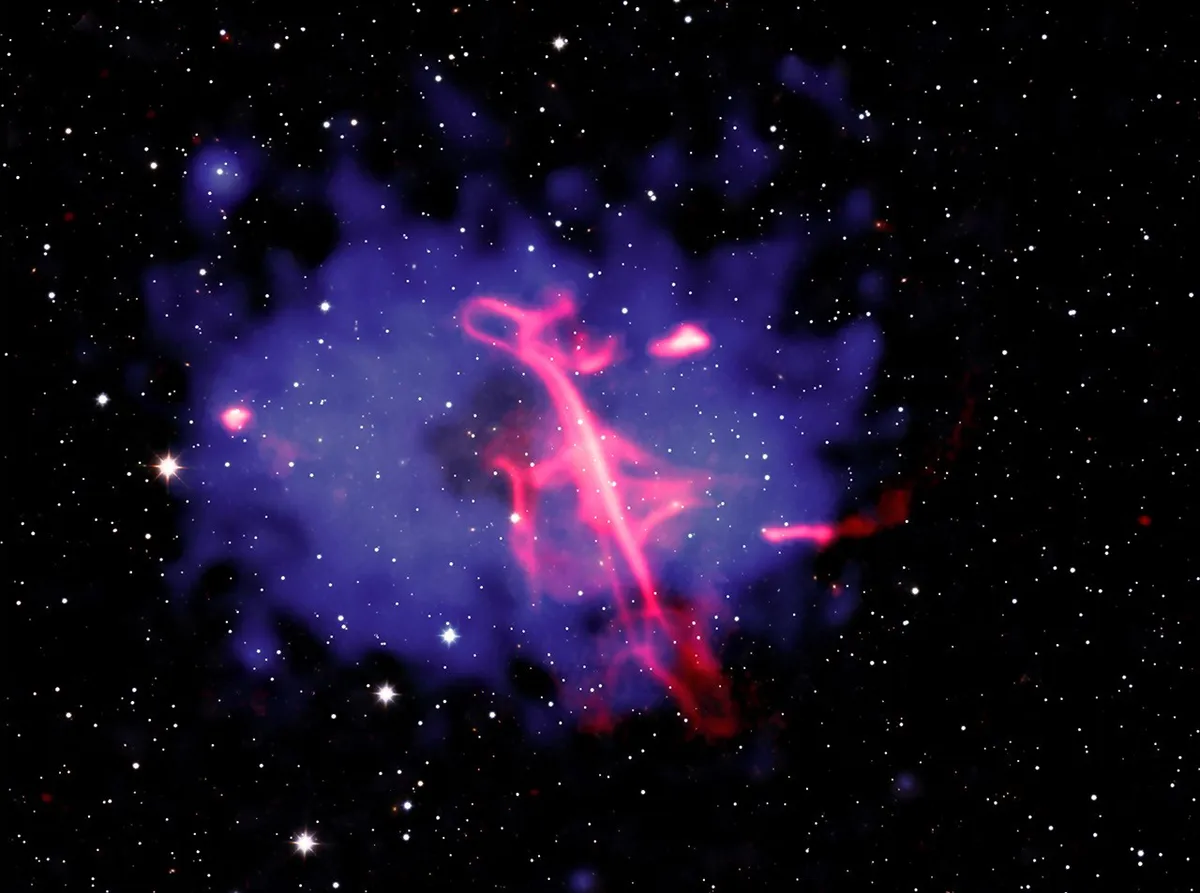
APOD: 2026 October 19 - Treble Clef: Unusual X-ray Hot Radio Source - NASA Science (.gov)
Discover the cosmos! Each day a different image or photograph of our fascinating universe is featured, along with a brief explanation written by a professional astronomer. X-ray: NASA/CXC/INAF-IRA/A. Botteon et al.; Infrared: UKIDSS-GPS; Radio: ASTRONLOFAR; Image processing: NASA/CXC/SAO/N. Wolk

US prize-winning cancer scientist Wan Fengyi joins China’s Zhejiang University - South China Morning Post
A Johns Hopkins University scientist whose award-winning work suggests that a brief stomach bug could raise the risk of colon cancer has moved to China full time. Wan Fengyi, a professor at the Johns Hopkins Bloomberg School of Public Health, has joined Zhejiang University in Hangzhou, according to his new profile on the Chinese university’s website. Wan returned to China this month and now holds a chair professorship at Zhejiang University. He is based at a national laboratory at its Second...
Multiplexed sensor arrays for high-spatiotemporal decoding of complex physiological networks - Nature
We’re sharing this article early to provide faster access to peer-reviewed, accepted research. It is citable and carries a permanent DOI. This version is subject to further edits and will be replaced automatically by the final Version of Record. All legal disclaimers apply. AbstractMultiplexed sensor arrays expand biomedical interfaces by allowing independently recoverable sensing sources to share limited transmission, addressing, readout, acquisition, and computational resources. This Review compares time-, frequency-, spatial-, optical-, code-, and hybrid-multiplexing through a requirement–resource framework. We examine how signal integrity, front-end electronics, calibration, materials, mechanics, power, and data handling constrain source-specific recovery and outline architecture-selection principles for reliable physiological sensing and bidirectional biointerfaces.
0 comments
No comments yet. Be the first to share your thoughts!