Safer treatment for venous thrombosis - McGill University Health Centre
This story deserves to be shared
Send it to someone who'd care, or post it on your networks.
This article is an excerpt. To read the full content, visit the original source. McGill University Health Centre
Related articles
Potential role of neutrophil extracellular traps in ovarian cancer-associated venous thrombosis - Nature
Gaku Yamamoto1,2, Mahiru Kawano1, Mina Sakata1, Michiko Bun1,3, Aasa Shimizu1, Erika Nakatsuka1, Yasuto Kinose1,2, Shuang Zhang4, Ryota Nakashima4, Kenjiro Sawada1,5 & … Michiko Kodama1 We’re sharing this article early to provide faster access to peer-reviewed, accepted research. It is citable and carries a permanent DOI. This version is subject to further edits and will be replaced automatically by the final Version of Record. All legal disclaimers apply.
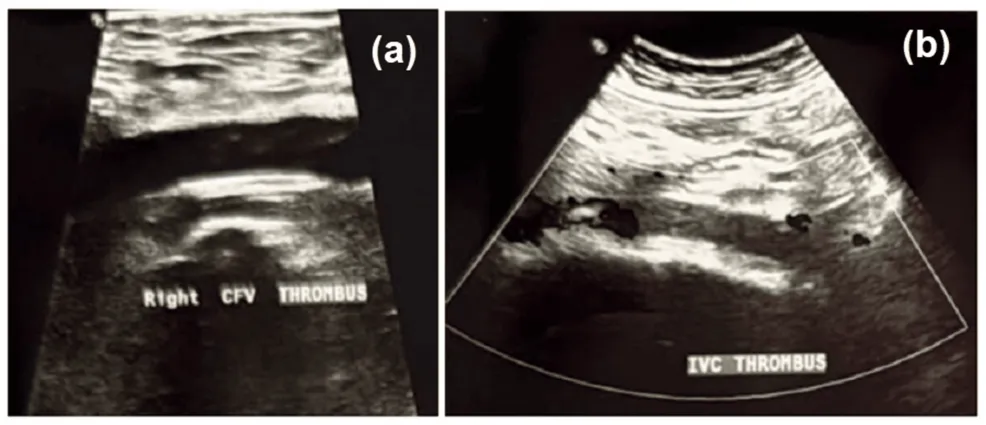
Postpartum “Hypercoagulable Storm” With Extensive Iliocaval Thrombosis and Pulmonary Embolism in a Patient With Heterozygous Factor V Leiden - Cureus
A 26-year-old woman presented to the emergency department four weeks after a lower segment cesarean section with a four-day history of progressive dyspnea, bilateral lower limb swelling, and leg pain. At presentation to the emergency department, she was tachycardic (150 beats/min), hypotensive (88/60 mmHg), and tachypneic (38/min), with an oxygen saturation of 93% on room air. Venous Doppler ultrasonography demonstrated extensive bilateral deep vein thrombosis (DVT) involving the iliac veins, right external iliac vein, infrarenal inferior vena cava (IVC), and right popliteal vein, with left popliteal involvement. Computed tomography (CT) pulmonary angiography demonstrated acute pulmonary embolism (PE) involving the right pulmonary artery and multiple segmental branches, with right lower lobe pulmonary infarction. Thrombophilia evaluation identified heterozygous Factor V Leiden, with negative antiphospholipid antibodies and lupus anticoagulant and normal protein C, protein S, and antithrombin III levels. The initial presentation raised concern for high-risk acute pulmonary embolism physiology, with hypotension (88/60 mmHg), marked tachycardia, and respiratory compromise requiring hi
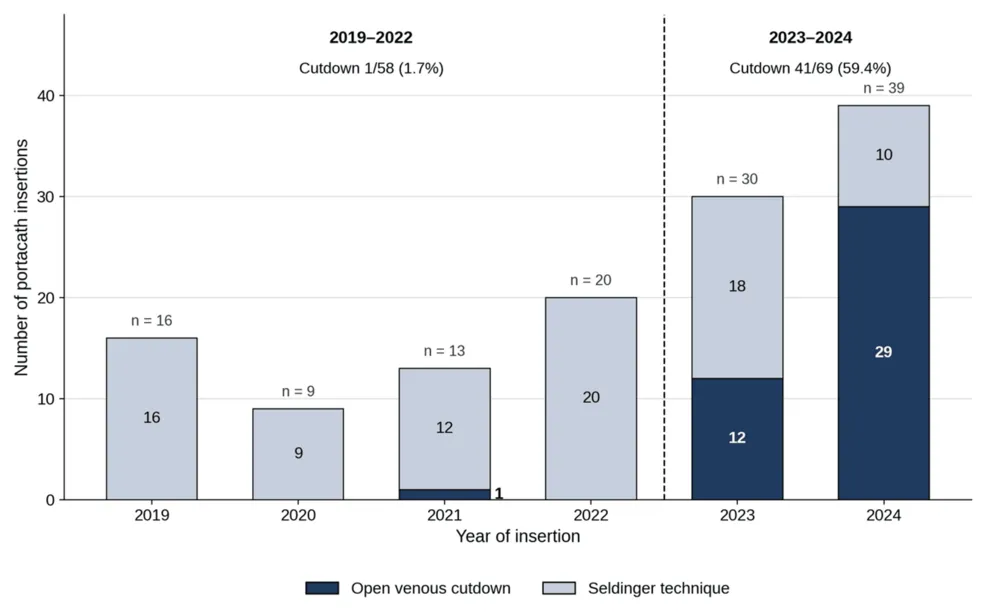
Totally Implantable Venous Access Port Insertion in a Regional Australian Centre: A Comparison of Open Venous Cutdown With the Seldinger Technique - Cureus
Background: Totally implantable venous access ports (TIVAPs) can be inserted via open venous cutdown or the Seldinger technique. Comparative evidence for safety and efficacy remains mixed, and Australian regional data are limited. Methods: A retrospective observational study of all adult patients undergoing TIVAP or port-a-cath insertion at Goulburn Valley Health, a regional Australian general surgery unit, between January 2019 and December 2024 was conducted. Procedural and postoperative outcomes were compared between open cutdown and Seldinger techniques using Fisher’s exact tests, with unadjusted odds ratios (ORs) and 95% confidence intervals (CIs). Because the use of open cutdown changed over time, sensitivity analyses adjusted for calendar year using Firth’s penalised logistic regression and were restricted to procedures performed during 2023-2024. Results: A total of 127 insertion episodes were included: 42 (33.1%) open cutdown and 85 (66.9%) Seldinger. Use of open cutdown increased over the study period, accounting for 59.4% of procedures during 2023-2024 compared with 1.7% during 2019-2022. First-attempt success (88.1% vs 82.4%; OR 1.58, 95% CI 0.50-6.00), technique convers
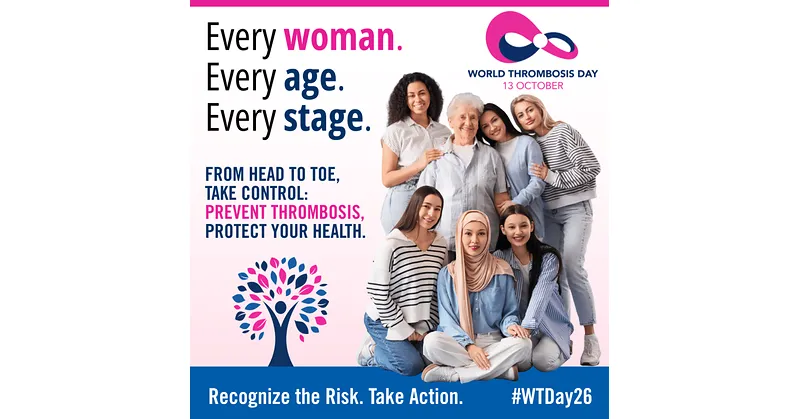
World Thrombosis Day campaign urges global action to protect women against blood clots - PR Newswire Canada
Global campaign brings together partners to raise awareness of women's unique blood clot risks, recognize warning signs and take action to prevent life-threatening events., /CNW/ -- One in four people worldwide die from conditions caused by thrombosis, yet blood clots remain among the most overlooked and misunderstood serious health threats. On World Thrombosis Day, October 13, thousands of partners around the world unite to raise awareness of the warning signs, risk factors and importance of timely care. This year, the global campaign puts women's health in focus, highlighting how blood clot risk can change throughout a woman's life, from reproductive health and pregnancy through the postpartum period, perimenopause, menopause and beyond. Learn more about World Thrombosis Day at www.worldthrombosisday.org.
0 comments
No comments yet. Be the first to share your thoughts!