Quantum Simulations Find Peak Superconductivity Isn't At Expected Point - Quantum Zeitgeist
This story deserves to be shared
Send it to someone who'd care, or post it on your networks.
This article is an excerpt. To read the full content, visit the original source. Quantum Zeitgeist
Related articles
Evidence for spin-fluctuation-mediated superconductivity in electron-doped cuprates - Nature
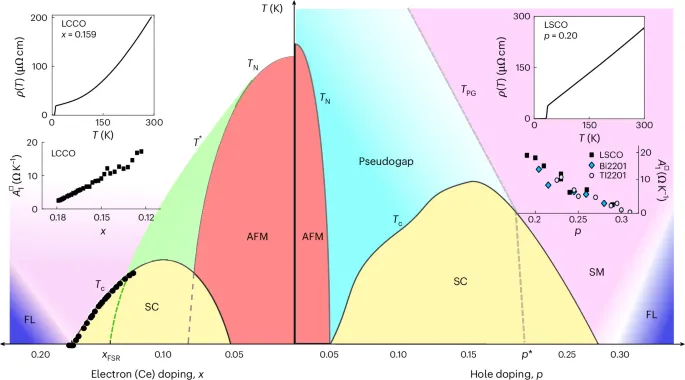
MainThe Bardeen–Cooper–Schrieffer theory of superconductivity, where the electron–phonon interaction binds two electrons into a Cooper pair, forms the basis of our present understanding of conventional superconductors. The critical temperature Tc is governed by an electron–phonon coupling constant λph through the McMillan formula1. The same interaction is also known to scatter electrons in the normal (resistive) state. At intermediate temperatures, where the resistivity ρ(T) is T linear, the associated scattering rate 1/τ = 2πλtrT. Here λtr is a measure of the electron–phonon coupling strength as manifested in charge transport. A near equivalence of λph and λtr has been demonstrated for a wide array of elements and alloys2 (Supplementary Fig. 2), affirming the correlation between the pairing strength and the strength of the relevant (transport) scattering process. Many superconductors of current interest, including heavy fermions, Fe-based superconductors, organic conductors, nickelates and cuprates, are believed to have a pairing mechanism that is non-phononic in origin.
0 comments
No comments yet. Be the first to share your thoughts!