Evidence for spin-fluctuation-mediated superconductivity in electron-doped cuprates - Nature
This story deserves to be shared
Send it to someone who'd care, or post it on your networks.
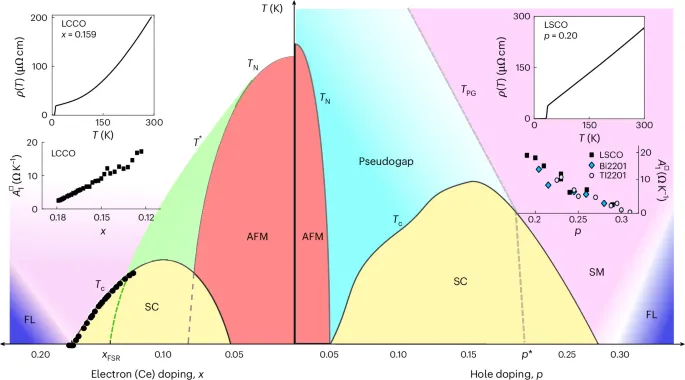
MainThe Bardeen–Cooper–Schrieffer theory of superconductivity, where the electron–phonon interaction binds two electrons into a Cooper pair, forms the basis of our present understanding of conventional superconductors. The critical temperature Tc is governed by an electron–phonon coupling constant λph through the McMillan formula1. The same interaction is also known to scatter electrons in the normal (resistive) state. At intermediate temperatures, where the resistivity ρ(T) is T linear, the associated scattering rate 1/τ = 2πλtrT. Here λtr is a measure of the electron–phonon coupling strength as manifested in charge transport. A near equivalence of λph and λtr has been demonstrated for a wide array of elements and alloys2 (Supplementary Fig. 2), affirming the correlation between the pairing strength and the strength of the relevant (transport) scattering process. Many superconductors of current interest, including heavy fermions, Fe-based superconductors, organic conductors, nickelates and cuprates, are believed to have a pairing mechanism that is non-phononic in origin.
This article is an excerpt. To read the full content, visit the original source. Nature
Related articles
IAEA Boosts Global Access to Electron Beam Technology - International Atomic Energy Agency
Pair-density waves found in uranium ditelluride beyond superconductivity — ScienceAlert - UA.NEWS
A research group led by scientists at the University of Illinois Urbana-Champaign has found compelling evidence of pair-density waves on the surface of uranium ditelluride. These structures persisted at temperatures higher than the superconducting transition temperature, ScienceAlert reports. The results were published in the journal PNAS. Electron pairs form patternsIn the superconducting state, electrons can form Cooper pairs and move through a material without electrical resistance or energy loss through heating. The existence of pair-density waves, or PDWs, was theoretically predicted as early as 2007. In this state, Cooper pairs form spatially repeating patterns resembling waves in sand. Uranium ditelluride enters a superconducting state at temperatures below approximately 2.1 kelvin, or about minus 271 degrees Celsius. The material also interests physicists as a possible rare spin-triplet superconductor: in such a system, paired electrons also have a small magnetic orientation. More current news is available on the UA. News Telegram channel Telegram. Observations of magnetic field and temperatureSigns of PDW had previously been recorded in uranium ditelluride.
ConnectWise suspends Cloud Backup service after supply chain attack - The Record from Recorded Future News

The housing gap between young people with and without wealthy parents has nearly doubled - Phys.org
Among 30-year-olds with parents in the wealthiest fifth of the population, nearly seven out of ten own their own home. Among those with parents in the least wealthy fifth, the figure is around four out of ten. And the difference has grown. "Financial support from parents is an important ticket into the housing market. And because housing is the most important route to wealth for most people, an early advantage in life can lead to large differences in wealth later on," says Ragnar Juelsrud.
0 comments
No comments yet. Be the first to share your thoughts!