Physical Capacity Decline Begins Decades Before Sarcopenia - EMJ
This story deserves to be shared
Send it to someone who'd care, or post it on your networks.

LONGITUDINAL data demonstrate that physical capacity decline begins before age 40, accelerating toward substantial sarcopenia risk. In a population-based cohort of 427 participants evaluated across nearly five decades from age 16 to 63, objective functional assessments revealed that physical performance follows a constitutive trajectory. Peak muscular endurance and aerobic capacity occurred between ages 26 and 36, whereas muscular power peaked as early as age 19 in women and age 27 in men. Following these peaks, functional capacity entered a progressive decline that initiated at modest rates of 0.3% to 0.6% annually before accelerating to over 2.0% per year by the seventh decade of life.
Cumulative functional loss reached 30% to 48% from peak performance to age 63 across upper-body muscular endurance, lower-limb power, and cardiorespiratory fitness. Relative rates of decline followed comparable curves in both sexes, indicating that physical capacity decline reflects an innate biological aging trajectory rather than sex-specific divergence.
This article is an excerpt. To read the full content, visit the original source. EMJ
Related articles

Biomarkers Related to Sarcopenia and Physiological Reserve in Total Joint Arthroplasty and Other Clinical Populations - Cureus
Sarcopenia is increasingly recognized as a multidimensional syndrome reflecting impaired physiological reserve rather than isolated skeletal muscle loss. Although numerous circulating biomarkers have been associated with sarcopenia and adverse orthopaedic outcomes, their biological significance varies according to the underlying clinical context. This narrative review integrates current evidence on circulating biomarkers of sarcopenia and physiological reserve across elective total hip and knee arthroplasty, fragility hip fracture, community-dwelling older adults, and medically complex populations. The available evidence demonstrates that sarcopenic phenotypes differ substantially between these populations, with predominantly disuse-related muscle deterioration in elective arthroplasty, frailty-associated sarcopenia after hip fracture, and metabolically driven muscle loss in chronic systemic diseases. Nutritional (albumin, geriatric nutritional risk index), inflammatory (C-reactive protein (CRP), neutrophil-to-lymphocyte ratio, CRP-to-albumin ratio), metabolic (aspartate aminotransferase-to-alanine aminotransferase ratio, glucose-to-albumin ratio), endocrine (vitamin D, insulin-lik
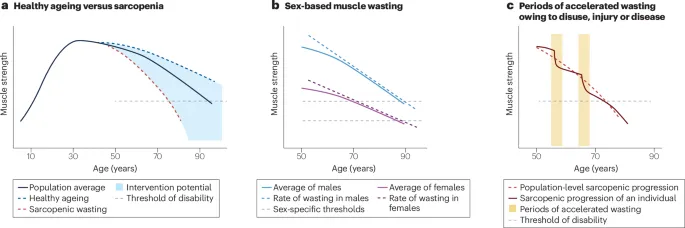
Strengthening muscle for healthy ageing: innovative treatments for sarcopenia - Nature
Plaza-Florido, A. et al. The long-lived immune system of centenarians. Nat. Rev. Immunol. https://doi.org/10.1038/s41577-026-01291-5 (2026). Article Bellantuono, I. Find drugs that delay many diseases of old age. Nature 554, 293–295 (2018). Article
Fentanyl in Italy and the European Opioid Market - Wired Gov
Italy’s low fentanyl death toll reflects Europe’s distinct opioid market history, not mafia restraint – but synthetic opioids such as nitazenes are a growing threat. Italy has recorded very few deaths involving fentanyl. A September 2026 article in The Economist invokes The Godfather films to suggest that ‘the country’s mafias seem to have collaborated to keep fentanyl out of their territory,’ protecting their established markets from a substance that kills customers and attracts police attention. Such a hypothesis had already been put forward by Roberto Saviano in La Repubblica. While it is an intriguing theory, there is no evidence for it. To understand the absence of an American-style fentanyl crisis in Italy as well as in other parts of Europe, we need to look at the history of opioid markets, rather than assume that godfathers hailing from unnamed ‘mafias’ are out there to protect their fellow countrypeople.
How You Use Weed Affects Sedation During Medical Procedures, Study Says - U.S. News & World Report

Just 3,000 steps a day may help slow Alzheimer's, scientists find - Science Daily
A new study suggests that even low levels of physical activity could protect the brain from Alzheimer’s disease – but not in the way scientists expected. The researchers tracked almost 300 older adults with early brain signs of Alzheimer’s for nine to 11 years using pedometers. They found that physical activity didn’t reduce the toxic amyloid plaques that most Alzheimer’s treatments now target.
0 comments
No comments yet. Be the first to share your thoughts!