Phospholipid remodeling of the cardiomyocyte membrane affects cardiac function - Nature
AcknowledgementsWe thank Yukiko Banzai, Yuko Ishiyama, Asami Ogawa, and Yingda Xiao of the University of Tokyo for their assistance with animal experiments and laboratory work. We are grateful to Yuriko Sakamaki of the Ochanomizu Research Facility, Institute of Science Tokyo, for her technical support with electron microscopy sample preparation and imaging. FundingThis work was supported by Grants-in-Aid for Scientific Research, Japan [grant Nos. 24K19023 to S. B. and 22K08174 to H. T.]; Sakakibara Heart Foundation Cardiovascular Research Program 2023 (to S. B.); Japan Foundation for Applied Enzymology (to S. B.). I. K. was supported by a Grant-in-Aid for Scientific Research (S) of the Japan Society for the Promotion of Science and by the Japan Agency for Medical Research, Development (JP20ek0210152, JP18gm6210010, JP20ek0210141, JP20ek0109440, JP20ek0109487, JP17gm0810013, JP18km0405209, JP21ek0109543, JP21ek0109569, JP21tm0724601, JP22ama121016, JP22ek0210172, JP22ek0210167, JP22bm1123011). Author informationAuthor notesThese authors contributed equally: Satoshi Bujo, Takayuki Fujiwara, Masayuki Kubota.
This article is an excerpt. To read the full content, visit the original source. Nature
Related articles

Pomegranate Compound Improves Heart Function Up to 80% in Mice With Heart Failure - ScienceAlert
Each time you eat a juicy pomegranate, your gut bacteria can produce a natural metabolite called urolithin A. This little-known compound is making a big splash. In recent years, scientists have paid close attention to urolithin A because it seems to have anti-inflammatory, antioxidant, anti-tumor, and anti-aging properties. Initial evidence in humans even suggests that urolithin A can help the body remove aged or damaged parts of our cells, thereby improving their overall health. Now, for the first time, researchers at King's College London (KCL) have found evidence that urolithin A can activate a protein that plays a key role in heart health. In mouse models with stiff and failing hearts, urolithin A improved measures of heart function by as much as 80 percent compared to untreated animals, according to a press release from KCL. The findings are published in Science Advances, with financial support from the British Heart Foundation. The results have scientists hopeful that urolithin A could be a previously unidentified treatment option for a common form of heart failure.
Experimental characterization and scaling of flexural rigidity in sewn multilayer structures - Nature
We’re sharing this article early to provide faster access to peer-reviewed, accepted research. It is citable and carries a permanent DOI. This version is subject to further edits and will be replaced automatically by the final Version of Record. All legal disclaimers apply. AbstractSewing is one of the established methods used to fabricate and assemble multilayer insulation (MLI) blankets for aerospace applications, yet the resulting effective flexural behavior remains insufficiently understood. This study investigates the room-temperature, quasi-static flexural behavior of MLI blankets composed of aluminized BoPET radiation shields and polyester net spacers across structural configurations of 2, 6, 12, and 24 layers. A full factorial design was employed to evaluate the influence of the number of layers, stitch density, needle thread tension, and needle foot force. Statistical analyses demonstrated that the number of layers is the dominant factor governing flexural response. Among the sewing parameters, needle thread tension was associated with modifications in bending length, while needle foot force primarily affected local compaction.
Targeted pathway mining reveals novel modified hexapeptides from the demiguisin family - Nature
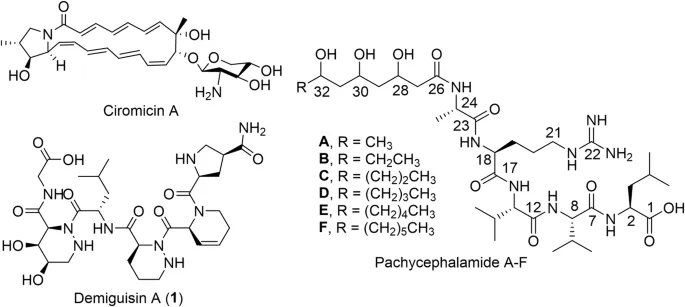
IntroductionBirds rely on a collection of behavioural, physiological, and chemical defences to mitigate the constant threat posed by pathogens and parasites in their environment1. Preen oil from the uropygial gland (UG) is a key component of avian integumentary immunity, supporting feather maintenance and waterproofing, while the UG is also known to harbour diverse microbes, including γ- and α-Pseudomonadota and Actinomycetota, that contribute to feather defense2,3. We recently exemplified a case of the bacterial isolate Amycolatopsis sp. PS_44_ISF1 derived from the UG of the toxic bird Pachycephala schlegelii that can directly contribute to the bird’s chemical defence system, by producing bioactive metabolites such as the antifungal macrolactam ciromicin A3,4, the co-secreted tensioactive lipopeptide family pachycephalamides, and a highly modified hexapeptide, named demiguisin A (1) (Fig. 1). The chemical structure of 1, caught our interest, as it contains non-proteinogenic piperazic acid (hexahydropyridazine-3-carboxylic acid, Piz) residues within the sequence Gly–β,γ-OH-Piz–Leu–Piz–DHPA–γ-c-Pro (Fig. 1)3,5.
0 comments
No comments yet. Be the first to share your thoughts!