Lupus Remission Linked to Better Pregnancy Outcomes - EMJ
This story deserves to be shared
Send it to someone who'd care, or post it on your networks.

WOMEN with systemic lupus erythematosus (SLE) who are not in remission may face an increased risk of adverse pregnancy outcomes, according to findings from a prospective cohort study examining pregnancy complications across different disease severity groups.
Researchers found that adverse pregnancy outcome rates varied substantially depending on patient characteristics and the definitions used to classify complications. The findings also highlighted the potential importance of achieving disease remission before pregnancy, particularly among women with additional clinical risk factors.
This article is an excerpt. To read the full content, visit the original source. EMJ
Related articles

Diet and exercise achieved diabetes remission in 27 of 50 participants — ScienceAlert - UA.NEWS
In Canada and the United Kingdom, combining a low-calorie diet with structured physical exercise made it possible to achieve type 2 diabetes remission in 27 of 50 participants in the intervention group over 24 weeks. In the control group, remission was recorded in two people, ScienceAlert reports. The study involved 96 peopleThe randomized study was conducted at three centers in Canada and the United Kingdom. It involved 96 people of diverse ethnic backgrounds with obesity and early-onset type 2 diabetes who were not receiving insulin therapy. The participants’ average age was 38. Early-onset type 2 diabetes is generally defined as a diagnosis made at or before the age of 45. This type of disease may progress more quickly than diabetes diagnosed at an older age, while patients face a higher risk of premature complications and death. More current news is available on the UA. News Telegram channel Telegram. Diet and exercise programParticipants in the intervention group consumed approximately 800–900 kilocalories per day during the first 12 weeks. Their program also included two supervised weekly sessions combining aerobic and strength exercises, as well as one independent workout.

This Diet And Exercise Combination Put Early-Onset Diabetes Into Remission in Half of Participants - ScienceAlert
Type 2 diabetes is not necessarily a lifelong diagnosis or a disease that gets progressively worse over time. Today, there is strong evidence to suggest that the risk of developing this metabolic disorder can be reduced by up to 58 percent in people who have prediabetes. Diet and exercise are a key part of that. Researchers in the United Kingdom (UK) and Canada have now identified a way to put more than 50 percent of patients with early onset type 2 diabetes into remission. It involves a low-calorie diet and a supervised exercise program. "Our remission rates are at the upper end of those previously reported in the literature for trials of similar duration," the authors write, led by Kaberi Dasgupta at McGill University in Canada. These findings, the team argues, reinforce the potential of lifestyle interventions to "support clinically meaningful remission". They also demonstrate "for the first time that such effects can be achieved in a multi-ethnic population with early onset type 2 diabetes through a combined low-energy diet and structured exercise intervention.

EASD: Combined Intervention in Early-Onset Type 2 Diabetes Tied to High Remission Rates - Gastroenterology Advisor
A combination of low-energy diet and structured supervised exercise induced early-onset type 2 diabetes remission in adults with obesity, yielding significantly higher remission rates compared with standard usual care. HealthDay News — A combined intervention of low-energy diet (LED) and structured supervised exercise can induce remission in early-onset type 2 diabetes (EOT2D), with higher remission rates than usual care alone, according to a study published online Oct. 1 in The Lancet Regional Health: Americas to coincide with the annual meeting of the European Association for the Study of Diabetes, held from Sept. 28 to Oct. 2 in Milan.
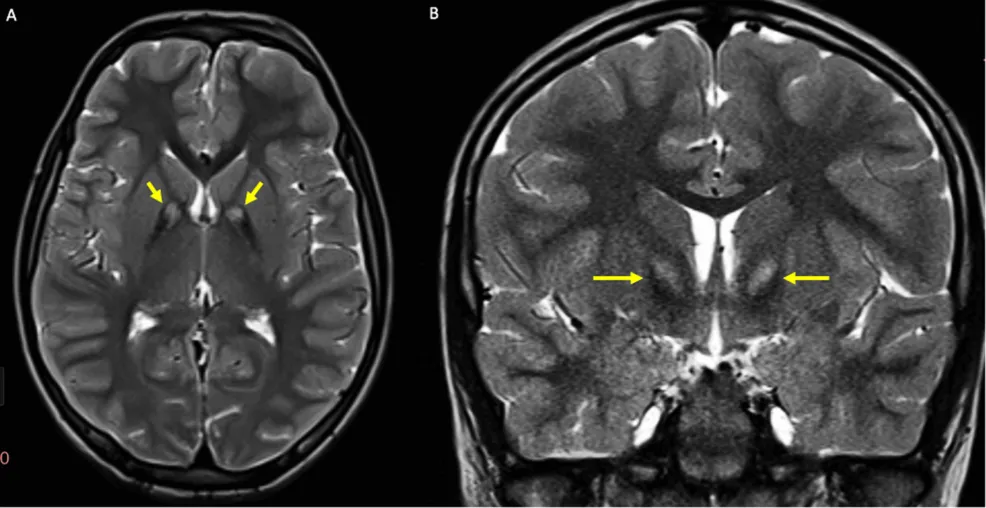
Eye-of-the-Tiger Sign: A Case Report of a Key MRI Clue to Pantothenate Kinase-Associated Neurodegeneration in an Eight-Year-Old Girl - Cureus
Pantothenate kinase-associated neurodegeneration (PKAN) is an autosomal recessive disorder and the most common form of neurodegeneration with brain iron accumulation (NBIA), whose imaging hallmark is the "eye-of-the-tiger" sign of the globus pallidus on brain MRI. We report the case of an eight-year-old girl, born to first-cousin parents, with a history of delayed walking and language acquisition, who presented with a four-month history of worsening gait instability and frequent falls. Neurological examination revealed dysarthria, lower-limb dystonia, postural tremor, brisk deep tendon reflexes, and bilateral extensor plantar responses. Brain MRI at 1.5 T showed bilateral, symmetric T2 hypointensity of the globus pallidus surrounding a central hyperintense focus, consistent with the eye-of-the-tiger sign, with marked pallidal signal loss on susceptibility-weighted imaging (SWI). The substantia nigra, dentate nuclei, cerebellum, and remaining brain parenchyma were normal, as were serum copper, ceruloplasmin, and lactate levels. This combination of a progressive extrapyramidal and pyramidal syndrome with the eye-of-the-tiger sign pointed to PKAN, pending genetic confirmation. This ca

Global Dementia Cases Set to More Than Double by 2050 - EMJ
GLOBAL dementia incidence is projected to more than double by 2050, reaching 24.7 million new cases annually, according to a meta-analysis of population-based studies. The researchers estimated 11.4 million new cases worldwide in 2023, highlighting differences by sex and country income level. The analysis included individual participant data from 38,418 people across 22 longitudinal cohorts spanning 18 countries or territories on six continents. The cohorts formed part of the Cohort Studies of Memory in an International Consortium (COSMIC), with baseline recruitment between 1990 and 2011 and follow-up data collected through 2021.

Second-ever case of rare fungus resistant to four antifungal drug classes detected in Kenya - Medical Xpress
Researchers recovered the pan-drug-resistant fungus from a 28-year-old woman with a hospital-acquired surgical wound infection in Nairobi. Credit: Pexels. While a mutant fungus in the real world might not be making humans violent and turning them against each other as in the fictional world of "The Last of Us," it is raising alarm bells for public health.
0 comments
No comments yet. Be the first to share your thoughts!