HER2-positive breast cancer: PET/CT technique shows promise for predicting treatment response - healthcare-in-europe.com
This story deserves to be shared
Send it to someone who'd care, or post it on your networks.
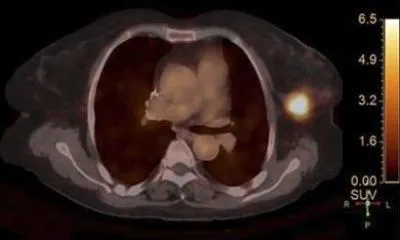
Findings may help identify patients who are less likely to respond to neoadjuvant therapy, potentially informing timely consideration of alternative treatment strategies or surgery
68Ga-HER2 PET/CT images before neoadjuvant therapy, at end of second cycle, and before surgery. (A) Baseline scan demonstrated soft-tissue lesion measuring approximately 2.3 × 2.2 cm in upper outer quadrant of left breast, with marked radiotracer uptake and SUVmax of 10.1. (B) At end of second cycle, imaging revealed residual lesion of approximately 2.2 × 1.0 cm in same region, without abnormal radiotracer accumulation. (C) Preoperative imaging demonstrated further reduction in lesion size to approximately 2.0 × 0.6 cm, with no abnormal tracer uptake detected. Image source: adapted from: Gao S, Zhang Z, Cheng C et al, Journal of Nuclear Medicine 2026 (CC BY 4.0)
This article is an excerpt. To read the full content, visit the original source. healthcare-in-europe.com
Related articles
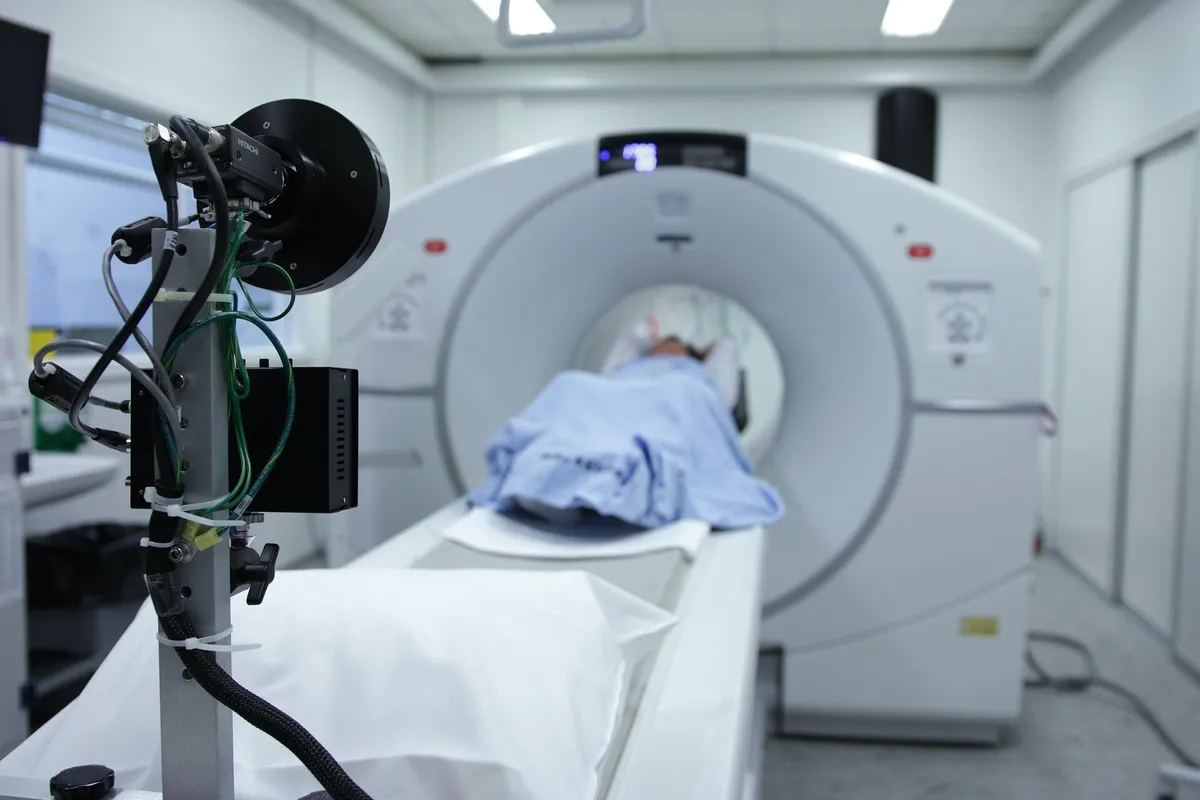
Next-generation total-body PET scanner can produce diagnostic-quality images in as little as 1 minute - Medical Xpress
A next-generation total-body PET/CT scanner can produce diagnostic-quality images in as little as 1 minute of scanning, according to research presented today at the 39th Annual Congress of the European Association of Nuclear Medicine (EANM'26). Even its fastest images were rated more highly on average than those from a standard PET/CT scanner. PET/CT is widely used to diagnose, stage and monitor cancer. Conventional PET/CT scanners have a short axial field of view, meaning they image the body section by section, typically requiring five to six 'bed positions' to cover the body from head to thigh. Long-axial field-of-view (LA-FOV) systems capture a much larger part of the body at once and detect more of the signal emitted by the radiotracer, raising the possibility of much shorter scans without sacrificing image quality.
What Is a PET Scan - Cleveland Clinic
Synergistic reductive decolorization of waterlogged archaeological wood via a thiourea dioxide–amine borane system - Nature
We’re sharing this article early to provide faster access to peer-reviewed, accepted research. It is citable and carries a permanent DOI. This version is subject to further edits and will be replaced automatically by the final Version of Record. All legal disclaimers apply. AbstractWaterlogged archeological wood (WAW) undergoes lignin oxidation in the presence of air, generating quinones and other conjugated chromophores that cause severe discoloration. As conventional reductants (e.g., Na2S2O4 and NaBH4) struggle to balance between decolorization performance and operational compatibility, a thiourea dioxide (TDO)–amine borane (AB) composite formulation was developed for WAW decolorization. A paper-based solid-phase model with a covalently linked o-quinone motif was constructed for quantitative evaluation. The performances of TDO, dimethylamine borane (DMAB), tert-butylamine borane (TBAB), and their combinations were evaluated on both model and WAW samples. The TDO–AB formulations outperformed single-component treatments in decolorization effect and rate.
IκB kinase epsilon deficiency attenuates osteoarthritis-associated pain and synovitis with limited cartilage protection in complementary mouse models - Nature
ORCID: orcid.org/0000-0002-3666-39521, Yuki Hyodo1, Ichiro Kurakazu1, Taisuke Uchida1, Ryota Hirose1, Masanari Kuwahara1, Takumi Kita1, Koki Kato1, Li Ziyang1, Gai Eto1 & … Yasuharu Nakashima1 We’re sharing this article early to provide faster access to peer-reviewed, accepted research. It is citable and carries a permanent DOI. This version is subject to further edits and will be replaced automatically by the final Version of Record. All legal disclaimers apply.
0 comments
No comments yet. Be the first to share your thoughts!