Forest complexity decoded: how ai and drone lasers read the canopy’s hidden language | Newswise - Newswise
This story deserves to be shared
Send it to someone who'd care, or post it on your networks.
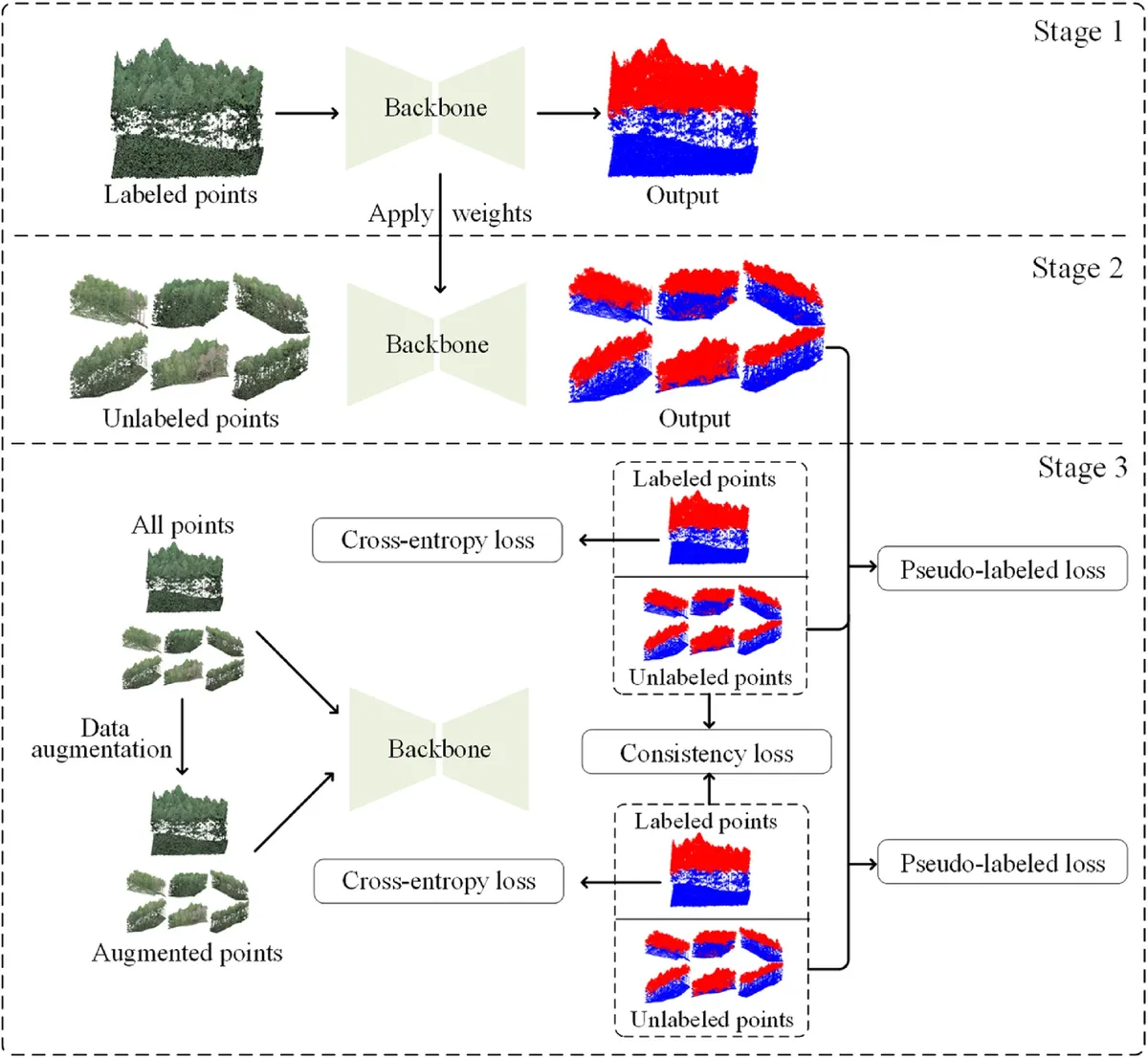
Newswise — Canopy structural complexity (CSC) describes how leaves, branches, and trunks are arranged in space—a property that influences everything from light penetration and microclimate to wildlife habitat and carbon cycling. Traditional field surveys rely on plot‑level metrics like tree height variation or canopy cover, but these two‑dimensional or discrete measures miss the true three‑dimensional internal arrangement of canopy elements. LiDAR has revolutionized forest monitoring by capturing millions of points that map canopy volume in 3D, yet extracting pure canopy from these dense point clouds remains a major obstacle. Most methods depend on fully labeled training data—point‑by‑point annotations that are prohibitively expensive and time‑consuming for large‑scale surveys across diverse terrain. Given these challenges, there is a pressing need to develop efficient and generalizable methods for canopy extraction and structural quantification from large‑scale, unlabeled forest point clouds.
This article is an excerpt. To read the full content, visit the original source. Newswise
Related articles
Argonne’s Aurora supercomputer powers two of the largest cosmological simulations to date | Newswise - Newswise
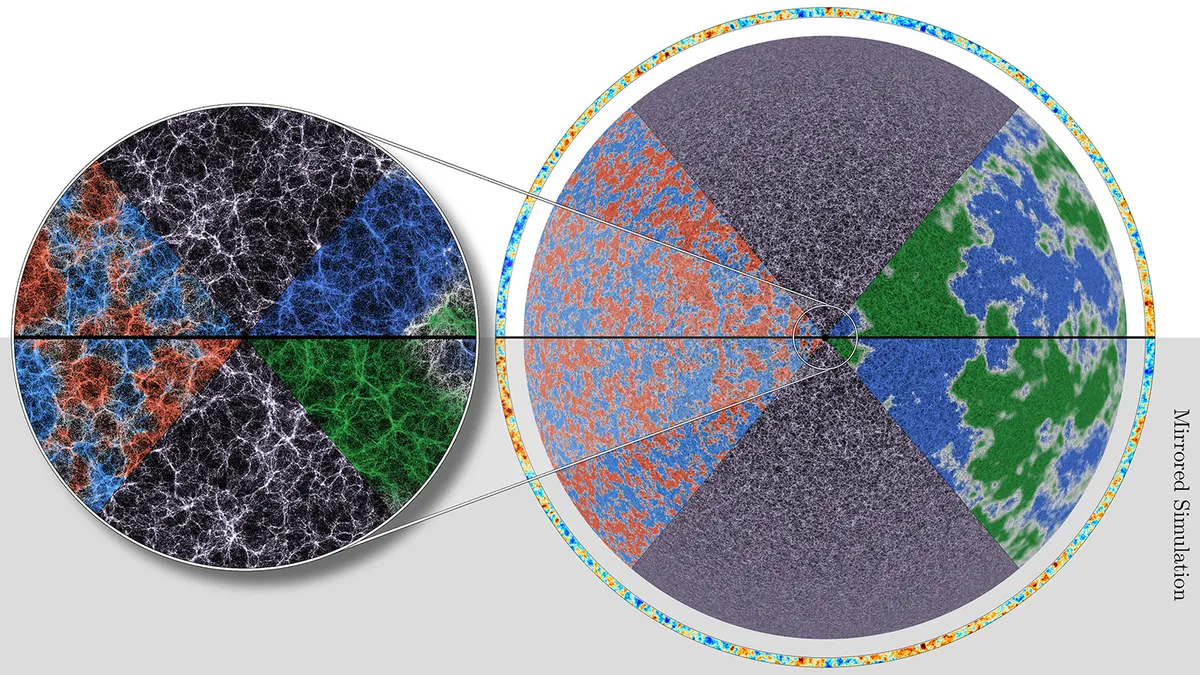
Researchers at the U. S. Department of Energy’s (DOE) Argonne National Laboratory have completed two of the largest cosmological simulations ever performed. Each simulation modeled the evolution of 13.4 trillion dark matter particles across a region 28.6 billion light-years wide. Dark matter is invisible to telescopes, but its gravitational effects drive galaxy formation and shape larger-scale structures in the universe. In the simulations, particles stand in as tracers of the dark matter density and velocity distributions. This allows researchers to trace how cosmic structure has evolved over billions of years. Simulations at this scale require enormous computing power. The team performed the calculations on Argonne’s Aurora exascale machine. One of the world’s largest supercomputers, the system has 10,624 nodes and 63,744 graphics processing units (GPUs). Aurora is housed at the Argonne Leadership Computing Facility (ALCF), a DOE Office of Science user facility. The team’s simulations used a significant portion of the system. Each run drew on 8,100 nodes and roughly 50,000 GPUs. The simulations and much of the data analysis were completed in about four days.
Apple’s HomePod Could Change How Listeners Discover Radio And Podcasts. - Insideradio.com
Apple is giving its smart speaker an artificial intelligence upgrade, a move that could eventually change how consumers discover and listen to music, radio and podcasts at home. The new HomePod mini 2 introduces a more conversational version of Siri that can draw on personal information, answer complex questions and make audio recommendations, potentially giving voice assistants a bigger role in deciding what people hear. The $149 speaker arrives in stores Oct. 30, although its biggest new feature, Siri AI, will come later through a free software update. It will initially support English in eight countries, including the U. S. The company has not specified when the update will be released. For the audio industry, the development promises to make voice-controlled listening more conversational and personalized. Rather than relying entirely on specific commands or knowing what to request, consumers could increasingly use AI assistants to help them find entertainment.

Sony updates the Walkman as a $5,900 gold-plated MP3 player - The Register
That price buys you an Android 16 device which can display an animated cassette Sony last week revived its famed Walkman brand of portable music players, with a trio of updated products that feature Android 16, touch screens, eye-popping prices, and dubious assertions of audiophile appeal. The Japanese giant named the new models the NW-WM1ZM3, NW-WM1AM3 and NW-ZX900. All can store and play many codecs, including MP3s, WMA, and FLAC files, plus others like Direct Stream Digital (DSD) and Apple Lossless, which use various tricks to avoid nasty artefacts accruing during the digitization process. Sony also says it has used “key components made from oxygen-free copper” because that apparently delivers “uncompromising sound quality.”

The Unlikely Longevity of Longchamp - Vogue
Across US college campuses, undergraduates are carrying Longchamp’s Le Pliage bag — the trusty, foldable tote that has had teenagers and 20-somethings in a chokehold since its launch in 1993. In Paris, schoolgirls are seen wielding the bag from as young as 13, while in the UK, it’s an undying staple of accessible luxury, associated with royals and it-girls including Lila Moss and Alexa Chung. And in Aaron Sorkin’s new film The Social Reckoning, Mikey Madison’s whistle-blowing protagonist carries the bag as part of her San Francisco tech employee uniform. On TikTok, creators crow about Le Pliage’s visually and physically satisfying design, produced in workshops across Western France. For many, it’s the perfect first “big girl” bag, priced accessibly at $165 for the classic large canvas iteration — and available in sizes ranging from extra-extra small through XL. “We’ve always had the image of being excellent value,” says CEO Jean Cassegrain. “It’s the history of our brand to always be contemporary, in sync with the times, and to adjust to new customer needs.”Cassegrain is the third generation in the Longchamp family.
0 comments
No comments yet. Be the first to share your thoughts!