Dynamic Coupling Analysis of New-Type Urbanization and Water Resources Security: A System Dynamics-Based Empirical Study From China - Wiley Online Library
This story deserves to be shared
Send it to someone who'd care, or post it on your networks.
This article is an excerpt. To read the full content, visit the original source. Wiley Online Library
Related articles
Local-tele coupling coordination of land use pressure and urbanization based on multi-source remote sensing data - Nature
We’re sharing this article early to provide faster access to peer-reviewed, accepted research. It is citable and carries a permanent DOI. This version is subject to further edits and will be replaced automatically by the final Version of Record. All legal disclaimers apply. AbstractAssessing land use pressure is fundamental to understanding regional sustainability. This study constructs a comprehensive Land Use Pressure Index (L) using remote sensing and socio-economic data from 2000 to 2019 across three dimensions—carbon effects, ecological risks, and landscape stability—with weights objectively determined by the entropy weight method. An Urbanization Composite Index (U) is also developed across demographic, economic, spatial, and social dimensions. We further introduce a local-tele coupling coordination framework incorporating an Inverse Distance Weighting (IDW) spatial weight matrix to capture inter-city spillover effects, extending traditional coupling analysis to include both local and tele-coupling interactions.
Orbital coupling effect enables low-chloride concentration electrolyte for four-electron redox in aqueous zinc | |iodine batteries - Nature
We’re sharing this article early to provide faster access to peer-reviewed, accepted research. It is citable and carries a permanent DOI. This version is subject to further edits and will be replaced automatically by the final Version of Record. All legal disclaimers apply. AbstractThe I-/I0/I+ redox chemistry is hindered by the inherent instability of the electrophilic I+, which undergoes hydrolysis in aqueous media or is rapidly consumed by comproportionation with triiodide ions. Here, we design a copper single-atom embedded nitrogen-doped carbon host that synergistically combines d-p orbital hybridization and local low-concentration chloride ions to stabilize the I+. The atomic Cu-Nx sites interact moderately with iodine species through Cu d- and I p-orbital hybridization, which enhances iodine species adsorption, accelerates redox kinetics, and increases the hydrolysis energy barrier of I+. Simultaneously, the Cu-Nx sites promote a localized I-Cl microenvironment through electrostatic interaction, enabling efficient I0/I+ conversion even in a low-concentration Cl- ion electrolyte.
Science Talk: A Perspective on Urbanization and Climate Change - UNU | United Nations University
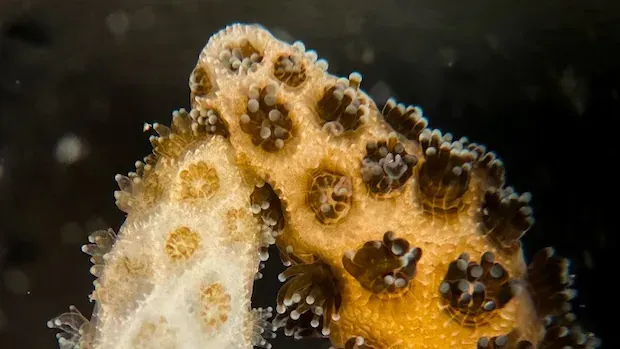
Scientists put a dying coral next to a healthy one — and watched it heal before their eyes - CBC
As It HappensScientists at Stanford University in California stumbled on a promising discovery when two coral fragments in the lab — one bleached and one healthy — tipped over in a tank and touched.'This could open a door to possible reef restoration,' says Stanford researcherSheena Goodyear · CBC News · Posted: Oct 23, 2026 1:37 PM EDT | Last Updated: 28 minutes agoListen to this articleEstimated 5 minutesThe audio version of this article is generated by AI-based technology. Mispronunciations can occur. We are working with our partners to continually review and improve the results. Scientists at Stanford University in California found that when a bleached coral fragment makes contact with a healthy one, the dying fragment can make a full recovery. (Danny Collins)The best medicine for a dying coral may be the power of touch. Scientists at Stanford University in California stumbled on a promising discovery when two coral fragments in the lab — one bleached and one healthy — tipped over in a tank and touched.
0 comments
No comments yet. Be the first to share your thoughts!