Delta Hospital’s Endoscopy Program Getting a New Home - Fraser Health
This story deserves to be shared
Send it to someone who'd care, or post it on your networks.
This article is an excerpt. To read the full content, visit the original source. Fraser Health
Related articles
Cannabis smokers may need more anesthesia during upper endoscopy - News-Medical
Patients who smoke or vape cannabis may need more anesthesia during an upper endoscopy than those who use edibles or do not use cannabis, according to a new study presented at the ANESTHESIOLOGY® 2026 annual meeting. The study suggests "not all cannabis is equal" when it comes to sedation during procedures, and that the route of cannabis use may matter for anesthetic planning.
Upper endoscopy patients who inhale cannabis may need more anesthesia than edible users - Medical Xpress
Patients who smoke or vape cannabis may need more anesthesia during an upper endoscopy than those who use edibles or do not use cannabis, according to a new study presented at the Anesthesiology 2026 annual meeting.
Real-world results confirm benefit of antigen therapy for prostate cancer - Medical Xpress
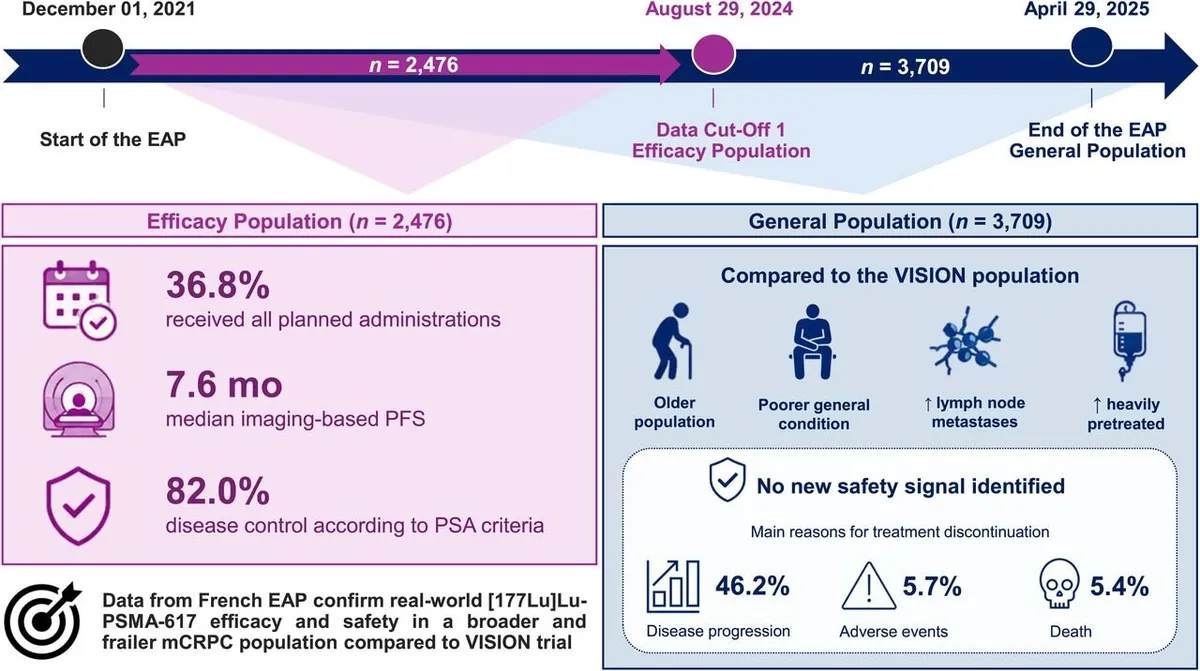
Overview of real-world treatment patterns and clinical outcomes with [¹⁷⁷Lu]Lu-PSMA-617 in patients with metastatic castration-resistant prostate cancer treated within the French Early-Access Program. The figure summarizes patient population, treatment exposure, efficacy outcomes and safety findings from routine clinical practice. Credit: KPL, Paris. Prostate-specific membrane antigen (PSMA)-targeted radiopharmaceutical therapy is safe and effective for patients with metastatic castration-resistant prostate cancer (mCRPC) in routine clinical practice, consistent with outcomes from the VISION trial. An analysis of outcomes from a French early-access program, the largest real-world cohort of patients studied to date, confirms the benefit-risk profile of the therapy, while also shedding light on patient selection and use trends. This research was published in The Journal of Nuclear Medicine.

KLK2-comPAS trial explores dual T-cell engagement in mCRPC - Urology Times
Kim Chi, MD, FRCPC, discusses the rationale and design of the phase 3 KLK2-comPAS trial evaluating pasritamig alone and in combination with JNJ-9401 in patients with mCRPC. In this video, Kim Chi, MD, FRCP, discusses the rationale and design of the phase 3 KLK2-comPAS trial (NCT07164443) evaluating pasritamig, alone and in combination with JNJ-9401, in patients with metastatic castration-resistant prostate cancer (mCRPC) who have exhausted available life-prolonging treatment options. The design of the study was presented at the 2026 European Society for Medical Oncology Annual Congress in Madrid, Spain as a trials in progress poster. Chi is a medical oncologist at BC Cancer in Vancouver, Canada, and a professor of medicine at the University of British Columbia. According to Chi, the KLK2-comPAS trial builds on the potential of kallikrein-related peptidase 2 (KLK2) as a therapeutic target because of its expression in normal and malignant prostate tissue. Pasritamig is a bispecific antibody that engages CD3 on T cells and KLK2 on prostate cancer cells to stimulate a targeted immune response.
Quebec’s 811 health line faces longer waits ahead of flu season - CityNews Montreal
Informations complètes et à jour, compilées par Google Actualités à partir de sources d'actualité du monde entier

Forget ‘ferritin face’ — experts explain the truth about iron deficiency - CP24
More people are low in iron than in any other micronutrient, according to the American Society of Hematology. But many live with fatigue, weakness, brain fog and other symptoms for months or years before a deficiency is caught. Nearly one-third of adults in the United States may be iron deficient, according to a 2024 study. And routine screening among children and pregnant women — who are at high risk — may miss more than 70 per cent of cases. Researchers estimate approximately 10.5 per cent of Canadians are iron deficient. Read more here. Some people online are self-diagnosing, citing dark under-eye circles and pale skin as evidence that they are low in iron. Social media influencers call the look “ferritin face,” named after a protein that stores the element in the body. Iron deficiency is common, prevalent and underrecognized, said Dr. Ariela Marshall, associate professor of medicine at the University of Minnesota. New diagnostic recommendations, which ASH released in September, aim to ensure more patients secure early treatment.
0 comments
No comments yet. Be the first to share your thoughts!