Celebrating math with the next generation - Toronto Metropolitan University (TMU)
This story deserves to be shared
Send it to someone who'd care, or post it on your networks.
This article is an excerpt. To read the full content, visit the original source. Toronto Metropolitan University (TMU)
Related articles
Glowing plants reveal immune responses around infection sites via two colors - Phys.org
Researchers at the MRC Laboratory of Medical Sciences (LMS) have developed a new way to make glowing biological reporters more accurate, allowing scientists to track gene activity in living plants over days, weeks and potentially even months and years. The approach could help researchers study how plants respond to disease, pests and environmental stress, while opening the door to similar applications in animal and human disease models.

The latest in space science: We look back at the Big Bang - NPR
The latest in space science: We look back at the Big Bang In this edition of Spacing Out, the team from Short Wave shares the latest developments in space science, including the theory on why the universe is made of matter In this edition of Spacing Out, the team from Short Wave discusses the latest space science news
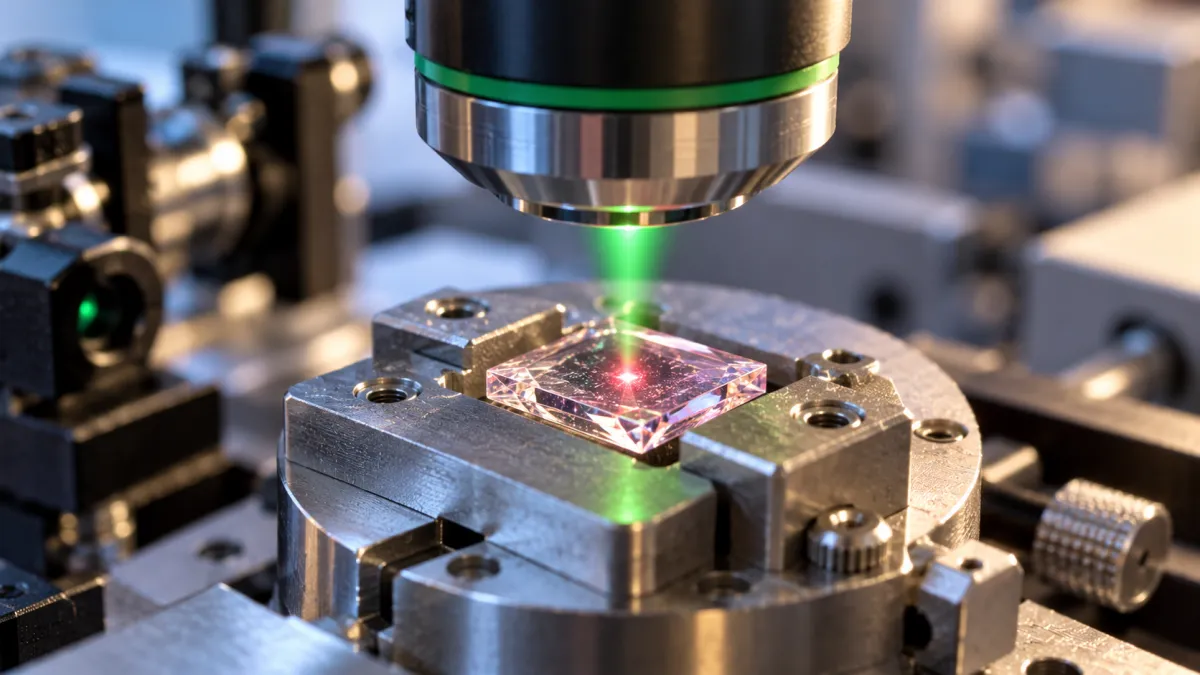
Scientists can now predict qubit behavior faster and more accurately - The Brighter Side of News
A molecular modeling approach identifies boron- and oxygen-containing diamond defects as promising candidates for quantum technologies. The calculations focus on small atomic clusters while retaining the surrounding crystal’s influence, making sophisticated quantum chemistry more manageable. The predictions help screen candidates, but practical qubit performance still requires tests of coherence, stability and other properties. Tiny imperfections in diamond could offer new ways to store and read quantum information. The challenge is deciding which defects deserve the time and expense of experimental testing. A computational study now brings tools from molecular chemistry to that search, identifying promising boron- and oxygen-containing candidates. John Mark P. Martirez, a staff research scientist at the U. S. Department of Energy’s Princeton Plasma Physics Laboratory, reports the work in ACS Central Science. His approach concentrates demanding calculations on a small group of atoms surrounding a defect. Crucially, the model still accounts for the influence of the diamond crystal beyond that group.

The Largest Canyon in the Solar System is Still Tectonically Active - Universe Today
For many decades, scientists assumed that Mars was geologically inactive. While its surface is covered in features that attest to its volcanic past, all evidence seemed to indicate that Mars was geologically dead. This is consistent with the fact that Mars' crust has no tectonic plates and instead consists of a single plate, making it a "Stagnant Lid" planet. However, with the arrival of NASA's InSight (Interior Exploration using Seismic Investigations, Geodesy and Heat Transport) lander, indications that the planet was still "alive" began to accumulate. Beyond "marsquakes" caused by impactors, InSight detected evidence of tectonic activity from within. In a recent study, scientists at Imperial College London and Columbia University presented seismic evidence that a marsquake originated beneath Valles Marineris. According to InSight's data, the event (S0976a) was caused by rocks slipping along fault lines deep within the crust. These findings suggest that faults formed billions of years ago, when Mars was much more active, are unstable enough to rupture under stress.
0 comments
No comments yet. Be the first to share your thoughts!