Associations between routine systemic biochemical indices and semen quality: a cross-sectional study in men undergoing health examination - Nature
This story deserves to be shared
Send it to someone who'd care, or post it on your networks.
We’re sharing this article early to provide faster access to peer-reviewed, accepted research. It is citable and carries a permanent DOI. This version is subject to further edits and will be replaced automatically by the final Version of Record. All legal disclaimers apply.
AbstractTo evaluate associations between routinely measured systemic biochemical indices and semen quality parameters in a real-world health-check population. In this retrospective cross-sectional analysis of routinely collected data, 264 men aged 21–60 years who underwent health examination between January 2023 and December 2024 were included. Nine continuous semen outcomes were correlated with 42 clinical and biochemical indices using Spearman rank correlation (378 tests). Benjamini–Hochberg false discovery rate (FDR) correction was applied within each outcome (primary analysis) and across all 378 tests (sensitivity analysis). The association between calculated serum osmolality and normal morphology was further examined in a post hoc supportive multivariable model.
This article is an excerpt. To read the full content, visit the original source. Nature
Related articles
Use of microstream capnography in sedation practices for pediatric patients undergoing magnetic resonance imaging - Nature
We’re sharing this article early to provide faster access to peer-reviewed, accepted research. It is citable and carries a permanent DOI. This version is subject to further edits and will be replaced automatically by the final Version of Record. All legal disclaimers apply. AbstractIn pediatric magnetic resonance imaging (MRI), there is a need for more advanced monitoring methods in addition to routine pulse oximetry to ensure safer nonoperating room anesthesia (NORA). The integrated pulmonary index (IPI) available in the Microstream capnography device provides an early indicator of a patient’s respiratory functions. In this study, we aimed to investigate the feasibility of using the IPI as an early indicator for detecting cardiorespiratory events. A prospective, observational study was conducted on pediatric patients aged 1 month to 18 years who were to undergo sedation for magnetic resonance imaging (MRI). The respiratory rate (RR), end tidal carbon dioxide (EtCO2), oxygen saturation (SpO2), heart rate (HR), complications, and EtCO2 changes (∆EtCO2) were recorded. IPI values at induction and at the end of the scan were evaluated.
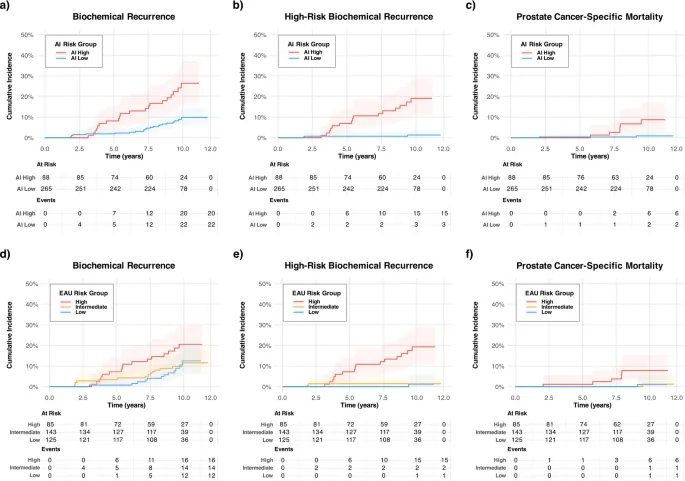
Multimodal AI refines EAU risk stratification in patients undergoing radiotherapy for prostate cancer - Nature
IntroductionRisk stratification before definitive treatment is fundamental to prostate cancer management, guiding treatment intensity and patient counseling. The European Association of Urology (EAU) risk classification system, based on prostate-specific antigen (PSA), International Society of Urological Pathology (ISUP) grade group, and clinical stage, remains the cornerstone for treatment decision-making in patients undergoing radiotherapy (RT)1. Despite their clinical utility, outcome heterogeneity remains substantial. In a Swedish population-based cohort of patients treated with RT, the 15-year cumulative incidence of biochemical recurrence (BCR) ranged from 18% in EAU low-risk disease to 36% in EAU high-risk disease, indicating that currently used categories do not fully capture individual prognosis2. Improving pre-treatment prognostic stratification may therefore help identify clinically distinct subgroups within established categories.

Perioperative Blood Management Strategies in Anemic Patients Undergoing Surgery: A Narrative Review - Cureus
Perioperative anemia is a common occurrence in patients undergoing surgery. The severity and cause of anemia can vary in different clinical settings. Anemia can complicate surgical patients and adversely affect the recovery of these individuals after surgery. Some of the causes of perioperative anemia include microcytic anemia and acute blood loss due to gastrointestinal bleeding or trauma. Other causes include hemodilution after fluid resuscitation and physiological changes in pregnancy. Managing anemia in surgical patients is an important aspect of perioperative care. In this narrative review, the causes of perioperative anemia, its consequences, and the effects of anemia on postoperative care were examined. Two independent reviewers conducted a literature search for studies related to perioperative anemia. The studies reviewed were published between March 27th, 1997, and April 14th, 2026. The literature search included the terms "perioperative anemia," "preoperative anemia," "postoperative anemia causes," and "anemia in elective surgeries." Perioperative anemia is a problem in both elective and emergency surgeries. It may remain a problem for patients during the postoperative pe

Maternal Vaccine Receipt, Intentions, and Refusal Among Pregnant Women Attending Antenatal Care in Panama City: A Cross-Sectional Study - Cureus
Background/objectives Maternal vaccination surveys often combine willingness and receipt, potentially obscuring differences between these measures. We quantified self-reported vaccine receipt, intention without receipt, complete reported receipt, and refusal in an urban Panamanian convenience sample and examined their relationship with vaccination recommendation. Methods We analyzed an anonymous cross-sectional survey completed from March 26 to July 25, 2026, by 204 pregnant women aged 18 years or older recruited in health-related settings in Panama City. Self-reported receipt meant reporting at least one maternal vaccine during the current pregnancy. Intention without receipt meant planning at least one vaccine without reporting receipt of any specific vaccine. Complete reported receipt was the independent response "already received all," rather than verified completion of a vaccination schedule. Modified Poisson regression with robust variance estimated prevalence ratios (PRs). A secondary, post hoc evaluation examined six rating items without claiming formal questionnaire validation. Results The number of women who chose self-reported receipt was 128/204 (62.7%; exact 95% confid

Maternal Vaccine Receipt, Intentions, and Refusal Among Pregnant Women Attending Antenatal Care in Panama City: A Cross-Sectional Study - Cureus
Background/objectives Maternal vaccination surveys often combine willingness and receipt, potentially obscuring differences between these measures. We quantified self-reported vaccine receipt, intention without receipt, complete reported receipt, and refusal in an urban Panamanian convenience sample and examined their relationship with vaccination recommendation. Methods We analyzed an anonymous cross-sectional survey completed from March 26 to July 25, 2026, by 204 pregnant women aged 18 years or older recruited in health-related settings in Panama City. Self-reported receipt meant reporting at least one maternal vaccine during the current pregnancy. Intention without receipt meant planning at least one vaccine without reporting receipt of any specific vaccine. Complete reported receipt was the independent response "already received all," rather than verified completion of a vaccination schedule. Modified Poisson regression with robust variance estimated prevalence ratios (PRs). A secondary, post hoc evaluation examined six rating items without claiming formal questionnaire validation. Results The number of women who chose self-reported receipt was 128/204 (62.7%; exact 95% confid
Detection of Helicobacter pylori in dental plaque among children with gastrointestinal disorders in a hospital-based cross-sectional study - Nature
We’re sharing this article early to provide faster access to peer-reviewed, accepted research. It is citable and carries a permanent DOI. This version is subject to further edits and will be replaced automatically by the final Version of Record. All legal disclaimers apply. AbstractHelicobacter pylori is responsible for gastritis and peptic ulcers, as well as gastric cancer. This bacterium can also be isolated from dental plaque, suggesting that the oral cavity may serve as a reservoir, contributing to reinfection after systemic antibiotic therapy. The present study was conducted to determine the presence of H. pylori and associated virulence genes in dental plaque from children with gastrointestinal disorders using PCR, and to investigate the relationship between the infection and dental caries experience (DMFT/dmft), tooth-brushing frequency, and dental visit frequency. In this cross-sectional study, 100 children with gastrointestinal disorders who were referred to Mofid Children’s Hospital in Tehran between 21 March 2023 and 19 March 2024 were included.
0 comments
No comments yet. Be the first to share your thoughts!